







Hydraulic Scissor Lift Platform
Products Description
A hydraulic scissor lift platform is a mechanical device used to lift people, goods, or equipment vertically using a scissor-like mechanism powered by hydraulic cylinders. These lifts are widely used in industries such as warehousing, construction, manufacturing, and automotive repair due to their stability, reliability, and ability to handle heavy loads.
Key Components:
Scissor Mechanism – Interlinked, folding supports that extend or retract to raise or lower the platform.
Hydraulic Cylinder – Provides the lifting force by pumping hydraulic fluid under pressure.
Platform (Deck) – The working surface where workers, tools, or materials are placed.
Base Frame – The sturdy foundation that supports the entire structure.
Power Unit (Pump & Motor) – Drives the hydraulic system to lift the platform.
Control System – Includes buttons or levers for operation (manual, electric, or pneumatic).
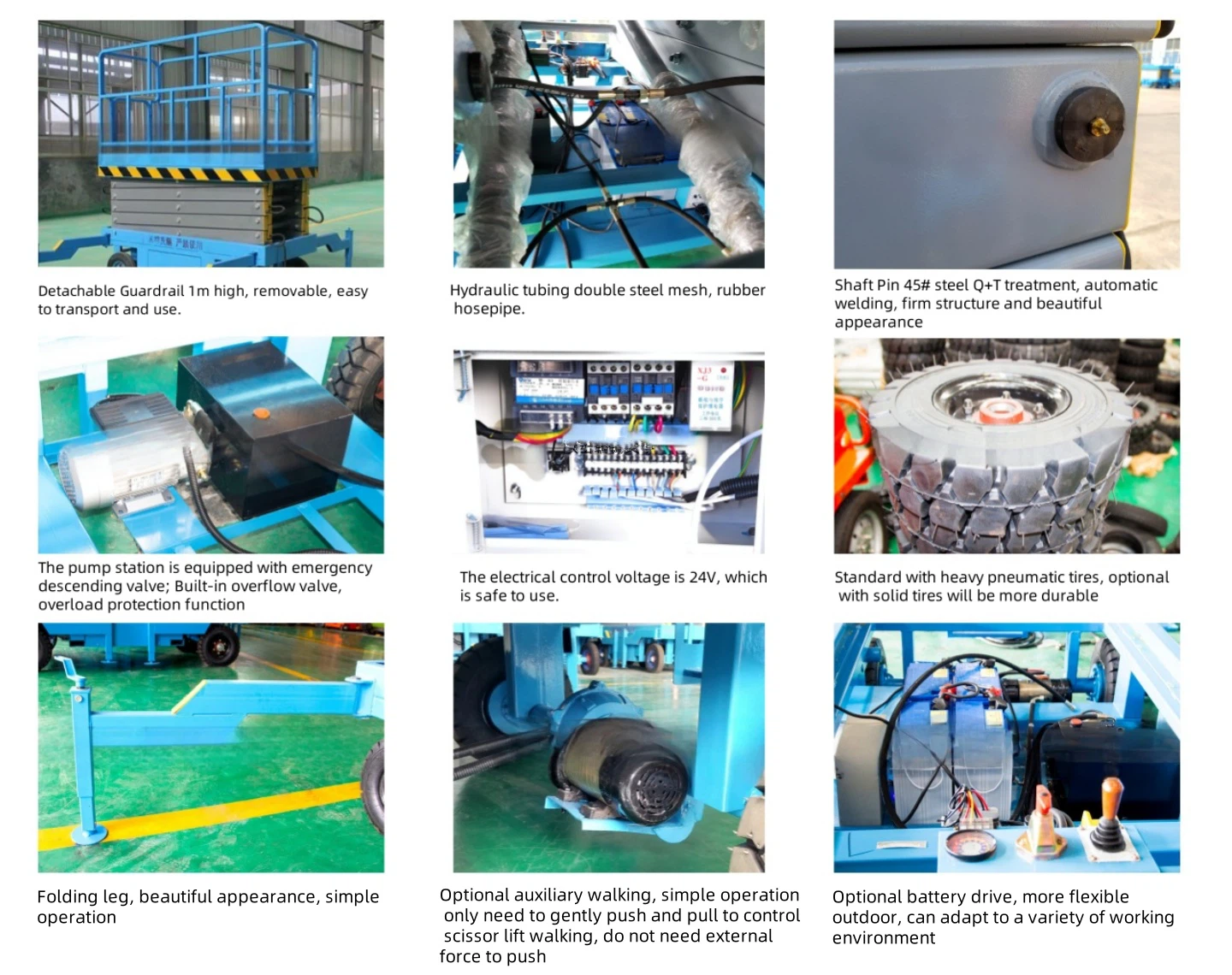
Safety Features – Emergency stop, overload protection, guardrails, and manual lowering valves.
Products Types
Types of Hydraulic Scissor Lifts:
Stationary Scissor Lifts – Fixed in one location, commonly used in warehouses.
Mobile Scissor Lifts – Equipped with wheels or casters for easy movement.
Rough Terrain Scissor Lifts – Designed for outdoor use with rugged tires and higher stability.
Low-Profile Scissor Lifts – Compact design for tight spaces with minimal ground clearance.
Key Components
Key Components of a Hydraulic Scissor Lift Platform:
Scissor Arms (Legs) – The crisscrossing metal supports that extend and retract to raise or lower the platform.
Hydraulic Cylinder – Provides the lifting force by pumping hydraulic fluid under pressure.
Platform (Deck) – The working surface where operators or materials are placed.
Base Frame – The foundation that supports the entire structure.
Hydraulic Pump & Power Unit – Generates hydraulic pressure to operate the cylinder.
Control Panel – Includes buttons or levers to operate the lift (up/down functions).
Safety Rails & Gates – Prevent falls when the platform is elevated.
Wheels or Casters (if mobile) – Allow for easy movement (in mobile scissor lifts).
Limit Switches & Emergency Stop – Prevent over-extension and allow for emergency shutdown.
Outriggers (if applicable) – Provide stability on rough or uneven surfaces.
key features
A hydraulic scissor lift platform is a versatile lifting device commonly used in industrial, construction, and warehouse settings. Here are its key features:
1. Hydraulic Power System
Uses hydraulic cylinders to provide smooth, stable lifting.
Ensures reliable operation with minimal maintenance.
2. Scissor Mechanism Design
Features a crisscross (X-shaped) linkage that extends vertically.
Provides a compact base when lowered and stable elevation when extended.
3. High Load Capacity
Can handle heavy loads, typically ranging from 500 kg to 10,000+ kg, depending on the model.
4. Adjustable Height
Lifting height varies from a few feet to over 20 feet (manual or powered models available).
Some models offer dual-stage or multi-stage extension for greater reach.
5. Stable & Secure Platform
Large work platform with anti-slip surfaces for safety.
Equipped with guardrails, safety locks, and overload protection.
6. Mobility Options
Stationary (fixed) models – Permanently installed.
Mobile models – Equipped with wheels (manual or self-propelled).
Rough-terrain models – For outdoor use with rugged tires.
7. Power Options
Electric Hydraulic – Quiet, eco-friendly, ideal for indoor use.
Diesel/Petrol Hydraulic – More powerful, suitable for outdoor/construction sites.
Manual Hydraulic (Pump-operated) – Cost-effective, no power needed.
8. Safety Features
Emergency stop button.
Tilt alarms for uneven surfaces.
Manual descent valve in case of power failure.
9. Applications
Warehouses (loading/unloading).
Construction sites.
Manufacturing & assembly lines.
Vehicle maintenance & repair.
Event staging & decoration.
10. Durability & Maintenance
Built with high-strength steel for long-term use.
Requires periodic hydraulic fluid checks and lubrication.
Application
Hydraulic scissor lift platforms are widely used across various industries due to their stability, reliability, and ability to provide vertical lifting with a large load-bearing capacity. Here are some key applications:
1. Warehousing & Logistics
Loading/Unloading Goods – Moving pallets, goods, and materials between trucks and warehouses.
Order Picking – Assisting workers in accessing high shelves safely.
Stock Management – Facilitating inventory checks in high-level storage racks.
2. Manufacturing & Industrial Facilities
Assembly Lines – Lifting workers and equipment to different heights for assembly tasks.
Maintenance Work – Providing access to machinery, conveyors, or overhead systems.
Material Handling – Transporting heavy components in factories.
3. Construction & Building Maintenance
Installation Work – Supporting workers in installing HVAC systems, electrical wiring, or ceilings.
Facade Cleaning & Repairs – Used as a safer alternative to ladders for exterior maintenance.
Site Logistics – Moving tools and materials to elevated work areas.
4. Retail & Supermarkets
Stocking Shelves – Helping staff reach high storage areas safely.
Display Setup – Assisting in arranging promotional displays or lighting fixtures.
5. Automotive & Aviation
Vehicle Repairs – Lifting mechanics to work under buses, trucks, or aircraft.
Aircraft Maintenance – Providing stable platforms for servicing high sections of planes.
6. Event & Entertainment Industry
Stage Setup – Elevating lighting, sound equipment, or performers.
Exhibition Stands – Assisting in the installation of banners and displays.
7. Healthcare & Hospitals
Equipment Maintenance – Accessing high ceilings for lighting or HVAC repairs.
Storage Retrieval – Reaching medical supplies in high storage areas.
8. Ports & Shipping
Container Handling – Assisting in loading/unloading cargo in docks.
Ship Maintenance – Providing access to ship hulls and decks.
Advantages
Hydraulic scissor lift platforms are widely used in various industries due to their efficiency, stability, and versatility. Here are some key advantages:
1. High Load Capacity
Capable of lifting heavy loads (ranging from hundreds to thousands of kilograms) with stability.
Ideal for industrial, construction, and warehouse applications.
2. Stable and Safe Operation
The scissor mechanism provides a balanced lift with minimal sway.
Equipped with safety features like guardrails, emergency stop buttons, and hydraulic safety valves.
3. Vertical Lifting with Minimal Space Requirement
Unlike articulated boom lifts, scissor lifts move straight up and down, making them ideal for confined spaces.
Compact designs available for indoor use (e.g., warehouses, workshops).
4. Smooth and Precise Positioning
Hydraulic systems ensure controlled, jerk-free movement.
Allows for precise positioning of workers or materials at different heights.
5. Durability and Low Maintenance
Hydraulic systems are robust and require less maintenance compared to mechanical lifts.
Designed to withstand harsh environments (e.g., construction sites, factories).
6. Versatility in Applications
Used in warehouses, manufacturing, construction, logistics, and even stage setups.
Available in different sizes (stationary or mobile) and power options (electric, diesel, pneumatic).
7. Cost-Effective Solution
More affordable than cranes or boom lifts for medium-height tasks.
Reduces labor costs by improving efficiency in material handling.
8. Easy to Operate
Simple controls (manual, push-button, or remote-operated).
Minimal training required for operators.
9. Adaptable to Different Work Environments
Some models feature rough-terrain capabilities, non-marking tires, or explosion-proof designs.
10. Improved Productivity
Enables quick access to elevated work areas, reducing downtime.
Conclusion:
Hydraulic scissor lifts are a reliable, efficient, and safe solution for lifting heavy loads vertically. Their stability, durability, and adaptability make them a preferred choice across multiple industries.
Parameters table

Pictures


Parts Details

Product production process
The production process of a Hydraulic Scissor Lift Platform involves several key stages, from design and material selection to assembly and testing. Below is a detailed breakdown of the typical manufacturing process:
1. Design & Engineering
Conceptual Design: Engineers create CAD (Computer-Aided Design) models based on load capacity, lift height, platform size, and application requirements.
Structural Analysis: Finite Element Analysis (FEA) ensures the scissor mechanism, base, and platform can handle expected loads.
Hydraulic System Design: Selection of hydraulic cylinders, pumps, valves, and hoses to ensure smooth lifting/lowering.
Safety Compliance: Designs must meet industry standards (e.g., ANSI, OSHA, EN 280 for mobile lifts).
2. Material Procurement
Steel/Frames: High-grade steel (e.g., Q235 or ST52) for the scissor arms, base, and platform.
Hydraulic Components: Cylinders, pumps, hoses, and valves from certified suppliers.
Electrical Components (if powered): Motors, control panels, wiring, and sensors.
Platform Decking: Checkered steel plate, aluminum, or anti-slip surfaces.
3. Cutting & Machining
Laser/Plasma Cutting: Steel plates and profiles are cut to precise dimensions.
Drilling & Milling: Holes and grooves are machined for bolts, pins, and hydraulic fittings.
Bending/Forming: Scissor arms and structural parts are bent using press brakes.
4. Welding & Fabrication
Frame Assembly: Base frame and scissor mechanism are welded using MIG/TIG methods.
Quality Checks: Weld integrity is tested via visual inspection, ultrasonic testing, or X-rays.
Surface Preparation: Grinding and sandblasting remove weld slag and rust.
5. Hydraulic System Installation
Cylinder Mounting: Hydraulic cylinders are attached to the scissor arms.
Pump & Valve Setup: The power unit (electric, pneumatic, or manual) is installed.
Hose Routing: High-pressure hoses connect the pump, valves, and cylinders.
Leak Testing: The system is pressurized to check for leaks.
6. Electrical & Control Integration (for powered lifts)
Wiring: Electric motors, control panels, and limit switches are connected.
Safety Features: Emergency stop buttons, overload sensors, and descent valves are installed.
Testing: Control functions (up/down) are verified.
7. Platform Assembly & Finishing
Deck Installation: The platform is bolted or welded to the scissor mechanism.
Guardrails/Gates (if applicable): Safety rails are added for worker protection.
Painting/Powder Coating: Corrosion-resistant coatings are applied.
Final Assembly: Wheels, outriggers, or stabilizers are attached (for mobile lifts).
8. Quality Control & Testing
Load Testing: The lift is tested at 125–150% of rated capacity to ensure stability.
Cycle Testing: Repeated lifting/lowering to verify hydraulic and mechanical durability.
Safety Checks: Emergency stop, tilt sensors, and manual lowering functions are validated.
Certification: Compliance with relevant standards is confirmed before shipping.
9. Packaging & Shipping
Disassembly (if required): Large lifts may be shipped partially assembled.
Protective Packaging: Components are wrapped to prevent damage during transit.
Documentation: User manuals, warranty cards, and compliance certificates are included.
Workshop view:
The company has installed an intelligent equipment management platform, and has installed 310 sets (sets) of handling and welding robots. After the completion of the plan, there will be more than 500 sets (sets), and the equipment networking rate will reach 95%. 32 welding lines have been put into use, 50 are planned to be installed, and the automation rate of the entire product line has reached 85%.


Hot Tags: hydraulic scissor lift platform, China hydraulic scissor lift platform manufacturers, suppliers, factory
You Might Also Like


Send Inquiry