







Wall Mounted Jib
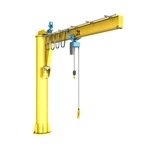
A wall-mounted jib crane is a compact and versatile lifting solution designed for efficient material handling in confined spaces. It is mounted on a wall or column, providing a rotating boom to lift, move, and position loads with precision. Ideal for workshops, assembly lines, loading docks, and storage areas, it enhances productivity while saving floor space.

Key Features
1. Space-Saving Design
Mounts directly to walls or structural columns, eliminating the need for floor space.
Ideal for areas with limited room for traditional overhead cranes.
2. 180° or 360° Rotation
Wall-mounted jibs typically offer 180° rotation for work along a wall.
Column-mounted jibs can provide 360° rotation for full coverage.
3. High Load Capacity
Available in capacities ranging from 250 kg to 5,000 kg (or more, depending on design).
Robust construction ensures durability and safety.
4. Adjustable Boom Length
Boom lengths vary from 2m to 10m, customizable to workspace requirements.
5. Smooth & Precise Operation
Manual or motorized rotation options.
Electric or pneumatic hoist compatibility for effortless lifting.
6. Low Maintenance & Easy Installation
Minimal moving parts reduce maintenance needs.
Engineered for quick assembly and integration into existing structures.

Parts & Components
A wall-mounted jib crane is a compact lifting solution designed for use in confined spaces where floor space is limited. It consists of several key components that work together to facilitate smooth and efficient load handling. Here are the main components of a wall-mounted jib crane:
1. Wall Bracket (Mounting Support)
Provides structural support and anchors the jib crane to the wall or column.
Must be securely fastened to a load-bearing wall or reinforced structure.
Can be fixed or pivoting, depending on the design.
2. Boom (Jib Arm)
The horizontal beam that extends outward to provide the lifting radius.
Can be fixed (stationary) or rotating (slewing) for greater coverage.
Made from steel (I-beam or tubular design) for strength and durability.
3. Rotation Mechanism (Slewing Unit) (If Rotatable)
Allows the boom to rotate, typically up to 180°–200° (some models offer 360° with additional support).
Includes slewing bearings or pivot bearings for smooth movement.
4. Hoist & Trolley
Electric or Manual Hoist – The lifting device (chain hoist, wire rope hoist, or lever hoist) that moves vertically.
Trolley – Moves along the length of the boom to position the load.
Can be manual push or motorized for easier operation.
5. End Stops (Boom Stops)
Safety devices at the ends of the boom to prevent the trolley from overrunning.
6. Load Limiter (Optional)
Ensures the crane is not overloaded beyond its rated capacity.
7. Control System (For Powered Cranes)
Pendant control (wired or wireless) for operating electric hoists and trolleys.
8. Reinforcement Structure (If Required)
Additional bracing or support columns may be needed for heavy-duty applications.

Parameters

Sketch

Advantages
A wall-mounted jib crane is a compact and versatile lifting solution that offers several advantages, especially in facilities with limited floor space. Here are the key benefits:
1. Space-Saving Design
Mounts directly to a wall or column, freeing up valuable floor space.
Ideal for workshops, warehouses, and production lines where floor-mounted cranes are impractical.
2. Cost-Effective
Lower installation and maintenance costs compared to freestanding jib cranes.
No need for additional support structures or foundations.
3. Improved Maneuverability
Provides a 180° or 360° rotation (depending on the model) for precise load positioning.
Enhances productivity by reducing the need for manual handling or forklifts.
4. Easy Installation & Relocation
Can be mounted on existing walls or reinforced columns.
Some models are modular, allowing for relocation if workspace layouts change.
5. Versatile Load Handling
Suitable for lifting light to medium loads (typically up to 2 tons, but some heavy-duty models go higher).
Works well with hoists, balancers, or manual chain blocks.
6. Enhanced Safety
Reduces worker strain by minimizing manual lifting.
Can be equipped with load limiters and anti-collision features for safer operation.
7. Customizable Reach & Height
Adjustable boom lengths and mounting heights to fit specific workspace requirements.
8. Ideal for Repetitive Tasks
Perfect for assembly lines, loading docks, and machine tending where repetitive lifting is needed.

Application
A wall mounted jib is a compact lifting solution designed for applications where floor space is limited or where mobility is not required. It consists of a horizontal boom (jib arm) mounted to a wall or column, allowing for rotation and lifting within a specific work area. Here are some common applications of wall-mounted jibs:
1. Manufacturing & Assembly Lines
Lifting and positioning components in assembly stations.
Handling tools, machinery parts, or workpieces in production areas.
2. Warehousing & Logistics
Loading/unloading goods from shelves or conveyors.
Moving packaged items in tight storage spaces.
3. Maintenance & Repair Shops
Supporting engines, motors, or heavy equipment during servicing.
Assisting in the installation of machinery parts.
4. Automotive & Aerospace Industries
Handling car parts, engines, or aircraft components.
Positioning heavy tools in repair bays.
5. Workshops & Small Factories
Lifting metal sheets, molds, or raw materials.
Aiding in welding, machining, or fabrication tasks.
6. Construction & Material Handling
Assisting in lifting building materials (bricks, pipes, etc.) in confined spaces.
Supporting scaffolding or formwork installation.
7. Laboratories & Testing Facilities
Moving sensitive or heavy testing equipment safely.
Advantages of Wall-Mounted Jibs:
Space-saving (no floor obstruction).
Cost-effective compared to freestanding cranes.
Easy installation on existing walls or columns.
Adjustable rotation (manual or powered).
Moderate load capacity (typically 250 kg to 2,000 kg).

Production Procedure
1. Material Procurement
Raw Materials: High-grade steel (ASTM A36 or equivalent), bearings, bolts, welding rods, paint, and other hardware.
Components: Slewing ring, hoist trolley, wire rope/chain, hook, and electrical components (if motorized).
Quality Check: Verify material certifications (MTC) and inspect for defects.
2. Design & Engineering
CAD Modeling: Create detailed drawings with dimensions, load capacity (SWL), and stress analysis.
Approval: Review design with engineering team to ensure compliance with standards (ISO, OSHA, ANSI).
3. Fabrication Process
A. Cutting & Shaping
Use CNC plasma/oxy-fuel cutting for steel plates and beams.
Machine components (slewing ring, brackets) to precise tolerances.
B. Welding
Weld the jib arm, support brackets, and wall-mounting plate using MIG/TIG welding.
Follow WPS (Welding Procedure Specification) and perform visual inspections.
C. Machining & Drilling
Drill holes for bolts, pins, and pivot mechanisms.
Machine bearing housings for smooth rotation.
D. Assembly
Assemble the jib arm with the slewing ring and pivot mechanism.
Install the hoist trolley (manual or electric) and wire rope/chain.
4. Surface Treatment
Sandblasting: Clean surfaces to remove rust and impurities.
Painting/Powder Coating: Apply primer and corrosion-resistant paint (RAL color as specified).
5. Quality Control & Testing
Dimensional Inspection: Verify tolerances per design.
Load Testing: Test with 125% of SWL (Safe Working Load) to ensure structural integrity.
Rotation Test: Check smooth movement of the jib arm.
Safety Checks: Inspect welds, bolts, and electrical components (if applicable).
6. Final Assembly & Packaging
Attach warning labels, capacity plates, and operation manuals.
Pack securely for shipping to prevent damage.
7. Installation & Commissioning (On-Site)
Wall Mounting: Ensure the wall structure can support the load (reinforced concrete or steel frame).
Alignment: Verify level and plumb for smooth operation.
Functional Test: Perform trial runs with and without load.
8. Documentation & Handover
Provide:
Manufacturer's test certificate
User manual
Warranty details
Compliance certificates (CE, OSHA, etc.)
9. Maintenance Guidelines
Regular lubrication of pivot points.
Periodic inspection of welds, bolts, and load-bearing parts.
Annual load testing (if required by regulations).

Workshop View
Henan Mine Crane Co., Ltd has implemented a smart equipment management platform and deployed 310 sets of handling and welding robots. Upon the fulfillment of the initiative, the total number of sets will exceed 500, achieving a 95% equipment networking rate. Currently, 32 welding lines are operational, with plans to install an additional 50. The overall automation rate for the entire product line has already reached 85%.


Hot Tags: wall mounted jib, China wall mounted jib manufacturers, suppliers, factory, Railway Wheel, Wheels, Double Girder Overhead Cranes, Electromagnetic Overhead Crane with Rotary Carrier Beam, Casting Overhead Ladle Crane, Forged Train Wheels
Previous
Floor Mounted Jib CraneNext
Wall Jib CraneYou Might Also Like


Send Inquiry