





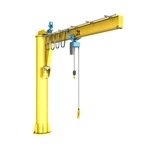


Wall Mounted Cantilever Crane
A wall jib crane (also known as a wall-mounted jib crane) is a versatile, space-saving material handling solution designed for light to medium-duty lifting tasks. Unlike free-standing floor-mounted cranes, it is mounted directly onto an existing wall or structural column. The crane features a horizontal boom (the jib) that can rotate, providing efficient, point-to-point lifting coverage for individual workstations or assembly areas.

Product name:Wall Type Jib Crane
Slewing Angle: 270°
Working Duty: A3-A4
Lifting Capacity: 0.25-10T
Lingfting Height: 2-10m
Electric Source: 3 Phase 380V 50HZ
Control method:Ground Control+ Remote Control (customized)
Lifting mechanism:Elctrical Hoist
Lifting speed:0.8/8m/min
Key Features
Space-Saving Design
The crane mounts directly onto an existing wall or column, requiring zero floor space. This makes it perfect for crowded workshops where ground area is limited.
Rotational Coverage
The boom typically rotates 180° (or up to 270° on corner columns), covering a broad semicircular work area. Rotation can be manual or motorized.
Simple & Cost-Effective
With a simple, lightweight structure, it is easy to install and has a lower initial cost compared to free-standing cranes. No special foundation is required.
Flexible Lifting Options
It can be equipped with manual chain hoists, electric hoists, or smart lifting devices, depending on the load and precision needs. The hoist travels along the boom for full coverage.
Ergonomic Operation
Designed for smooth, low-effort movement, it reduces operator fatigue and improves productivity. Controls can be pendant or wireless remote.
Safety Features
Standard features include limit switches, overload protection, and emergency stops to ensure safe operation.
Low Maintenance
Built with durable components and sealed bearings, the crane requires minimal upkeep and offers long-term reliability.

Parts & Components
Main Components
A typical wall jib crane consists of the following key parts:
| Component | Description |
|---|---|
| Wall Bracket / Support | The fixed steel structure that is bolted or welded to the load-bearing wall or column, anchoring the entire crane. |
| Jib Boom (Arm) | The horizontal rotating arm, usually a steel I-beam or box-section, which supports the lifting device. |
| Lifting Device | Can be a manual chain hoist, electric chain hoist, or wire rope hoist mounted on a trolley that travels along the boom. |
| Rotating Mechanism | A pivot bearing or slewing ring at the wall connection that allows the boom to rotate smoothly, typically up to 180° or 270°. |
| Trolley & Track | The trolley runs along the underside of the jib boom, enabling lateral movement of the load. |
| Cable Festoon System | Manages the power and control cables, ensuring they do not tangle during rotation. |
| Limit Stops / Stoppers | Prevent the trolley from rolling off the end of the boom. |

Parameters

Sketch

Advantages
Exceptional Space Efficiency
Since the crane is wall-mounted, it occupies zero floor space. This is its greatest advantage, as it leaves the floor area completely clear for machinery, workpieces, and pedestrian traffic.
Cost-Effective Investment
The structure is simpler than that of a free-standing jib crane or an overhead bridge crane. It requires no dedicated foundation, which significantly reduces installation costs and project lead times.
Excellent Workstation Coverage
The boom typically rotates 180° (with the wall as the pivot point) or up to 270° (if mounted on a corner column). This provides a large, circular or semi-circular working area, ideal for serving one or two adjacent workstations.
High Efficiency & Ergonomic Benefits
With an electric hoist and smooth rotation, operators can move loads quickly and precisely. This significantly reduces manual lifting effort, minimizes operator fatigue, and improves overall productivity.
Easy Installation & Maintenance
Installation is straightforward. The bracket is simply attached to the existing building structure. The crane has a simple mechanical design, and its components (hoists, trolleys) are standardized, making maintenance and spare parts replacement easy.
Flexible Lifting Options
It can be equipped with different types of hoists (manual, electric, or even intelligent lifting devices) depending on the load weight, speed, and control precision required.

Application
Wall jib cranes are most suitable for indoor, light to medium-duty applications with repetitive lifting cycles. They are widely used in:
Manufacturing & Assembly Lines: For feeding raw materials to machines, lifting components for assembly, or moving finished parts to the next station.
Automotive Industry: Handling engine blocks, transmissions, and other heavy parts on production lines.
Warehouses & Storage Areas: Loading and unloading goods at storage bays, or moving items onto delivery trucks.
Maintenance & Repair Shops: Lifting engines, pumps, or heavy machinery parts during service and repair work.
Machine Shops: Loading and unloading heavy workpieces onto machine tools such as lathes, milling machines, or grinding machines.
Loading Docks: As a supplemental tool for handling materials at the dock area alongside larger overhead cranes.

Production Procedure
The production procedure of a floor-mounted jib crane involves several steps, from design and manufacturing to assembly and testing. Here is a general overview of the production procedure for a floor-mounted jib crane:
1.Design Phase:
- Project Requirements: Understand the specific requirements of the customer, including lifting capacity, working radius, height, and any special features needed.
- Engineering Design: Create detailed engineering drawings and specifications for the floor-mounted jib crane, considering factors such as material strength, safety standards, and operational requirements.
2.Material Selection:
- Choose high-quality materials for the various components of the crane, including the base, column, jib arm, boom, hoist trolley, and other structural elements. The materials should be selected based on factors like strength, durability, and resistance to environmental conditions.
3.Fabrication:
- Cut and shape the raw materials according to the design specifications.
- Weld the components together to form the main structure of the floor-mounted jib crane.
- Ensure precision and accuracy in the fabrication process to maintain structural integrity.
4.Surface Treatment:
- Apply surface treatments such as painting or coating to protect the crane from corrosion and environmental wear.
- Surface treatments may include priming, painting, or galvanizing, depending on the materials used and the intended application.
5.Assembly:
- Assemble the various components, including the base, column, jib arm, boom, hoist trolley, and any additional features according to the engineering design.
- Ensure that all connections are secure and that the crane is structurally sound.
6.Installation of Mechanical Components:
- Install the hoist mechanism, rotation mechanism, and other mechanical components.
- Connect the electrical components, including wiring, control panels, and safety features.
7.Quality Control and Testing:
- Conduct thorough quality control inspections at different stages of the manufacturing process to ensure compliance with design specifications and industry standards.
- Perform load testing to verify the crane's lifting capacity and overall functionality.
8.Documentation and Certification:
- Prepare documentation, including user manuals, maintenance instructions, and certification documents.
- Ensure that the floor-mounted jib crane complies with relevant safety and quality standards.
9.Packaging and Shipping:
- Package the floor-mounted jib crane securely to prevent damage during transportation.
- Arrange for shipping to the customer's location.
10.Installation and Commissioning:
- Provide on-site installation services or detailed installation instructions for the customer.
- Commission the crane, ensuring that all components function correctly and safely.
11.Training:
- Offer training to operators on the proper use, maintenance, and safety procedures associated with the floor-mounted jib crane.
12.After-Sales Support:
- Provide ongoing support, including maintenance services, spare parts availability, and troubleshooting assistance.

Workshop View
Henan Mine Crane Co., Ltd has implemented a smart equipment management platform and deployed 310 sets of handling and welding robots. Upon the fulfillment of the initiative, the total number of sets will exceed 500, achieving a 95% equipment networking rate. Currently, 32 welding lines are operational, with plans to install an additional 50. The overall automation rate for the entire product line has already reached 85%.


Hot Tags: wall mounted cantilever crane, China wall mounted cantilever crane manufacturers, suppliers, factory
Previous
Wall Travelling Jib CranesYou Might Also Like


Send Inquiry