







Workshop Jib Crane
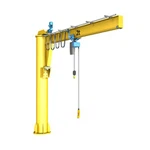
A jib crane is composed of a vertical support column or wall bracket paired with a horizontal arm - known as the jib - that rotates about its axis. Mounted on a trolley that runs along the jib arm is a hoist, which may be manual, electric, or pneumatic. With minimal physical exertion, the operator can lift, lower, and position loads within the arm's reach and rotation arc with a high degree of precision.
In a workshop environment, the key benefit lies in targeted material handling. Jib cranes remove the need for workers to manually lift heavy components, cutting fatigue and injury risk while accelerating workflow. According to one manufacturer, worker fatigue drops by 40% compared with manual lifting, and customers report a 25% gain in work speed after installing dedicated jib crane workstations.
Main Types for Workshop Applications
Column-Mounted (Pillar) Jib Cranes
This is the most widely used configuration in workshops. A vertical steel column is fixed to a concrete foundation, and the jib arm pivots around it - usually through a full 360 degrees. It suits open workshop areas requiring a central or dedicated lifting point. Adequate floor space and a properly engineered foundation are necessary to withstand the moment loading produced by off-center loads.
Wall-Mounted (Bracket) Jib Cranes
These are fixed directly to an existing structural wall or building column, conserving valuable floor space. They are ideal for workstations arranged along a wall or production line. Rotation is generally restricted to 180° or 270°. A key prerequisite is confirming that the supporting structure can bear not only the vertical load but also the rotational moment forces generated during operation.
Articulating (Multi-Joint) Jib Cranes
These use a segmented boom with two pivot points, allowing the arm to reach around corners, into machinery, or over obstacles that would obstruct a straight-arm crane. They are frequently found in machine shops for loading CNC machines or in tight spaces where standard jibs cannot reach. Capacities tend to be lower than those of straight-arm models.
Mobile/Portable Jib Cranes
These are counterbalanced units on wheels or casters, built for temporary or flexible lifting duties. They can be relocated between workstations and need no permanent foundation. A typical unit offers 500 kg capacity with 360° rotation, runs on a maintenance-free battery, and may include hydraulic extension for awkward placements.
Selection Considerations
Capacity and Duty Cycle: Assess not only the maximum load weight but also how often the crane will be used. Occasional use (A3 duty) fits light cycles with 15-minute work periods. Continuous production demands A5 or higher class, engineered for 8-hour daily operation.
Span and Height: Measure the required hook coverage radius and the maximum lift height. Verify that the chosen jib configuration delivers sufficient height under boom (HUB) for the tallest loads and lifting equipment.
Foundation vs. Wall Mounting: Floor-mounted cranes need adequate floor space and a properly engineered foundation. Wall-mounted units remove the floor footprint but require a structurally sound wall or column able to handle rotational moment loads. Consult a structural engineer whenever load-bearing capacity is in doubt.
Hoist Selection: Manual chain hoists are cost-effective for lighter or infrequent lifting. Electric hoists boost efficiency and lessen operator effort for heavier loads or repetitive cycles.
Environmental Factors: Workshop conditions may call for specific features. Spark-resistant hoists suit areas with grinding or cutting. Corrosion-resistant finishes are appropriate for humid or wash-down environments. Cleanroom-compatible designs serve pharmaceutical or electronics manufacturing.
Core Technical Specifications
| Parameter | Typical Range for Workshop Use |
|---|---|
| Capacity | 80 kg to 20,000 kg (0.08–20 t); most common: 250 kg–5 t |
| Span/Reach | 2,000 mm to 10,000 mm (some models up to 6,000 mm for standard, custom longer) |
| Height Under Boom (HUB) | 1,800 mm to 8,000 mm depending on model and column height |
| Slewing Range | 180° (wall), 270° (limited column), or 360° (full column/free-standing) |
| Slewing Method | Manual push-pull (standard for ≤1 t), powered (electric/pneumatic) for heavier or frequent cycles |
| Hoist Options | Manual chain block, electric chain hoist, or wire rope hoist |
| Power Supply | 380–420V / 3-phase / 50 Hz (typical); custom voltages available |
| Control | Pendant push-button or radio remote |

Key Features
Structure & Motion Characteristics
360° Rotation Arc – Column-mounted jib cranes rotate a full 360 degrees around their vertical support column, providing maximum coverage in open workshop areas. Wall-mounted versions typically offer a more limited rotation of 180° or 270°, depending on the mounting configuration and structural constraints.
Horizontal Jib Arm – The horizontal arm, known as the jib, pivots around its axis to enable precise load positioning. The arm length determines the working radius and the area of coverage available to the operator.
Trolley-Travel Hoist Movement – The hoist is mounted on a trolley that travels along the jib arm, allowing loads to be moved both radially (along the arm) and rotationally (around the pivot). This two-axis movement provides comprehensive coverage within the crane's working envelope.
Articulating Boom Capability – Multi-joint jib cranes feature a segmented boom with two pivot points, enabling the arm to reach around corners, into machinery, or over obstacles that would block a straight-arm crane. These are commonly used in machine shops for loading CNC machines or in confined spaces where standard jibs cannot access.
Compact Footprint Options – Wall-mounted and mobile designs can significantly reduce or completely eliminate floor space requirements. Wall-mounted units attach directly to existing structural walls or building columns, while portable units can be relocated as needed.
Operational Efficiency & Ergonomics
Targeted Material Handling – Jib cranes are designed for precise load positioning within a defined work area, making them ideal for workstation-specific lifting tasks. They eliminate the need for workers to manually lift heavy parts, reducing fatigue and injury risk.
Reduced Worker Fatigue – By removing the need for manual lifting of heavy components, jib cranes significantly cut worker fatigue. One manufacturer reports a 40% reduction in worker fatigue compared to manual lifting methods.
Improved Workflow Speed – Customers report a 25% increase in work speed after installing dedicated jib crane workstations. The ability to quickly and precisely position loads accelerates production processes.
Minimal Physical Effort – The operator can lift, lower, and position loads within the arm's reach and rotation arc with precision and minimal physical effort. This is particularly beneficial for repetitive lifting tasks.
Lower Injury Risk – By eliminating manual lifting of heavy parts, jib cranes reduce the risk of musculoskeletal injuries and other workplace accidents associated with manual material handling.
Configuration & Adaptability
Multiple Hoist Options – Jib cranes are compatible with manual, electric, or pneumatic hoists to match different load and cycle requirements. Manual chain hoists are cost-effective for lighter or infrequent lifting, while electric hoists improve efficiency for heavier loads or repetitive cycles.
Column-Mounted (Pillar) Configuration – The most common configuration for workshop use. A vertical steel column is anchored to a concrete foundation, and the jib arm rotates around it. This type is ideal for open workshop areas where a central or dedicated lifting point is required.
Wall-Mounted (Bracket) Configuration – These are attached directly to an existing structural wall or building column, saving valuable floor space. They are well-suited for workstations positioned along a wall or production line.
Mobile/Portable Configuration – Counterbalanced units on wheels or casters are designed for temporary or flexible lifting tasks. They can be moved between workstations and do not require permanent foundations.
Customizable Capacity and Duty Cycle – Jib cranes are available from light A3 duty (occasional use with 15-minute work periods) up to A5 or higher class designed for 8-hour daily operation. Capacity and duty cycle can be matched to specific application requirements.
Span and Height Flexibility – The crane can be configured based on the required hook coverage radius and the maximum lift height needed. The chosen jib configuration must provide adequate height under boom (HUB) for the tallest loads and lifting equipment.
Safety & Environmental Adaptability
Moment Load Engineering – Both column-mounted and wall-mounted jib cranes require properly engineered foundations or structural supports to resist the moment loading created by off-center loads. This is a critical design consideration for safe operation.
Structural Verification Support – Before installing a wall-mounted jib crane, it is essential to verify that the supporting structure can handle not just the vertical load, but the rotational moment forces generated during operation. A structural engineer should be consulted if load-bearing capacity is uncertain.
Environment-Specific Options – Workshop environments may require specific features. Spark-resistant hoists are available for areas with grinding or cutting. Corrosion-resistant finishes suit humid or wash-down environments. Cleanroom-compatible designs serve pharmaceutical or electronics manufacturing.
Foundation vs. Wall Mounting Choice – Floor-mounted cranes require sufficient floor space and a properly engineered foundation. Wall-mounted units eliminate the floor footprint but require a structurally sound wall or column capable of handling rotational moment loads. The choice depends on available space and structural conditions.

Parts & Components
1. Vertical Support Column / Wall Bracket
The vertical support column (for column-mounted models) or wall bracket (for wall-mounted models) serves as the primary structural anchor of the jib crane. It bears the entire load of the jib arm, hoist, trolley, and lifted material, transferring all forces to the foundation or supporting structure.
2. Jib Arm (Boom)
The horizontal arm that pivots around the vertical support column or wall bracket. It defines the working radius and coverage area of the crane. On articulating models, the jib arm is segmented with two pivot points for greater reach flexibility.
3. Hoist
The lifting mechanism mounted on the trolley. It can be manual (chain hoist), electric, or pneumatic, depending on the application requirements. The hoist performs the actual lifting and lowering of loads.
4. Trolley
The wheeled carriage that travels along the jib arm. It carries the hoist and allows horizontal movement of the load along the length of the jib arm. The trolley may be manual or motorized.
5. Pivot / Rotation Mechanism
The bearing assembly that connects the jib arm to the vertical support column or wall bracket, enabling rotational movement. Column-mounted models typically rotate 360°, while wall-mounted versions are usually limited to 180° or 270°.
6. Foundation / Mounting Base
For column-mounted cranes, a concrete foundation anchors the vertical column to the floor and resists the moment loading created by off-center loads. For wall-mounted cranes, the mounting base consists of brackets and anchor points fixed to the existing structural wall or building column.
7. Runway / Support Structure (for Wall-Mounted and Mobile Models)
Wall-mounted jib cranes rely on the building's structural wall or column as their support structure, which must handle both vertical loads and rotational moment forces. Mobile/portable jib cranes use a counterbalanced base on wheels or casters instead of a fixed foundation.

Parameters

Sketch

Advantages
1. Targeted Material Handling
Jib cranes are designed for precise load positioning within a defined work area, making them ideal for workstation-specific lifting tasks. Unlike overhead cranes that cover an entire facility, jib cranes focus lifting capability exactly where it is needed most.
2. Reduced Worker Fatigue
By eliminating the need for manual lifting of heavy parts, jib cranes significantly cut worker fatigue. One manufacturer reports a 40% reduction in worker fatigue compared to manual lifting methods.
3. Improved Workflow Speed
Customers report a 25% increase in work speed after installing dedicated jib crane workstations. The ability to quickly and precisely position loads accelerates production processes and reduces bottlenecks.
4. Lower Injury Risk
Eliminating manual lifting of heavy components reduces the risk of musculoskeletal injuries and other workplace accidents associated with manual material handling, creating a safer working environment.
5. Minimal Physical Effort
The operator can lift, lower, and position loads within the arm's reach and rotation arc with precision and minimal physical effort. This is particularly beneficial for repetitive lifting tasks and improves operator comfort throughout the shift.
6. Space-Saving Design Options
Wall-mounted jib cranes attach directly to existing structural walls or building columns, preserving valuable floor space. This makes them well-suited for workstations positioned along a wall or production line where floor space is at a premium.
7. Flexible Rotation and Reach
Column-mounted models rotate a full 360 degrees, while wall-mounted versions typically offer 180° or 270° rotation. Articulating models with two pivot points can reach around corners, into machinery, or over obstacles that would block a straight-arm crane.
8. Multiple Hoist Options
Jib cranes are compatible with manual, electric, or pneumatic hoists, allowing users to match the lifting solution to their specific load and cycle requirements. Manual chain hoists are cost-effective for lighter or infrequent lifting, while electric hoists improve efficiency for heavier loads or repetitive cycles.
9. Mobile and Portable Configurations
Counterbalanced units on wheels or casters provide temporary or flexible lifting capability. They can be moved between workstations and do not require permanent foundations, offering maximum flexibility in dynamic workshop environments.
10. Customizable Capacity and Duty Cycle
Jib cranes are available from light A3 duty (occasional use with 15-minute work periods) up to A5 or higher class designed for 8-hour daily operation. This allows precise matching of the crane to the actual demands of the application.
11. Environment-Specific Adaptability
Spark-resistant hoists are available for areas with grinding or cutting. Corrosion-resistant finishes suit humid or wash-down environments. Cleanroom-compatible designs serve pharmaceutical or electronics manufacturing. This adaptability ensures reliable performance across diverse industrial settings.
12. Cost-Effective Workstation Lifting
Compared to larger overhead crane systems, jib cranes offer a more economical solution for dedicated workstation lifting. They require less structural investment and can be installed more quickly, delivering targeted lifting capability without the cost of full-facility coverage.

Application
CNC and Machine Loading - Jib cranes load raw stock into lathes, milling machines, and machining centers, then unload finished parts. Articulating models reach into the machine enclosure, reducing setup time and keeping the operator clear of the work zone.
Assembly Lines and Workstations - Wall-mounted or column-mounted jib cranes lift components onto assembly fixtures and position sub-assemblies at ergonomic working height. This reduces fatigue over long shifts and keeps production flowing without waiting for a shared overhead crane.
Welding Stations - Jib cranes handle steel plates, beams, and fabricated components during welding and fit-up. The operator can position heavy workpieces precisely for tack welding, then rotate the boom to move the assembly to the next station. Spark-resistant hoists are available when grinding or cutting occurs nearby.
Maintenance and Repair Bays - Free-standing jib cranes with 360° rotation remove and install engines, transmissions, pumps, and motors. The vehicle or equipment does not need to be repositioned during multi-step repair jobs, saving significant time.
Warehousing and Loading Operations - Jib cranes load and unload trucks, transfer goods to storage racks, and move materials between staging areas. They provide localized lifting power where overhead cranes cannot reach, such as inside a truck trailer or at a loading dock.
Steel Fabrication and Heavy Manufacturing - Heavy-duty column-mounted jib cranes with wire rope hoists handle steel plates, sections, and heavy weldments. High capacities and long spans allow fabrication shops to move large components between machines without relying on a bridge crane.
Tool Rooms and Mold Shops - Articulating or column-mounted jib cranes change molds, dies, and heavy tooling on presses and injection molding machines. Quick, precise positioning reduces changeover time, which is critical for production efficiency.
Foundries and Casting Operations - Heavy-duty jib cranes with heat-resistant and spark-resistant features handle sand molds, castings, and ladles. They keep hot, heavy loads under control in hazardous environments.
Automotive and Truck Service - Jib cranes lift engines, transmissions, axles, and drivetrain components. A 360° rotating boom allows the technician to lift a component from the vehicle, rotate it to a bench, and lower it without repositioning the vehicle.
Aerospace and Precision Manufacturing - Articulating jib cranes with precision electric hoists handle delicate, high-value components such as engine parts and avionics modules. Smooth, controlled movement prevents damage to expensive parts.
Pharmaceutical and Cleanroom Environments - Stainless steel or coated jib cranes with cleanroom-compatible hoists lift equipment, containers, and materials in controlled environments. Sealed components prevent particle generation and withstand frequent wash-down.
Ports, Shipyards, and Heavy Logistics - Heavy-duty column-mounted or free-standing jib cranes with galvanized finishes handle cargo, ship components, and heavy equipment in outdoor or semi-outdoor environments. They provide reliable lifting power in harsh conditions.

Production Procedure
1. Design & Engineering
The production process begins with a thorough review of customer requirements, including capacity, span, height under boom (HUB), rotation angle, duty cycle, and environmental conditions. Engineers produce detailed drawings and calculations to determine structural dimensions, material specifications, and load-bearing requirements. For wall-mounted units, structural verification of the supporting wall or column is also performed at this stage.
2. Material Selection & Preparation
High-quality steel plates and profiles are selected according to the engineering specifications. Materials are inspected for grade, thickness, and surface quality. Steel plates are then cut to size using CNC flame cutting or plasma cutting equipment, ensuring precise dimensions and clean edges for subsequent welding.
3. Column & Jib Arm Fabrication
The vertical support column and jib arm are fabricated through welding. The column is typically formed from rolled steel sections or welded box construction, while the jib arm may be a solid beam, truss, or box-section design. Welding is performed by certified welders following approved welding procedures to ensure structural integrity.
4. Welding & Structural Assembly
All structural components - including the column, jib arm, end plates, mounting flanges, and reinforcement ribs - are assembled and welded together. Dimensional accuracy is maintained throughout the assembly process using jigs and fixtures. Welds are visually inspected and may undergo non-destructive testing (NDT) such as ultrasonic or magnetic particle inspection for critical joints.
5. Machining & Surface Treatment
After welding, machined surfaces such as pivot bores, bearing seats, and mounting faces are precision-machined to ensure proper fit and alignment. The entire structure then undergoes surface preparation, including shot blasting or sandblasting to remove mill scale, rust, and contaminants. A protective paint system is applied - typically primer plus topcoat - with corrosion-resistant finishes available for harsh environments.
6. Hoist & Trolley Integration
The hoist (manual, electric, or pneumatic) and trolley are selected or manufactured according to the specification. The trolley is fitted to the jib arm, and the hoist is mounted onto the trolley. Electrical components, including power supply systems, control pendants, and wiring, are installed and connected. For electric hoists, VFD control systems may be integrated for smooth operation.
7. Pivot & Rotation Mechanism Assembly
The rotation mechanism - including bearings, pivot shafts, and locking devices - is assembled and installed at the connection point between the jib arm and the vertical support column or wall bracket. The rotation system is tested to ensure smooth 360° (or limited-angle) movement without binding or excessive play.
8. Quality Control & Load Testing
Each completed jib crane undergoes rigorous quality control inspections. Dimensional checks verify that all specifications are met. Functional tests confirm that the hoist, trolley, and rotation mechanism operate correctly. A load test is performed at 100% rated capacity (and typically 125% for proof load testing) to verify structural integrity, braking performance, and stability under load.
9. Surface Finishing & Final Inspection
After testing, the crane receives final surface finishing, including touch-up painting and application of safety markings, warning labels, and capacity plates. A final inspection ensures that all components are properly installed, all fasteners are torqued to specification, and the crane complies with relevant safety standards and regulations.
10. Packaging & Shipping
The completed jib crane is disassembled into major components for transport - typically the column, jib arm, hoist, trolley, and hardware - and carefully packed to prevent damage during shipping. Components are secured with steel strapping, protective wrapping, and wooden crating as needed. Shipping documents, installation manuals, and certification papers are prepared and included with the shipment.
11. Installation & Commissioning Support
Depending on the contract scope, the manufacturer may provide on-site installation and commissioning services. This includes foundation preparation guidance, structural mounting, assembly of components, electrical connection, and operational testing. Operator training and maintenance instructions are also provided to ensure safe and efficient use of the equipment.

Workshop View
Henan Mine Crane Co., Ltd has implemented a smart equipment management platform and deployed 310 sets of handling and welding robots. Upon the fulfillment of the initiative, the total number of sets will exceed 500, achieving a 95% equipment networking rate. Currently, 32 welding lines are operational, with plans to install an additional 50. The overall automation rate for the entire product line has already reached 85%.


Hot Tags: workshop jib crane, China workshop jib crane manufacturers, suppliers, factory
Previous
Floor Mounted Jib CraneYou Might Also Like


Send Inquiry