


If you are shopping for lifting equipment, you have likely come across both overhead cranes and hoists. Many buyers treat them as the same thing. They are not.
Choosing the wrong one leads to wasted budget, poor efficiency, or worse - a safety risk on the floor. This article breaks down exactly what separates an overhead crane from a hoist, how they work together, and which one your facility actually needs.
What Is an Overhead Crane?
An overhead crane is a complete material handling system. It is installed above your workspace on fixed rails and moves loads in three directions: left and right along the runway, forward and back along the bridge, and up and down via the hoist.
The system consists of several major components working together.
Main Components of an Overhead Crane


Single Girder Crane Parts Double Girder Overhead Crane Parts
Bridge girder - the horizontal beam that spans the width of your bay
End trucks - the wheel assemblies that travel along the runway rails
Runway rails - the fixed tracks mounted to your building structure or freestanding supports
Trolley - the unit that travels along the bridge girder
Hoist - the lifting mechanism mounted on the trolley
Control system - pendant, remote, or cab control
The key point: the overhead crane is the full system. The hoist is just one part of it.
Types of Overhead Cranes


Single Girder Overhead Crane Double girder overhead crane
Overhead cranes come in two main structural types.
Single girder overhead crane - one main beam, suitable for loads up to 32 tons in most standard configurations. Lower cost, lighter weight on your building structure.
Double girder overhead crane - two parallel beams, handles heavier loads up to 500 tons, offers lower hook height for better vertical lift clearance.
Both types cover the full floor area of your bay. That full-coverage capability is the defining advantage of a bridge crane system.
What Is a Hoist?
A hoist is a lifting device only. It moves loads vertically - up and down. It does not, on its own, provide horizontal coverage.
Types of Hoists Used in Overhead Cranes
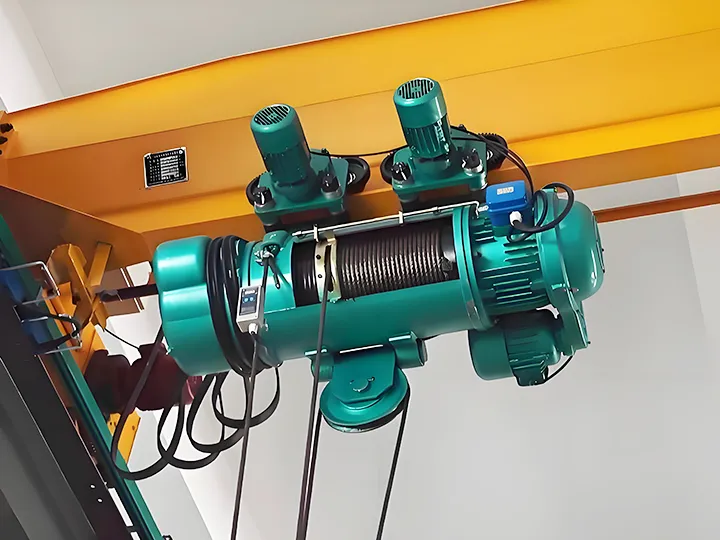

Wire Rope Electric Hoist Chain Electric Hoist
There are two primary types used in industrial settings.
Wire rope electric hoist - uses a steel wire rope wound on a drum. Suitable for heavy loads, high lifting heights, and frequent cycles. Common load range: 1 to 80 tons.
Chain electric hoist - uses a metal chain. Better for lighter loads and lower lifting heights. More compact and lower cost, typically under 10 tons.
A hoist can be mounted on an overhead crane trolley, a jib crane arm, a monorail beam, or even a fixed point on a structure. Its job is the same in every case: lift the load.
Can a Hoist Work Without a Crane?
Yes. A fixed-point hoist mounted to a beam or ceiling hook can lift loads directly below it. But it cannot move that load horizontally. For most production environments, that limitation makes a standalone hoist impractical for material flow between workstations.
Overhead Crane vs Hoist: Side-by-Side Comparison
This table summarizes the core differences between the two.
| Feature | Overhead Crane System | Hoist Only |
|---|---|---|
| Horizontal movement | Full bay coverage (X and Y axis) | None (vertical only) |
| Vertical movement | Yes, via the hoist component | Yes |
| Coverage area | Entire floor under the runway | Fixed point directly below |
| Typical load range | 1 – 500+ tons | 0.25 – 80 tons |
| Installation requirement | Runway structure required | Beam or fixed anchor point |
| System complexity | High (full system) | Low (single component) |
| Best for | Production lines, full-bay coverage | Localized lifting, single workstation |
The difference is fundamentally about coverage. Overhead cranes and hoists serve different scopes of work - the crane gives you full bay mobility, the hoist gives you a lift point.
How Overhead Cranes and Hoists Work Together
This is where many buyers get confused. In a standard overhead crane setup, the hoist is not separate from the crane - it is installed as part of it.
The trolley travels along the bridge girder. The overhead crane hoist is mounted on that trolley. When you operate the crane, you are controlling all three axes simultaneously: bridge travel, trolley travel, and hoist lifting.
This integrated design means the hoist selection directly affects the performance of the whole system. Key parameters to match include:
Lifting capacity - the hoist must match or exceed the crane's rated load
Lifting height - determined by drum capacity and wire rope length
Duty class - ISO M classification (M1 to M8) must match your operating frequency
Headroom - low-headroom hoist designs maximize vertical lift clearance
A mismatch between hoist specification and crane application is one of the most common causes of premature equipment failure.
Which One Do You Actually Need?
Use this simple framework.
Choose an Overhead Crane System When:
You need to move loads to multiple points across your bay
Your facility has a defined production flow between workstations
Load weight exceeds what a jib crane or monorail can handle
You need full-floor material handling coverage
Choose a Standalone Hoist When:
You need to lift and lower at a single fixed point only
The application is maintenance, loading dock work, or a single machine station
Budget and space constraints rule out a full runway system
A jib crane or monorail will provide the limited horizontal movement needed
For most manufacturing facilities, the answer is a complete overhead crane system - with the right overhead crane hoist selected to match the duty requirements.
Conclusion
An overhead crane is a system. A hoist is a component. Understanding that distinction prevents costly misspecification.
If your operation requires moving materials across a work area, you need an overhead crane. If you need to lift at a single point, a hoist - mounted on a jib, monorail, or fixed point - may be sufficient.
Before requesting a quote, define your load weight, lift height, travel distance, and daily cycle count. Those four parameters determine whether you need a full bridge crane system or a simpler hoist solution.
If you are unsure which configuration fits your facility, Mine Crane engineering team can review your layout and recommend the right setup.
FAQ
Q1: Is a hoist the same as an overhead crane?
No. A hoist is a lifting device that moves loads vertically. An overhead crane is a complete system that includes a hoist, trolley, bridge girder, runway rails, and control system. The hoist is one component of the crane. You can use a hoist without a full crane system, but an overhead crane always requires a hoist as its lifting mechanism.
Q2: Can I add a hoist to an existing overhead crane?
Yes, in most cases. However, the replacement hoist must match the crane's rated capacity, lifting height, and duty class. It also needs to be compatible with the existing trolley mounting. Always confirm the hoist specifications with the crane manufacturer before purchasing a replacement or upgrade.
Q3: What is the difference between a wire rope hoist and a chain hoist on an overhead crane?
Wire rope hoists handle heavier loads, higher lifting heights, and higher cycle frequencies. They are the standard choice for industrial overhead cranes above 5 tons. Chain hoists are more compact and lower cost, suited for lighter applications under 10 tons with lower operating frequency. For high-duty production environments, wire rope is typically the better long-term investment.
Q4: How do I choose the right hoist capacity for my overhead crane?
Start with your maximum load weight and add a safety margin - most engineers apply 10–25% above the maximum expected load. Then confirm the duty class matches your daily lift cycles. ISO and FEM standards classify crane duty from M1 (light occasional use) to M8 (very heavy continuous use). Mismatching duty class to actual use is a leading cause of premature hoist failure.
Q5: What is a low-headroom overhead crane hoist, and when do I need one?
A low-headroom hoist is designed to minimize the distance between the bottom of the bridge girder and the hook. It is used when vertical clearance in your facility is limited. Standard hoists require more headroom. If your building height is restricted, specifying a low-headroom design allows you to maximize the usable lifting height within the available space.


