


How to Measure Workshop Dimensions for Overhead Crane Quote | Span, Height & Hook Guide
Learn how to measure workshop dimensions before requesting an overhead bridge crane quote. Understand span, building height, hook height, bay width, and runway beam location to avoid costly design mistakes and get accurate crane pricing.
Accurate workshop measurements-especially span, building height, hook height, bay width, and runway beam location-directly determine crane feasibility, lifting performance, and final installation cost. Even small errors at the measurement stage can lead to wrong crane selection, reduced lifting height, or expensive structural modifications later.
How to correctly measure span for overhead bridge crane design
How building height vs hook height affects usable lifting space
How to define bay width and crane coverage area
How to locate and plan runway beam position correctly
What exact workshop data crane suppliers require for quotation
How to avoid common buyer mistakes that increase installation cost
FAQ – Overhead Bridge Crane Workshop Measurement Guide
Before requesting an overhead bridge crane quotation, buyers should understand that accurate workshop measurements are essential for proper crane design, pricing, and installation planning. The following frequently asked questions explain the key dimensions, structural requirements, and layout considerations that crane suppliers typically need to evaluate before recommending a suitable overhead crane system.
+What information does a crane supplier need before quoting an overhead bridge crane?
+How do I measure workshop dimensions for a bridge crane installation?
+What is the difference between building height and hook height?
+How is crane span measured correctly in industrial workshops?
+Why is runway beam location important in crane system design?
+Can incorrect bay width or structure affect crane performance?
Why Workshop Measurement Is the First Step in Overhead Bridge Crane Selection
An overhead bridge crane is not a standalone lifting machine that you can simply choose from a catalog. It is a workshop-integrated material handling system, and its design is directly based on the actual building conditions. That is why, in any industrial overhead crane quotation process, the first thing a crane supplier will ask is not the capacity-it is the workshop dimensions.
In industrial projects, whether it is a single girder overhead crane, a double girder bridge crane, or a low headroom overhead crane system, the starting point is always the same: how the crane fits into the workshop structure. If the measurement is wrong, the whole crane design will shift, sometimes leading to a mismatch between crane performance and actual working requirements.
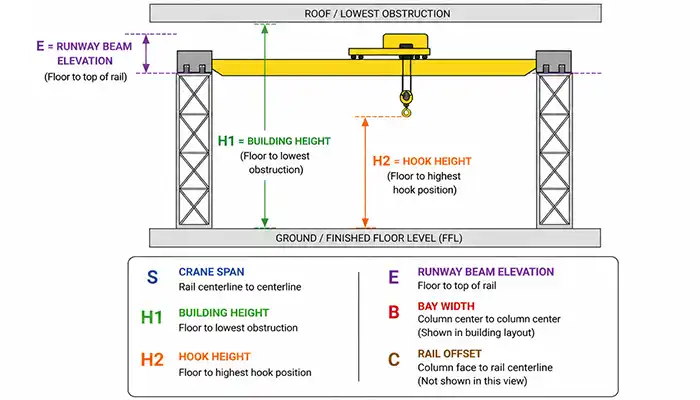
In practical terms, workshop measurement is not paperwork. It is the foundation of crane runway design, lifting height planning, and structural load calculation.
+Overhead bridge cranes are integrated workshop lifting systems, not standalone machines
+Every workshop dimension directly affects overhead crane engineering design
+Structural load distribution in overhead crane systems
+Lifting height optimization and hook height planning
+Crane runway design and workshop travel layout
+Incorrect workshop measurement leads to industrial project problems
+Reduced hook height in industrial operation
+Over-designed or under-designed overhead crane systems
+Installation delays and additional structural cost
+Practical takeaway for crane buyers
Crane Span-Core Design Dimension in Overhead Bridge Crane Systems
In any overhead bridge crane design, span is one of the first technical values a supplier locks into the engineering drawing. It is not just a number on paper. It directly defines how the crane bridge structure, runway beam spacing, and even fabrication limits will be designed.
In industrial workshops such as steel fabrication plants, machinery assembly workshops, steel mills, and warehouse crane systems, span determines whether the crane can move smoothly across the working area without structural conflict or unnecessary cost increase.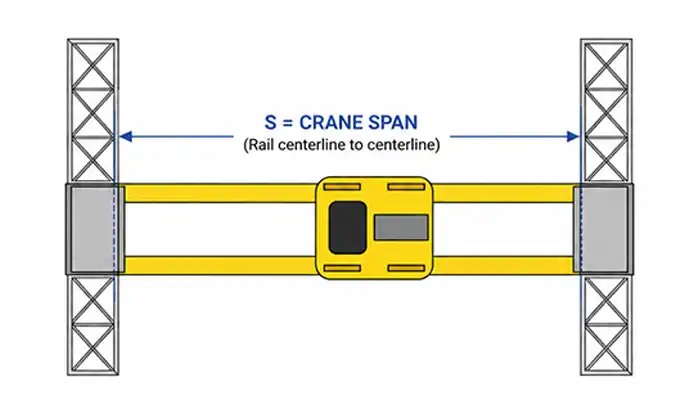
+What Span Means in Overhead Crane Systems
+How to Measure Span Correctly in Workshop Crane Layout
+Why Span Is Critical in Overhead Bridge Crane Design
+Determines Crane Bridge Structural Size
+Impacts Deflection, Stability, and Overall Performance
+Affects Crane Beam Fabrication and Transportation
+Common Buyer Errors in Measuring Crane Span
+Measuring Internal Wall Distance Instead of Rail Center Distance
+Ignoring Future Workshop Expansion Space
+Practical Takeaway for Crane Buyers
Building Height- Workshop Vertical Limitation in Overhead Bridge Crane Systems
Building height is one of the most important parameters in any overhead bridge crane installation project, but it is also one of the most commonly misunderstood. In industrial workshops, many buyers think building height is simply the roof height. In practice, it is more about the available usable vertical space for crane operation, not the architectural height of the building.
For any single girder overhead crane, double girder bridge crane, or low headroom crane system, building height directly controls whether the crane can be installed and how much lifting height can actually be achieved.
+What Building Height Actually Means in Crane Design
+Correct Measurement Method for Workshop Crane Projects
+Why Building Height Matters in Overhead Crane Selection
+Defines Crane Installation Feasibility
+Impacts Selection Between Standard Crane and Low Headroom Crane Design
+Affects Industrial Lifting Height (Hook Height Performance)
+Structural Constraints to Watch in Real Workshop Conditions
+Roof Trusses
+Lighting Systems
+Ventilation Ducts and Piping Systems
+Practical Takeaway for Crane Buyers
Hook Height - Lifting Performance Indicator in Overhead Bridge Crane Systems
Hook height is one of the most practical and "on-site visible" performance indicators in any overhead bridge crane system design. In industrial workshops, whether it is a single girder overhead crane, double girder bridge crane, or low headroom overhead crane, what operators actually feel every day is not the crane capacity, but how high the hook can lift the load.
This is why hook height becomes a key factor in crane selection, workshop layout planning, and production efficiency evaluation.
+Hook Height vs Building Height in Overhead Crane Design
+How to Calculate Required Hook Height for Overhead Bridge Crane Systems
+Load Height
+Lifting Clearance
+Safety Margin (Typically 300–1000 mm)
+Why Hook Height Is Often Misunderstood by Crane Buyers
+Many Buyers Confuse Crane Capacity with Lifting Height
+Standard Cranes Reduce Usable Hook Height Due to Trolley Design
+Engineering Impact of Hook Height in Overhead Crane Systems
+Determines Production Efficiency in Industrial Workshop Operations
+Influences Crane Type Selection (Standard vs Low Headroom Crane)
+Practical Takeaway for Crane Buyers
Bay Width -Operational Coverage and Workflow Layout in Overhead Bridge Crane Systems
Bay width is often underestimated in early overhead bridge crane planning, but in industrial workshops it plays a direct role in how efficiently materials move between production areas. Whether the facility uses a single girder overhead crane, double girder bridge crane, or multiple crane systems across different bays, bay width defines the actual working coverage and how smoothly the workflow is organized.
In practical terms, crane selection is not only about lifting capacity or span. It is also about how the crane serves different production zones inside the workshop.
+Definition of Bay Width in Industrial Workshops
+How to Measure Bay Width Correctly for Crane Planning
+Column Center-to-Center Spacing
+Usable Internal Working Width
+Why Bay Width Affects Overhead Crane System Design
+Determines Working Zones Inside the Workshop
+Influences Crane Quantity and Coverage Strategy
+Impacts Material Handling Efficiency
+Practical Workshop Considerations in Real Crane Projects
+Multiple Bays May Require Multiple Crane Systems
+Irregular Bay Spacing Affects Crane Travel Optimization
+Practical Takeaway for Crane Buyers
Runway Beam Location -Most Critical but Often Ignored in Overhead Bridge Crane Systems-
Runway beam location is one of those details that often looks simple on paper, but in industrial overhead bridge crane installation projects it decides whether the whole system runs smoothly or becomes difficult to install and maintain. In many cases, buyers focus on crane capacity or span first, while runway beam positioning is only considered later. This usually creates problems during installation.
In practical industrial workshops, especially steel structure factories, machinery production plants, and fabrication workshops, the runway system is the industrial "foundation line" of the crane. If it is not correct, the crane cannot operate properly even if the rest of the design is accurate.
+What Runway Beam Location Means in Overhead Crane Systems
+Key Measurement Points for Runway Beam Layout
+Beam Elevation Height
+Distance from Wall or Column to Rail Centerline
+Structural Support Type (Building-Supported or Independent System)
+Why Runway Layout Matters in Real Crane Projects
+Determines Crane Stability and Alignment
+Affects Structural Reinforcement Requirements
+Impacts Installation Cost and Project Timeline
+Common Mistakes Buyers Make in Runway Beam Planning
+Assuming Building Structure Can Support Crane Load
+Not Planning Runway Beam Position During Early Workshop Design
+Practical Takeaway for Crane Buyers
What Information Crane Suppliers Need for Accurate Overhead Bridge Crane Quotation
In industrial overhead bridge crane quotation and technical proposal preparation, suppliers do not simply price a crane based on tonnage. A proper quotation depends on how well the workshop conditions are understood. The crane must match both the structural environment of the building and the actual working requirements in daily production.
In industrial practice, whether it is a single girder overhead crane, double girder bridge crane, or low headroom crane system, missing or unclear data will directly affect design accuracy, delivery time, and final installation result.
That is why crane suppliers always request a complete set of structural and operational information before confirming any design.
+Complete data required for overhead crane quotation and system design
+Span measurement (center-to-center runway beams)
+Building height (floor to lowest obstruction)
+Hook height requirement
+Bay width and working layout
+Runway beam position and structural condition
+Crane capacity (tons)
+Duty class and working frequency
+Power supply details
+Type of materials being handled
+Practical takeaway for crane buyers
Buyer Checklist Before Requesting a Crane Quote
Workshop Dimensions Checklist
Span measured correctly (rail center-to-center)
Building height measured to lowest obstruction
Bay width confirmed (column spacing)
Runway beam location identified
Crane Performance Requirements
Required lifting capacity
Required hook height
Working frequency and duty level
Structural Conditions
Column strength and spacing
Floor load capacity
Roof clearance limitations
Site & Environment Conditions
Indoor or outdoor application
Power supply availability
Temperature, dust, or special environment factors
Material Handling Details
Type of load (steel, machinery, scrap, etc.)
Maximum load weight
Load size and lifting method
Common Mistakes That Increase Overhead Bridge Crane Cost and Installation Risk
In industrial overhead bridge crane projects, most cost increases do not come from the crane itself. They come from incorrect or incomplete workshop information provided at the beginning stage. When the span, building height, hook height, or runway beam layout is not correctly defined, the final design often needs adjustment during engineering or installation.
In industrial practice-especially in steel fabrication workshops, machinery plants, and steel structure production facilities-these mistakes can lead to redesign, delay, or unnecessary upgrade of the crane system.
+Measuring wall-to-wall instead of span centerline
+Ignoring hook height loss in standard overhead crane systems
+Overlooking runway beam structural requirements
+Not considering future production expansion
+Providing incomplete workshop drawings to suppliers
+Practical takeaway for crane buyers
Conclusion
Measuring workshop dimensions correctly before requesting an overhead bridge crane quote is the foundation of a safe, cost-effective, and efficient crane system. Span, building height, hook height, bay width, and runway beam location work together to define crane feasibility and performance. When these parameters are clearly defined, suppliers can design a precise solution, avoid structural conflicts, and ensure maximum lifting efficiency without unnecessary cost increases.


