


Most Important Takeaway
In grain and coal handling environments, dust explosions are a predictable hazard-not an exception. Any overhead crane operating in these conditions must be designed to eliminate ignition risks, making explosion-proof crane kits a critical requirement rather than an upgrade.
Key Takeaways
This guide answers the following critical buyer questions:
Why are grain and coal dust environments considered high explosion risk zones?
How can an overhead crane become an ignition source?
Why are standard crane kits unsafe in dust-heavy operations?
What makes an explosion-proof crane kit different in real applications?
How do you match crane design with hazardous area classifications?
What specifications must be confirmed before selecting a crane system?
Core Insights:
Dust explosions require only a small ignition source-often from crane components
Grain and coal handling operations frequently create explosive atmospheres
Standard overhead cranes are not sealed or protected against dust ignition
Explosion-proof crane kits are engineered to prevent sparks, heat, and dust ingress
Correct crane selection depends on environment, duty, and zone classification
Misjudging explosion risk leads to safety hazards, downtime, and compliance issues
Dust Explosion Risk in Grain and Coal Handling Environments
Grain and coal handling looks routine on the surface-moving bulk materials from one place to another. But once dust becomes airborne, the risk profile changes quickly. What you are dealing with is not just material handling anymore, but a combustible atmosphere that can ignite under the right conditions.
This section breaks down how that risk forms, why it matters, and where it typically shows up in daily operations.
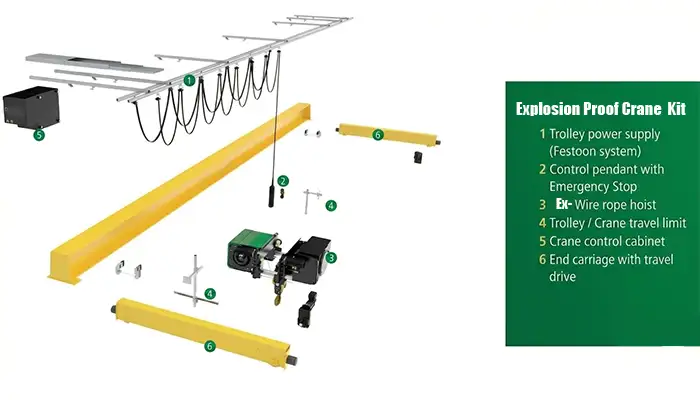
Explosion proof overhead crane kit,top running single girder cranedesiign with capacity 1- 20 ton , double girder explosion proof cranes with capaicty from 3 ton to 80 ton, contact us to get tailored solution . WhatApp: + 86 150 38346929.
Dust Formation and Explosion Conditions in Handling Systems
In grain and coal facilities, dust does not appear as an exception. It is part of the process itself. Once it becomes airborne and concentrated, ignition conditions can form without any unusual event.
+What Creates an Explosive Dust Atmosphere
+Why Grain and Coal Are Highly Combustible
+Where These Risks Occur in Real Operations
How Overhead Crane Systems Introduce Ignition Risks
In dust-heavy environments like grain silos or coal handling plants, an overhead crane does more than lift loads. It moves, heats up, switches power on and off, and interacts with the surrounding air. All of that can create ignition sources.
The issue is not one single failure. It's the combination of normal crane behavior and suspended dust. When those two meet, the risk becomes real.
Crane-Related Ignition Sources in Dust Environments
Ignition risks in overhead crane systems mainly come from electrical activity, mechanical movement, and slow-building static effects. Each of them is normal in operation, but the environment changes how they behave.
+Electrical Components as Ignition Sources
+Mechanical and Friction-Related Heat Sources
+Static Electricity and Surface Temperature Effects
+Combined Risk Conditions in Real Operation
Why Standard Crane Kits Are Not Suitable
At first glance, a standard overhead crane kit may look sufficient. It lifts the load, fits the span, and meets basic duty requirements. But in grain and coal handling environments, that's not the full picture.
The real issue is not lifting capacity-it's whether the crane can operate safely in a dust-laden atmosphere. Standard crane kits are not designed with this condition in mind. Over time, small design gaps turn into real risks.
Limitations of Standard Crane Design in Dust Environments
Standard crane systems are built for general industrial use. When they are placed in grain or coal handling areas, the mismatch between design and environment becomes clear over time.
+Open Design and Dust Exposure
+Lack of Explosion Protection Engineering
+Compliance Gaps in Hazardous Environments
+What This Means for Buyers
What Makes Explosion-Proof Crane Kits Essential
Once you understand how dust forms and where ignition risks come from, the next question is straightforward: how do you control those risks in actual crane operation?
This is where explosion-proof crane kits come in. They are not just modified versions of standard cranes. The design approach is different from the start-focused on preventing ignition, controlling heat, and isolating risk inside the system.
Explosion Control Approach in Crane System Design
Explosion-proof crane kits are built to work in environments where dust is already part of daily operation. The goal is not to avoid dust entirely, but to prevent it from becoming an ignition source inside or around the equipment.
+Core Design Principles for Hazardous Environments
+Key Features of Explosion-Proof Overhead Crane Kits
+Matching Protection Levels to Dust Conditions
+What This Means in Practice
Hazardous Area Classification and Crane Selection
Choosing the right crane for grain or coal handling is not just about capacity or span. The first thing to get right is the hazard level of the environment. That's where hazardous area classification comes in.
In simple terms, classification tells you how often explosive dust is present and how concentrated it can be. Once that is clear, the crane design follows. If the classification is wrong-or ignored-the crane specification will also be wrong.
From Hazard Zones to Crane Design Decisions
Hazardous area classification directly influences how a crane is designed, configured, and approved for use. It is not an administrative step-it is the base reference for all technical decisions.
+Understanding Dust Hazard Zones
+Practical Zone Distribution in Facilities
+Why Classification Directly Affects Crane Design
+What This Means for Crane Selection
How to Select the Right Crane Kit for Grain and Coal Handling
Selecting a crane kit for grain or coal handling is not just about choosing a model from a catalog. It's about matching the crane to how your site actually operates-what you lift, how often you lift, and what the environment looks like day to day.
A small gap in input can lead to a crane that works on paper but struggles in operation. So it's worth going step by step.
+Define Load and Application Requirements
+Evaluate Environmental Conditions
+Choose the Appropriate Crane Configuration
+Confirm Technical and Compliance Requirements
What This Means for Buyers
Selecting the right crane kit is about connecting four things clearly:
What you lift
How often you lift
Where you lift
How the environment behaves during operation
When these inputs are clearly defined, the crane can be configured to match real working conditions. When they are unclear, the result is often either over-design or unexpected performance issues.
In grain and coal handling, a properly matched crane is not only more stable in operation, but also safer and more predictable over time.
Common Buyer Mistakes in Dust Hazard Applications
Most issues with crane systems in grain and coal handling don't come from complex technical failures. They usually start with simple assumptions made early in the project.
Once the crane is installed, those assumptions are hard-and expensive-to correct.
+Underestimating Explosion Risk
+Selecting Based on Price Instead of Safety
+Ignoring Long-Term Maintenance Needs
+Lack of Detailed Project Input
Practical Industrial Applications
Dust explosion risk is not theoretical-it shows up in very specific types of facilities. Understanding these applications helps connect crane design to real working conditions.
+Grain Processing and Storage Facilities
+Coal Handling in Power Plants and Ports
+Integrated Bulk Material Handling Systems
Inspection, Maintenance, and Operational Safety
Even the right crane design needs proper inspection and maintenance. In dust environments, conditions change over time, and regular checks are part of keeping the system safe.
+Routine Inspection Focus Areas
+Preventive Maintenance in Dust Environments
+Ensuring Long-Term Safe Operation


