










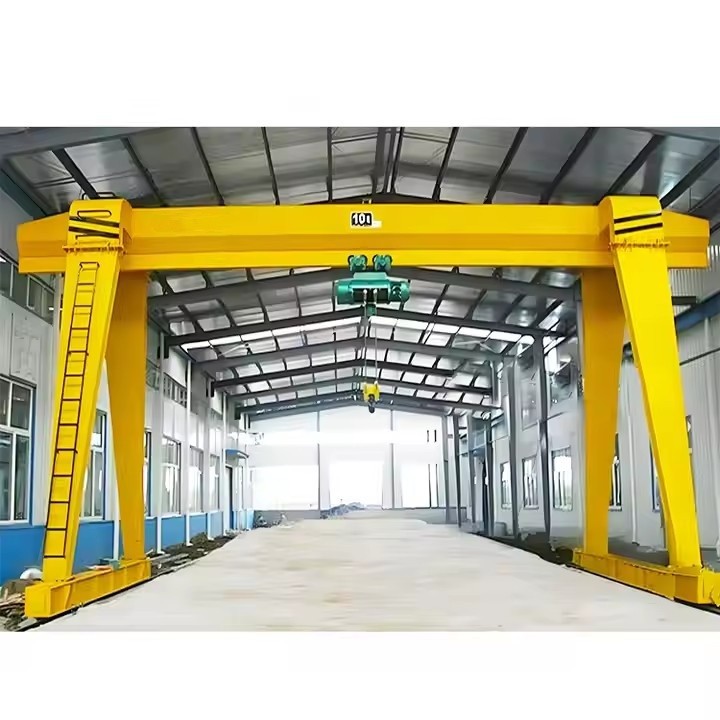


Indoor Single Beam Gantry Crane Component
Products Description
| Feature | Details |
|---|---|
| Design | Single horizontal girder supported by two legs that move along rails or wheels. |
| Lifting Capacity | Typically from 1 to 20 tons (can be customized). |
| Span Range | 3 to 20 meters, depending on workshop layout. |
| Height | Compact design suitable for low-ceiling workshops. |
| Travel Type | Can be rail-mounted (indoor tracks) or rubber-tyred (mobile). |
| Lifting Mechanism | Usually equipped with an electric chain hoist or wire rope hoist. |
| Operation | Controlled via pendant control, remote control, or cab. |
Case Studies & Innovations
Place of Origin:Henan, China
Warranty:2 years
Weight (KG):60000 kg
Video outgoing-inspection:Provided
Machinery Test Report:Provided
Application:warehouses,factory and other place
Crane type:box type gantry crane
Travelling speed:20m/min
Lifting mechanism:Electric Hoist
Control method:Ground Control+ Remote Control (customized)
Working duty:A5
Working Temperature:-20~+40℃
Industrial voltage:380V50HZ3Phanse or other
Color:Customised
Customization:Accepted

Pictures & Components
An Indoor Single Beam Gantry Crane is a practical lifting solution for light to medium-duty material handling inside workshops or warehouses. Its design is compact, yet highly functional, and composed of essential structural and mechanical components that work together to provide smooth, safe, and precise lifting.
1. Single Girder (Main Beam)
The horizontal beam that spans the gap and supports the hoist/trolley. Built from box-type or I-beam structure for strength and lightness.


2. Support Legs (Gantry Legs)
Two vertical columns that connect the girder to the base. They bear the vertical load and allow crane travel along the ground.
3. End Carriages / Wheels
Located at the bottom of the legs. May include steel wheels (for rail travel) or rubber wheels (for mobile type). Allow crane to move longitudinally.


4. Electric Hoist / Trolley
The lifting mechanism mounted on the girder. Can be an electric chain hoist or wire rope hoist, depending on capacity. Moves horizontally across the beam.

5. Electrical System
Includes power lines, control cables, circuit breakers, motor starters, and limit switches. Powers all movement and safety systems.
6. Control Unit
Operated via pendant control, remote control, or cab control. Controls the lifting, trolley movement, and crane travel.

7. Power Supply
Electric power via cable reel, festoon system, or sliding wire depending on layout.
8. Limit Switches
Safety devices to prevent over-travel of the hoist, trolley, or crane itself. Helps avoid collisions or mechanical damage.

9. Buffers / End
Stops Installed at the ends of crane travel range to absorb impact and prevent overrun.
10. Travel Drives (Motorized Wheels)
Motors for moving the gantry along the rails or floor. Typically variable-speed motors with brakes.
.
11. Adjustable Base Plates / Rails
For fixed installation, the crane may move on embedded rails; for mobile types, adjustable legs and outriggers may be added.

Optional Components
Rubber tyres with steering for mobile version
Frequency inverter (VFD) for speed control
Anti-collision sensors
Load limiters / Overload protection
Rotating hook or double-speed hoist
Lighting or warning alarms

Sketch

Main technical

Advantages
Lightweight & Compact
Ideal for workshops with limited space or lower ceiling height.
Easy Installation
No need for building columns or roof beams-just floor-mounted rails or freestanding.
Cost-Effective
Lower cost than a double girder or full overhead crane system.
Easy Maintenance
Fewer components make maintenance simple and affordable.
Flexible Movement
Can be relocated or adjusted as needed within the facility.
Precise Handling
Suitable for assembly lines, machining areas, and light-duty production.
Application:
Machinery Workshops
Loading/unloading parts and equipment.
Warehouses
Handling goods between shelves, trucks, and pallets.
Assembly Lines
Assisting with part positioning and tool handling.
Mold & Tool Shops
Lifting heavy molds or jigs.
Maintenance Bays
Servicing large equipment and vehicles.
Fabrication Plants
Moving steel plates, pipes, or components.
Crane production procedure
1. Requirement Analysis & Technical Design
Client Consultation: Understand the customer's specific needs (load capacity, span, lifting height, working environment, control system, safety features).
Site Assessment: Evaluate the installation site, environmental conditions, and any special constraints.
Engineering Design:
Develop detailed 3D CAD drawings and structural calculations for the girder, end carriages, trolley, hoist, and electric systems.
Customize components such as motors, brakes, control panels, and safety devices based on project specifications.
Ensure compliance with international standards (ISO, FEM, CMAA, etc.).
2. Material Procurement
Steel Structure Materials: Source high-quality steel plates, beams, and profiles (Q235B/Q355B or equivalent) for the girder and frame.
Electrical & Mechanical Components: Purchase motors, gearboxes, brakes, hoists, control panels, limit switches, cables, and other electrical components from approved suppliers.
Specialty Items: Order additional customized parts (e.g., explosion-proof motors, stainless steel components, or corrosion-resistant finishes if needed).
3. Steel Structure Fabrication
Cutting: Use CNC cutting machines or laser cutters to process steel plates and profiles according to design specifications.
Beveling: Perform edge preparation for welding using beveling machines.
Welding:
Weld the main girder, end carriages, and other structural components according to certified welding procedures.
Conduct weld inspections (visual inspection, ultrasonic or X-ray testing if required).
Straightening: Use hydraulic presses to ensure the girder and frame are straight and dimensionally accurate.
Machining: Machine key connection points (e.g., wheel bases, trolley rails) for precise assembly.
4. Surface Treatment
Sandblasting/Shot Blasting: Remove rust, scale, and surface impurities from the steel structure to achieve SA2.5 or better surface grade.
Painting/Coating:
Apply primer and finishing coats based on the environmental working conditions (e.g., marine-grade paint for outdoor cranes).
Optional: Apply anti-corrosion, anti-static, or explosion-proof coatings depending on the client's requirements.
5. Component Assembly
Hoist & Trolley Assembly:
Assemble the electric hoist and trolley system, including motors, gear reducers, wire ropes or chains, and hook blocks.
Pre-install limit switches, brakes, and cable reels.
End Carriage Assembly:
Install traveling wheels, bearings, buffers, and drives onto the end carriages.
Electrical Wiring:
Pre-wire key components (e.g., hoist motor, trolley motor) in accordance with the electrical layout.
Install control systems, power supply cables, festoon systems, or cable carriers.
6. Pre-Assembly & Trial Fitting
Pre-assemble the girder, end carriages, hoist, trolley, and electrical system at the factory to ensure proper fit and alignment.
Conduct tolerance checks on critical dimensions (e.g., span, wheelbase, and diagonal measurements).
7. Factory Testing (Pre-Delivery Inspection)
Mechanical Testing: Perform no-load and partial-load tests on hoisting, trolley travel, and crane travel systems to verify smooth and reliable operation.
Electrical Testing: Verify proper functioning of motors, control panels, limit switches, alarms, and safety devices.
Safety Inspection:
Overload protection testing.
Emergency stop and brake system verification.
Check for proper function of sound and light alarms.
Note: A third-party inspection can be arranged if required by the client.
8. Disassembly & Packaging
Disassemble major components (girder, trolley, hoist, end carriages) for transport.
Protect all surfaces with anti-corrosion oil or protective wraps.
Use reinforced wooden crates or steel frames for sensitive components like motors, control systems, and electrical parts.
9. Delivery & Logistics
Organize transportation (by truck, rail, or sea) to the customer's site.
Provide detailed installation manuals, electrical diagrams, and operation guides along with the shipment.

Workshop view:
The company has installed an intelligent equipment management platform, and has installed 310 sets (sets) of handling and welding robots. After the completion of the plan, there will be more than 500 sets (sets), and the equipment networking rate will reach 95%. 32 welding lines have been put into use, 50 are planned to be installed, and the automation rate of the entire product line has reached 85%.


Hot Tags: indoor single beam gantry crane component, China indoor single beam gantry crane component manufacturers, suppliers, factory, Grab Overhead Crane, Casting Steel Overhead Crane, Metallurgical Crane, Eot Crane, Railway Wheel, Upper Rotary Electromagnetic Bridge Crane
You Might Also Like


Send Inquiry