







Widely Used 50 Ton Double Girder Gantry Crane
Products Description
1.Double Main Girders:
Fabricated from high-strength steel.
Box-type or I-beam welded construction.
Provide superior load-carrying capacity and reduced deflection.
2.End Carriages:
Equipped with motor-driven wheels to allow gantry movement on ground rails.
Trolley with Winch Hoist:
Moves along the main girders.
Equipped with a heavy-duty winch for lifting 50 tons safely and efficiently.
3.Supporting Legs (A-frame or L-type):
Connected to wheels at the bottom.
Provide stability and mobility.
4.Crane Wheels:
Forged steel with heat treatment for wear resistance.
Often driven by a motor-reduction gear system.
5.Control Cabin (optional):
Fully enclosed with HVAC and ergonomic controls.
Offers excellent visibility for safe operation.
Core Components:Engine, Bearing, Gearbox, Motor, Gear
Place of Origin:Henan, China
Warranty:2 years
Weight (KG):50000 kg
Video outgoing-inspection:Provided
Machinery Test Report:Provided
Application:Outdoor
Keywords:Gantry Crane
Rated Loading Capacity:50Ton
Cross travelling speed:44.6m/min
Long travelling speed:47.1m/min
Control way:cabin
Power supply:Cable reel
Steel track:QU80
Power:3-phase AC 50HZ 380V

Pictures & Components
1.Main beam
1)Structure and Design
Double girder configuration: Two parallel girders span the width of the crane, providing greater strength and stability than a single girder.
Box-type beam construction (most common):
Made of high-strength Q345B/Q235B steel plates.
Welded to form a rigid hollow box section.
Offers excellent torsional and bending resistance.
May also be of truss-type (for long spans with lower weight demands), though box beams are standard for 50-ton applications.
2)Functions
Supports the trolley and hoist that moves along its length.
Transfers vertical and horizontal loads to the legs and end carriages.
Ensures the trolley operates smoothly along the rail mounted on top or side of the beam.
3)Trolley Rail
Hardened steel rails are precisely aligned and mounted on top of the beam for trolley travel.
Can be welded or bolted, depending on design.
4)Fabrication and Quality Control
Automatic submerged arc welding ensures consistent weld quality.
Non-destructive testing (NDT) is applied to critical welds.
Beams are stress-relieved and straightened after welding to prevent deformation.
Shot blasting is applied to remove surface rust before painting.
5)Surface Treatment
Corrosion-resistant epoxy primer and polyurethane finish paint.
Optional zinc-rich primer for marine or coastal environments.
6)Customization Options
Span length, beam height, and steel grade can be tailored.
Additional features like walkways, guardrails, and lighting brackets can be added for maintenance or inspection.
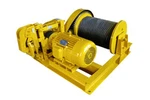
2.Lifting System
The lifting system of a widely used 50-ton double girder gantry crane is the heart of the crane, responsible for the safe, reliable vertical movement of heavy loads. It consists of a winch trolley mounted on top of the double girders, which houses the hoisting mechanism, rope drum, motor, gearbox, hook, and related components.
 |
 |
3.End carriage
1)Structure
Welded box-girder or steel plate construction for high rigidity.
Designed to withstand vertical loads from the main beam and dynamic lateral forces during travel.
Connected rigidly or via bolts to the main girders and support legs (for gantry cranes).
2)Traveling Wheels
Typically equipped with four or eight wheels (depending on load and design).
Forged or cast steel wheels, surface-hardened for durability.
Double-flanged design for accurate rail alignment.
One side often features rail sweeps to keep rails clear of debris.
  |
4.Crane travelling mechanism
The crane traveling mechanism of a widely used 50-ton double girder gantry crane is the system that allows the entire crane structure-including the main beams, trolley, and lifting load-to move along the length of the ground rails. It is essential for positioning the crane above the load or unloading area and is engineered for stability, precision, and heavy-duty performance.
5.Trolley travelling mechanism
The trolley traveling mechanism of a widely used 50-ton double girder gantry crane is the system that enables the trolley-housing the lifting winch and hook assembly-to move horizontally along the length of the crane's main beams. This motion allows precise positioning of the load along the span of the crane.

7.Crane Hook
1)Forged Hook Body
Made of high-strength alloy steel (e.g. 34CrNiMo6).
Drop-forged and heat-treated for maximum durability and toughness.
Designed to handle dynamic and static loads without deformation or failure.
2)Hook Type
Single hook or double hook depending on application.
Typically double-sheave pulley block design for 50-ton capacity to reduce rope tension.
Hook can rotate 360° with thrust bearing, allowing flexible load positioning.

8.Motor
1)Hoisting Motor
High-power squirrel cage or slip ring induction motor
Often equipped with integrated brake for safe load holding
Designed for short-time duty with frequent starts/stops (FEM Class A5–A7)
2)Trolley and Crane Traveling Motors
Compact, helical geared motors (e.g. SEW, Nord, or Chinese equivalents)
Direct drive or coupled via shaft and gear reducer
Controlled by VFD (Variable Frequency Drive) for smooth start/stop and adjustable speed

.
9.Sound and light alarm system & limit switch
The Sound and Light Alarm System and Limit Switches on a widely used 50-ton double girder gantry crane are critical safety and warning components designed to prevent accidents, alert personnel, and ensure precise operational control. These systems help maintain a safe working environment and protect both the crane and surrounding workers.
1)Sound and Light Alarm System
This system provides audible and visual alerts during crane operations, especially during movement or lifting.
2)Limit Switches
Limit switches automatically stop motion to prevent over-travel or mechanical damage.

10.Safety Devices
1)Overload Limiter (Load Limiter)
Prevents the crane from lifting loads beyond its rated capacity (50 tons).
Uses load cells, pressure sensors, or electronic monitoring systems.
Triggers alarm or halts hoisting motion when overload is detected.
2)Limit Switches
Installed on hoisting, trolley, and crane travel systems.
Types include:
Hoist upper/lower limit switch
Trolley travel end limit switch
Crane long travel end limit switch
Prevent over-travel and mechanical collision.
3)Emergency Stop Button
Located on the pendant, cabin, and control panels.
Immediately cuts off power to all crane systems when pressed.
4)Sound and Light Alarm System
Siren and flashing light alert nearby workers when the crane is operating.
Typically activated during lifting or crane movement.
5)Buffer and End Stops
Installed at both ends of crane and trolley tracks.
Polyurethane or rubber bumpers absorb impact and prevent collision.
End stops physically block trolley or crane from running off the rails.
6)Anti-collision Devices (optional)
Infrared or laser sensors detect proximity to other cranes or obstacles.
Prevents collisions in multi-crane bays.
11.Control Mode
1)Cabin Control (Operator Cabin)
Description: The operator is seated inside a cabin mounted on the crane, typically on the gantry structure. This allows for direct and complete control of the crane's functions.
2)Pendant Control (Wired Remote Control)
Description: A handheld wired control device (pendant) connected to the crane via a cable. The operator can stand on the ground and control the crane's functions.
3)Wireless Remote Control
Description: A wireless remote control system allows the operator to control the crane from a distance using radio signals. It offers greater freedom of movement and improved visibility compared to the pendant control.
4)Automatic Control (PLC or Programmable Logic Controller)
Description: In some cases, the crane may be partially or fully automated using a PLC control system. This mode is used for repetitive tasks, allowing the crane to follow pre-programmed routes or movements.
5)Hybrid Control System
Description: A combination of the above control methods. The crane can be operated in manual (operator-driven) mode or switched to automatic control for certain functions.

12.Sketch

Main technical

Advantages
1. High Lifting Capacity
50-ton lifting capacity is ideal for heavy-duty applications, allowing the crane to lift and transport large, cumbersome loads safely and efficiently.
The double girder design ensures superior structural strength, enabling the crane to handle the maximum load without compromising stability.
2. Superior Stability and Durability
The double girder structure distributes the load evenly across the crane, reducing stress on individual components.
Designed for heavy-duty operation, these cranes are built to withstand tough conditions, including extreme temperatures, rough environments, and continuous use.
Durability is enhanced by the robust frame, high-quality steel materials, and advanced design.
3. Wide Span and Height Flexibility
The design of the double girder gantry crane allows for a wide span and variable lifting heights to accommodate different workspace sizes and lifting requirements.
The height adjustment makes it suitable for tall structures or large equipment handling.
4. Improved Lifting Precision
Advanced hoisting and control systems enable precise load positioning, which is crucial in applications like material handling in construction, shipbuilding, or container stacking.
Smooth control systems reduce the risk of load swinging or tipping.
5. Enhanced Safety Features
Overload limiters, limit switches, and safety alarms (sound and light) ensure safe operation, protecting both workers and the crane from mishaps.
The ability to incorporate anti-collision systems or wind speed sensors ensures safety during outdoor operations and multi-crane environments.
6. Efficient and Flexible Operation
Multiple control modes such as pendant, wireless remote, or cabin control offer flexibility and convenience, allowing the operator to select the most efficient mode based on the task.
Variable speed control for hoisting, traveling, and trolley movement allows for smoother operations, reducing mechanical wear and improving overall productivity.
7. Cost-Effective in the Long Run
Low maintenance and long service life due to high-quality components and well-engineered design.
Energy-efficient motors and systems can reduce operational costs over time.
Less downtime for repairs or maintenance due to robust safety systems that prevent overloads and unnecessary strain on the crane.
Application
1. Ports and Shipping Industry
Container Handling: Used to load and unload containers from ships or trucks at container terminals. Its large lifting capacity is ideal for handling heavy shipping containers.
Cargo Movement: Moves bulk cargo, heavy equipment, and machinery between ships, trucks, or storage areas within port terminals.
Shipbuilding and Repairs: Commonly used to move large sections of ships during construction or repair processes, particularly for lifting heavy steel plates and sections.
2. Construction Industry
Material Handling: Frequently used on construction sites to move heavy construction materials such as concrete blocks, steel beams, and prefabricated components.
Heavy Equipment Handling: Lifts and positions large construction equipment, like cranes, excavators, and bulldozers, on-site.
Infrastructure Projects: Used in the construction of large infrastructure projects such as bridges, tunnels, and dams for moving massive machinery and structural components.
3. Steel Plants and Heavy Manufacturing
Steel Mills: Used to lift heavy steel billets, plates, or coils in manufacturing facilities.
Casting and Forging: Handles molds, castings, and forged parts with precision during production.
Machinery and Equipment Handling: Moves heavy machines, tools, or heavy machinery between different stages of production, assembly, or maintenance.
4. Power Plants
Power Equipment Handling: Ideal for lifting and positioning large turbines, generators, and other power plant equipment.
Maintenance and Repair: Assists in the maintenance of power plant components, moving large replacement parts or machinery for repairs.
Installation of Heavy Components: Used to install heavy components such as transformers, motors, and large pipe sections during construction.
5. Shipyards
Ship Assembly: A 50-ton double girder gantry crane is crucial for assembling large sections of ships, especially in shipbuilding facilities where large, heavy parts must be moved and aligned.
Load and Unload Materials: It handles steel plates, parts, and other materials used in ship construction or repair.
Boat Lifting and Dry Docking: Used for lifting boats or small ships for maintenance, cleaning, or painting.
6. Warehouses and Distribution Centers
Storage and Retrieval: In warehouses, this crane is used to move heavy pallets, containers, and storage units in and out of racking systems.
Bulk Material Handling: In distribution centers, it is used for lifting and moving bulk materials from one area to another.
Crane production procedure
1. Design and Engineering
Initial Design and Specifications:
Customer Requirements: The process begins with gathering detailed requirements from the customer, including lifting capacity (50 tons), span, lifting height, and operating environment (indoor, outdoor, temperature conditions, etc.).
Design Specifications: Engineers create detailed design drawings and technical specifications, which include the dimensions of the crane, load-bearing calculations, material selection, and safety features.
Structural Analysis: Structural engineers perform stress analysis to ensure that the crane can safely support the maximum load. Materials such as high-strength steel are selected based on the load requirements.
CAD (Computer-Aided Design):
3D modeling and structural analysis are carried out using advanced CAD software. This allows engineers to visualize the crane's components and perform simulations to ensure proper functionality.
2. Procurement of Materials
Material Selection: High-quality steel, motors, and other components are sourced based on the design specifications.
Steel: Structural steel for the main beam, gantry frame, and other parts is typically high-strength steel to ensure durability and load-bearing capacity.
Motors and Electrical Components: Motors for hoisting, traveling, and trolley movement are sourced from trusted suppliers, as well as other electrical components such as limit switches, sensors, and control systems.
Welding Consumables: Appropriate welding rods, flux, and other consumables are selected based on the welding requirements.
Component Procurement:
Other components, including crane wheels, hooks, ropes, and control systems, are sourced. These may be procured from specialized manufacturers or suppliers.
3. Fabrication and Manufacturing
Cutting and Shaping:
The steel plates are cut, shaped, and processed using CNC machines and plasma cutters to meet the required dimensions.
Main Beam: The main beam is fabricated from high-strength steel plates and welded together to form a rigid structure capable of carrying heavy loads.
Welding and Assembly:
Gantry Frame: The double girder gantry frame is welded together. The frame is designed to be robust and resistant to bending under heavy load conditions.
Girder Assembly: The upper and lower beams are welded or bolted together, ensuring precise alignment to avoid any misalignment that could affect crane operation.
Trolley and Hoist Assembly: The hoist unit is assembled, including the motor, gears, and drum for lifting. The trolley, which moves along the girder, is also assembled during this stage.
Machining:
Critical components such as wheels, hoist drums, and axle shafts are machined to high tolerances to ensure smooth operation and durability.
4. Component Assembly
End Carriage: The end carriage, which allows the crane to travel along the runway beams, is assembled. This includes the wheels, motors, and gearboxes.
Hook and Lifting Mechanism: The crane's hook is installed, and the lifting mechanism is checked for smooth operation. The ropes, drum, and hook block are assembled and tested to ensure proper load-bearing capacity.
Electrical Systems and Wiring:
Wiring for the crane's electrical components (motors, control systems, limit switches) is installed.
Control panels, including the pendant or cabin controls, are mounted and wired according to the design specifications.
5. Painting and Surface Treatment
Surface Cleaning: All metal parts are cleaned and treated to remove any rust, dirt, or contaminants before painting.
Painting: The crane components are painted with a corrosion-resistant coating to protect them from the elements (especially for outdoor cranes). The paint process may involve:
Primer: Applied to ensure adhesion and corrosion resistance.
Top Coating: A durable topcoat is applied to protect the crane from environmental conditions like moisture, dust, and harsh weather.
Quality Control: After painting, the crane components are inspected for any defects in the surface finish.
6. Assembly and Installation
Main Frame Assembly: The main girder, end carriage, trolley, and hoist are assembled into the final structure. The crane frame is carefully aligned to ensure proper weight distribution.
Installation of Safety Features: All safety devices (limit switches, overload protection, anti-collision systems, etc.) are installed and tested.
Electrical and Control System Integration: The electrical control systems, including the motor drives, limit switches, and wireless control systems (if applicable), are integrated into the crane structure.
7. Testing and Quality Assurance
Pre-Assembly Testing: Individual components such as motors, electrical systems, and hoists are tested for functionality before final assembly.
Load Testing: The crane is tested with load weights up to its rated capacity (50 tons) to ensure that all components perform correctly under stress. During this phase, any adjustments needed for alignment, tension, or balance are made.
Functionality Testing: The crane is tested for all its movements:
Hoisting: Lifting and lowering of loads.
Trolley and Crane Movement: Movement along the beams, both horizontally and vertically.
Control Systems: Ensuring smooth operation of all control modes (manual, remote, or automatic).
Safety Systems Testing: All safety systems (emergency stops, overload limiters, alarms, etc.) are tested to ensure they activate correctly in case of a fault or overload.
8. Packaging and Delivery
Disassembly and Packing: Once testing is complete, the crane may be disassembled into parts to facilitate easier transport, especially for large cranes. Components are packed securely to prevent damage during shipping.
Transportation: The crane components are transported to the customer site. Special arrangements are made if the crane is being shipped internationally or needs to be transported via sea or rail.
9. Installation and Commissioning
Site Preparation: The site is prepared with the appropriate crane rails, power supply, and control systems.
Installation: On-site engineers assemble and install the crane, ensuring that all components are properly aligned and secure.
Final Testing and Commissioning: The crane is tested again on-site to ensure it performs as expected, and final adjustments are made.
10. Handover and Training
Training: The customer's operators and maintenance staff are trained on how to safely operate the crane and perform routine maintenance tasks.
Handover: The crane is officially handed over to the customer, and all necessary documentation (manuals, safety guidelines, maintenance schedules) is provided.

Workshop view:
The company has installed an intelligent equipment management platform, and has installed 310 sets (sets) of handling and welding robots. After the completion of the plan, there will be more than 500 sets (sets), and the equipment networking rate will reach 95%. 32 welding lines have been put into use, 50 are planned to be installed, and the automation rate of the entire product line has reached 85%.


Hot Tags: widely used 50 ton double girder gantry crane, China widely used 50 ton double girder gantry crane manufacturers, suppliers, factory
You Might Also Like


Send Inquiry