







Remote Control Type Double Girder Gantry Crane
Products Description
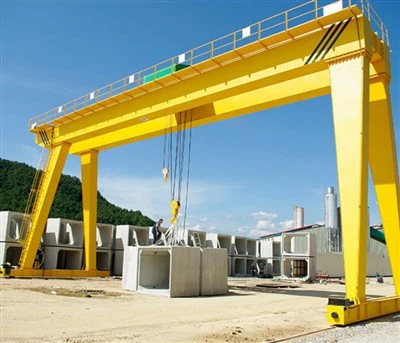
A double girder gantry crane is a gantry crane that has two main girders across the span. It travels on rails or wheels and supports a trolley hoist that moves along the girders. When controlled remotely, it allows the operator to manage crane operations from a safe distance using a radio remote control.
Core Components:Engine, Bearing, Gearbox, Motor, Gear
Place of Origin:Henan, China
Warranty:2 years
Weight (KG):50000 kg
Video outgoing-inspection:Provided
Machinery Test Report:Provided
Application:Outdoor
Keywords:Gantry Crane
Rated Loading Capacity:50Ton
Cross travelling speed:44.6m/min
Long travelling speed:47.1m/min
Control way:cabin
Power supply:Cable reel
Steel track:QU80
Power:3-phase AC 50HZ 380V

Pictures & Components
1.Main beam
Structure
Box-type design or welded I-beam (box girder is more common for heavy loads).
Made of high-strength structural steel (usually Q235B or Q345B).
Welded and reinforced to handle high bending stress and torsional loads.
Designed to support a trolley hoist that travels on top of the girders.
Configuration
Two main beams are connected at both ends by end carriages and supported by gantry legs.
Each main beam includes:
Rails on top for the trolley/hoist to run.
Cable trays or festoon systems to carry electrical cables.
Often includes walkways and maintenance platforms on one or both beams.
2.Lifting System
1)Trolley Hoist (Lifting Trolley)
The core of the lifting system, mounted on rails on top of the double girders.
Moves horizontally along the girders to position the hook above the load.
Contains the hoisting mechanism, including the motor, gearbox, drum, rope, and hook.
2)Hoisting Mechanism
This is the part inside the trolley responsible for actual lifting/lowering of loads.
Hoist Motor:
Drives the lifting motion.
Usually a heavy-duty squirrel cage motor or slip-ring motor.
Equipped with brake system for safety.
Gearbox / Reducer:
Reduces motor speed and increases torque.
Ensures smooth lifting even under heavy loads.
Wire Rope Drum:
Wound with steel wire rope.
Converts rotational motion into vertical movement.
Wire Rope:
High-strength steel cable that connects to the hook block.
Grooved drum prevents rope overlap.
Hook Block:
Carries the hook and pulley system.
Rotating hook with safety latch.
May have single or double reeving depending on capacity.
Limit Switches:
Prevent over-lifting or over-lowering.
Essential for safe operation.
 |
 |
3.End carriage
The end carriages are horizontal steel structures located at both ends of the gantry crane. They support the main beams (girders) and house the traveling mechanism, allowing the whole crane to move back and forth along its working area.
  |
4.Crane travelling mechanism
The crane traveling system of a remote control type double girder gantry crane is the mechanism that enables the entire crane structure (including girders, trolley, and legs) to move along the runway rails laid on the ground. This system is essential for positioning the crane over the load handling area.
5.Trolley travelling mechanism
The trolley traveling system of a remote control type double girder gantry crane is responsible for the horizontal movement of the trolley hoist along the top of the two main girders. This allows the crane to precisely position the lifting hook over the load.

7.Crane Hook
The hook of a remote control type double girder gantry crane is the primary load-handling device, responsible for safely attaching to and lifting the load. It is a critical component of the crane's lifting mechanism, engineered for strength, durability, and safety.

8.Motor
1)Hoisting Motor
Drives the lifting and lowering of loads.
Usually a three-phase squirrel cage induction motor or slip ring motor.
Equipped with a brake system to hold the load in place when the motor is off.
Often paired with a gear reducer for torque multiplication and speed reduction.
2)Trolley Traveling Motor
Powers the movement of the trolley along the girders.
Typically smaller than the hoisting motor but designed for precision control.
Often uses a Variable Frequency Drive (VFD) for smooth acceleration/deceleration.
3)Crane Traveling Motor
Powers the movement of the entire crane along the runway rails.
Usually consists of two motors, one on each end carriage.
High torque, moderate speed motor.
Controlled via remote control with VFD for smooth, precise motion.

.
9.Sound and light alarm system & limit switch
1)Sound and Light Alarm System
Purpose:
To alert nearby personnel about crane operations for safety.
Warn of crane movement, lifting operations, and potential hazards.
2)Limit Switch System
Purpose:
To prevent crane or trolley overtravel and overhoisting/overlowering.
Acts as a safety interlock that stops motion before damage or accident occurs.

10.Safety Devices
1)Overload Protection Device (Load Limiter)
Monitors the load weight in real-time.
Prevents the crane from lifting loads exceeding its rated capacity.
Automatically stops the hoisting motion and sounds an alarm if overload is detected.
2)Upper and Lower Limit Switches
Upper limit switch: Stops the hoist from raising the hook too high, preventing damage to the crane.
Lower limit switch: Prevents the hook from lowering beyond the safe point, avoiding collision with the ground or structure.
3)Travel Limit Switches
Installed at the ends of the crane runway rails to prevent the crane from traveling beyond its designated area.
Similarly, trolley travel limit switches stop the trolley at the ends of the girders.
4)Emergency Stop Switches
Located on the remote control transmitter and on the crane itself.
Immediately cuts power to motors and brakes all movements to stop the crane in an emergency.
5)Anti-collision Devices
Used especially where multiple cranes operate on the same runway.
Detects proximity to other cranes or obstacles and stops or slows the crane to avoid collision.
6)Crane Anti-sway Control
Reduces swinging of the load during traveling and trolley movement.
Helps stabilize the load to improve safety and precision.
7)Brake System
Electromagnetic or hydraulic brakes on hoisting, trolley, and traveling motors.
Automatically engaged during power failure to hold the load safely.
11.Control Mode
1)Wireless Remote Control
The most common control mode for remote control gantry cranes.
Operator controls the crane wirelessly via a handheld transmitter.
Features include:
Buttons or joysticks to control hoisting, trolley traveling, and crane traveling.
Emergency stop button on the remote.
Adjustable speed control via variable frequency drives (VFD).
Benefits:
Allows the operator to move freely around the working area for better visibility and safety.
Eliminates the need for a cab, reducing crane weight and cost.
Reduces operator fatigue.
2)Cabin Control
Operator sits inside a cab mounted on the crane structure.
Controls via joysticks, pedals, or buttons.
Used when:
Large or heavy loads require precise control.
Visibility from the ground is limited.
Cabin may have air conditioning, safety glass, and ergonomic seats.
3)Pendant Control
Wired control station suspended near the crane.
Operator stands nearby holding a control pendant.
Provides direct control with physical buttons and switches.
Usually used in smaller or simpler gantry cranes.
4)PLC / Automated Control
For advanced cranes with automation features.
Programmed via a Programmable Logic Controller (PLC).
Supports semi-automatic or fully automatic operation, such as:
Predefined travel paths.
Load positioning.
Anti-sway control.
Remote control may still be used for manual override.

12.Sketch

Main technical

Advantages
1. Improved Safety
Operator controls crane remotely, keeping a safe distance from the load and crane operation zone.
Reduces risk of accidents caused by operator fatigue or limited visibility.
Emergency stop and safety devices are integrated into the remote system.
2. Enhanced Operator Mobility and Visibility
Operator can move freely around the worksite for better load positioning and observation.
No need for a fixed cab, allowing optimal vantage points depending on the task.
Ideal for complex or large work areas.
3. Higher Load Capacity and Stability
Double girder design supports heavier loads compared to single girder cranes.
More robust structure results in improved stability and longer crane life.
4. Flexible Installation and Operation
Can be installed indoors or outdoors.
Suitable for various industries: shipyards, steel mills, warehouses, construction sites.
Remote control allows operation in harsh or hazardous environments without exposing operators.
5. Cost Savings
Eliminates the need for operator cabins, reducing manufacturing and maintenance costs.
Reduces labor costs by enabling one operator to control multiple cranes (in some setups).
Lower power consumption through optimized motor control and VFDs.
6. Precision and Efficiency
Remote control with variable frequency drives allows smooth, precise movements.
Reduces load sway and improves positioning accuracy.
Enhances workflow speed and productivity.
Application
1. Heavy Manufacturing and Fabrication
Handling heavy steel structures, large machine parts, and fabricated assemblies.
Used in factories for moving bulky components during production.
2. Shipyards and Ports
Loading and unloading heavy cargo containers, ship parts, and equipment.
Facilitates safe operation in large open spaces with remote control flexibility.
3. Steel Mills and Metal Processing Plants
Transporting heavy coils, slabs, ingots, and steel plates.
Double girder design supports very heavy loads typical in steel processing.
4. Construction Sites
Lifting and moving heavy building materials, precast concrete segments, and structural steel.
Remote control allows safe operation around active construction zones.
5. Warehousing and Logistics Centers
Moving heavy pallets, containers, or equipment within large warehouses.
Enables precise load positioning in tight spaces.
6. Power Plants and Heavy Equipment Maintenance
Handling heavy turbines, generators, transformers, and large machinery parts.
Remote control enhances safety in high-risk maintenance areas.
7. Rail Yards and Automotive Industry
Moving large automotive parts, engines, and rail components.
Supports high throughput and repetitive handling tasks.
Crane production procedure
1. Requirement Analysis & Design
Collect client requirements: load capacity, span, lift height, working environment.
Conduct structural and mechanical design of crane components:
Double girder main beam
End carriages
Hoisting mechanism
Traveling and trolley systems
Remote control integration
Prepare detailed engineering drawings and 3D models.
Perform stress and safety calculations.
Confirm design with client and regulatory compliance.
2. Material Procurement
Source high-quality raw materials: steel plates, structural steel profiles, motors, electrical components.
Ensure materials meet standards (e.g., ASTM, EN, GB).
Purchase remote control system, limit switches, safety devices.
3. Fabrication
Cut steel plates and profiles according to design dimensions.
Assemble main girders using welding, bolting, and riveting.
Fabricate end carriages, trolley frames, hook assemblies.
Ensure welding quality through inspections (e.g., ultrasonic testing, visual checks).
Apply anti-corrosion treatments (painting, galvanizing).
4. Machining and Assembly of Components
Machine parts such as wheels, shafts, gears, and couplings.
Assemble hoisting mechanisms, including motor, gearbox, drum, and wire ropes.
Assemble trolley traveling and crane traveling mechanisms.
Install brakes, limit switches, and electrical wiring.
5. Electrical System Integration
Install motors, variable frequency drives (VFD), control panels.
Connect remote control receivers and safety devices.
Perform wiring and cable routing with proper insulation and protection.
6. Testing and Quality Control
Conduct static and dynamic load tests to verify lifting capacity and safety.
Perform functional tests of all mechanical and electrical systems.
Test remote control responsiveness and safety interlocks.
Inspect alignment, travel smoothness, brake functionality.
Quality assurance checks and certification.
7. Packaging and Shipping
Disassemble components if required for transport.
Protect components with packaging materials to prevent damage.
Arrange transportation logistics (road, sea, or air).
8. Installation and Commissioning (usually onsite)
Assemble crane on client site, including girders, end carriages, trolley, and hoisting mechanism.
Connect electrical systems and test controls.
Perform load test and safety inspection at the installation site.
Train client operators on remote control and safety procedures.
9. After-Sales Support
Provide operation manuals and maintenance guides.
Offer technical support and spare parts supply.
Schedule regular maintenance and inspection services.

Workshop view:
The company has installed an intelligent equipment management platform, and has installed 310 sets (sets) of handling and welding robots. After the completion of the plan, there will be more than 500 sets (sets), and the equipment networking rate will reach 95%. 32 welding lines have been put into use, 50 are planned to be installed, and the automation rate of the entire product line has reached 85%.


Hot Tags: remote control type double girder gantry crane, China remote control type double girder gantry crane manufacturers, suppliers, factory, Electromagnetic Overhead Crane, Gantry Crane, Forged Part, Casting Steel Overhead Crane, Steel Mill Overhead Cranes, Single Girder Overhead Crane Company
You Might Also Like


Send Inquiry