










Mobile Crane Gantry
Products Description
Types of Mobile Gantry Cranes:
Rubber-Tired Gantry (RTG) Cranes
Commonly used in container terminals and heavy industry.
Large, powered by diesel or electric motors.
Can perform steering maneuvers such as 90-degree turns or crab steering.
Portable Gantry Cranes
Smaller, often made of aluminum or steel.
Ideal for workshops, warehouses, and maintenance tasks.
Can be manually moved and adjusted in height.
Adjustable Gantry Cranes
Feature variable height and width settings for different lifting requirements.
Used in automotive, aviation, and construction industries.
Product Overview
Key Features & Components:
Gantry Frame – The main structure consisting of vertical supports and a horizontal beam.
Hoisting Mechanism – Includes an electric or manual hoist for lifting loads.
Mobility System – Equipped with rubber tires or wheels for movement.
Power System – Can be diesel, electric, or battery-powered.
Control System – Manual, remote, or automated operation options.
Core Components PLC, Bearing, Gearbox, Motor, Gear
Place of Origin Henan, China
Warranty 1.5 years
Weight (KG) 12000 kg
Application workshop,widely
Lifting mechanism Electric Winch Trolley
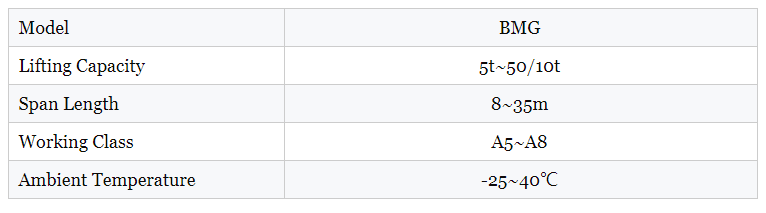
Span 8m~35m
Power Source 3 Phase 380V 50hz
Working Duty A5-A8
Color Customer Requirements
Crane feature Safety
After-sales Service Provided Online Support
Pictures & Components
Gantry Frame
The main structure that supports the entire crane. It includes:
Main Beam (Girder): The horizontal structure that holds the hoist.
Legs (Support Columns): Vertical supports that connect the beam to the base.
Cross Bracing: Reinforces the frame for added stability.

Hoisting System ⚙️
Responsible for lifting and lowering loads. It includes:
Hoist Motor: Powers the lifting mechanism. Can be electric, hydraulic, or manual.
Wire Rope or Chain: Connects the hoist to the load.
Lifting Hook or Spreader Bar: Attaches to the load for lifting.

3.End carriage
1) Key Features of the End Carriage:Design:Two Types:Runway End: Installed on the elevated runway or track supported by a building structure.
Ground Rail End: Installed on the gantry leg, running along the ground rail.The design ensures the crane's balanced operation by allowing one side to move on a runway while the other operates on a floor-level rail.
Material:Constructed using high-strength steel for durability and stability.Reinforced to handle the dynamic forces generated during crane movement and load lifting.
Wheel Assembly:Includes forged steel wheels for high load capacity and wear resistance.Wheels are mounted on precision bearings to reduce friction and ensure smooth operation.The wheels on the ground rail end typically include a flanged design to prevent derailment.
Drive Mechanism:The end carriage is powered by an electric motor with a gearbox.Includes variable frequency drives (VFD) for smooth acceleration and deceleration, reducing wear and tear.

Mobility System 🚜
Allows the crane to move within the work area. Components include:
Rubber Tires or Caster Wheels: Enables smooth movement. Can have steering and locking mechanisms.
Steering System: Some models have motorized steering for maneuverability.
Drive Motors (for Powered Cranes): Electric or diesel-powered motors drive movement.
Trolley travelling mechanism
Key Components of the Trolley Traveling Mechanism:Trolley (Hoist Trolley):The trolley itself is mounted on rails or tracks on the main beam and carries the hoist (which is used to lift and lower the load).The trolley moves horizontally along the beam to position the hoist and load.
Drive System:The trolley's movement is powered by an electric motor (either DC or AC) that drives the wheels connected to the trolley.The motor is often paired with a gearbox and sometimes a variable frequency drive (VFD) to control speed, acceleration, and deceleration for precise movements.
Rail System:The trolley moves along a rail system fixed to the main beam. The rail is typically mounted on the top, bottom, or side of the beam, depending on the crane design.These rails are designed to ensure smooth and stable movement of the trolley and hoist, with minimal friction.
Motor and Brake:The motor powers the trolley's movement, while an integrated braking system (such as an electromagnetic brake) ensures that the trolley can be stopped quickly and safely when needed.Braking systems prevent the trolley from overshooting or swaying excessively, especially during precise positioning.
Positioning Sensors:Some semi gantry cranes include position sensors or limit switches to detect the trolley's location along the beam, ensuring it doesn't exceed travel limits.
6.Crane wheel
1) Key Components and Features of Semi Gantry Crane Wheels:Wheel Material:The wheels are typically made from high-strength steel or forged steel to ensure durability, load-bearing capacity, and resistance to wear.Alloy steel wheels may also be used in some cases for added toughness, especially in harsh environments.
2) Wheel Type:Flanged Wheels: Most semi gantry cranes use Flanged wheels, which have a raised lip around the edge to keep them securely on the rail track. This feature helps prevent derailment, ensuring safe and stable operation.Plain Wheels: Less common, but in some specific crane setups, plain wheels may be used if derailing is not a concern.
3)Wheel Design:Wheels typically feature a cylindrical shape with a curved tread to provide optimal contact with the rails. This design reduces wear and tear on both the wheels and the rails.The wheels often have grooved treads to fit specific track profiles, which can vary depending on the type of rails used.
4)Bearings:The wheels are mounted on precision bearings to reduce friction, ensuring smooth movement of the crane along the rails. Bearings also help to minimize the wear and tear on the wheels and improve overall efficiency.Depending on the design, roller bearings or ball bearings may be used, depending on the load capacity and speed requirements.

7.Crane Hook
1)Key Components of the Crane Hook:Hook Body (Hook Frame):The main structure of the hook is made from high-strength steel or alloy materials, designed to withstand heavy loads.The hook body is the U-shaped or C-shaped part of the hook where the load is secured. It features a narrow throat where the lifting sling, chain, or rope is attached.
2)Safety Latch:Many crane hooks are equipped with a safety latch or safety catch to prevent the lifting sling, chain, or rope from accidentally slipping off the hook during the lifting operation.The latch is spring-loaded or manually operated and can be opened to allow the attachment or removal of the load.
3)Swivel Mechanism:Some crane hooks come with a swivel feature, which allows the hook to rotate freely, preventing the load from twisting during lifting or transport.A rotating hook helps reduce stress on the load and lifting system, especially when lifting long or heavy objects.
4)Load Pin or Shackle:The load pin or shackle is used to secure the lifting sling or chain to the hook. These components are designed to handle heavy forces and ensure that the load is securely attached to the crane.The pin is typically made of hardened steel and is integral to the hook's load-bearing capacity.

Power System ⚡
Supplies energy for lifting and movement. Types include:
Electric (Battery or Wired): Common in warehouses and workshops.
Diesel Engine: Used in large outdoor gantry cranes like RTGs.
Manual Operation: Found in small, lightweight portable gantry cranes.

.
Sound and light alarm system & limit switch
Sound and Light Alarm System:The sound and light alarm system is installed on semi gantry cranes to alert operators and workers about various operational states or potential hazards. These systems improve crane safety by providing visual and audible signals in real time.
Key Features of the Sound and Light Alarm System:Audible Warning (Sound Alarm):The sound alarm is a loud, distinctive noise (such as a horn, siren, or bell) used to alert people in the area about crane operations. It typically sounds during:Crane movement (to warn others of the crane's motion)Load lifting (to alert of load changes)Overload conditions (to signal an unsafe lifting condition)Proximity hazards (if the crane is moving too close to workers or obstacles)
Visual Warning (Light Alarm):The light alarm usually involves the use of flashing lights or strobe lights mounted on the crane. These lights serve as a visual alert, making the crane's actions visible from a distance, especially in noisy or large areas.
Common uses of light alarms include:Indicating when the crane is in operation or moving.Providing warnings about unsafe load conditions or potential mechanical malfunctions.Flashing during emergency situations or crane shutdowns.Signaling specific phases of operation (e.g., crane ready for lifting or lowering).
Integration with Crane Controls:The alarm system is integrated with the crane's control system, meaning the alarms activate automatically in response to certain conditions.
Safety Enhancements:The sound and light alarms serve to:Alert workers to move out of the crane's path, preventing accidental injury.Alert operators when a limit has been reached, reducing the risk of operational mistakes and damage.Provide clear signals during maintenance or testing phases, preventing accidental operation.

Safety Features
Ensures safe operation and prevents accidents. Includes:
Overload Protection Sensors: Prevents lifting loads beyond capacity.
Emergency Stop System: Stops the crane in case of malfunction.
Anti-Sway System: Reduces load movement for stability.
11.Control Mode
1) Manual control: The operator directly controls the various operating mechanisms of the crane through buttons or switches on the manual control panel. Simple operation, suitable for small or short-term operations; can be quickly adjusted according to specific needs.
2) Wireless remote control: The various functions of the crane are controlled by a wireless remote control, and the operator can operate at a safe distance. Improves the flexibility and safety of operation, especially suitable for complex or dangerous working environments.
3) Wired remote control: Operate through the control line connected to the crane, and the operator inputs instructions through a handheld controller. Compared with wireless remote control, the signal is stable and not easily interfered with, which is suitable for operation in a fixed area.
4) Automated control: Automated operation is achieved through PLC (Programmable Logic Controller) or computer system, and the operation of the crane is controlled according to the preset program. Improves the accuracy and consistency of operation, suitable for large-scale and repetitive operations, and reduces interference from human factors.
5) Frequency conversion control: The speed of the motor is adjusted by the frequency converter to achieve precise control of the operating speed of the crane. It can smoothly accelerate and decelerate, improve the safety and efficiency of lifting operations, and reduce the impact on equipment.

12.Sketch

Main technical
Advantages
Advantages of a Mobile Gantry Crane 🚜🏗️
A Mobile Gantry Crane is a highly versatile lifting solution that offers numerous benefits across different industries. Its mobility, flexibility, and cost-effectiveness make it a preferred choice for handling heavy loads.
1. Mobility & Flexibility 🔄
✅ No Fixed Rails Required – Unlike rail-mounted gantry cranes, mobile gantry cranes can move freely across different work areas.
✅ Easy Relocation – Can be repositioned quickly for different lifting tasks.
✅ Multi-Directional Steering – Some models offer 90-degree turns or crab steering for tight spaces.
2. Cost-Effective Solution 💰
✅ Lower Installation Costs – No need for permanent tracks or foundations.
✅ Energy Efficient – Many models operate on electric power, reducing fuel costs.
✅ Less Maintenance – Compared to overhead cranes, mobile gantry cranes have simpler mechanisms, reducing upkeep expenses.
3. Versatile Applications 🏭
✅ Indoor & Outdoor Use – Suitable for warehouses, factories, ports, and construction sites.
✅ Customizable Sizes – Available in different capacities and heights to suit various industries.
✅ Multi-Purpose Handling – Can lift containers, machinery, heavy materials, and precast concrete.
4. High Lifting Capacity ⚙️
✅ Handles Heavy Loads – Can lift from a few tons up to hundreds of tons, depending on the model.
✅ Adjustable Heights & Widths – Some models have telescopic or adjustable legs for different load sizes.
✅ Heavy-Duty Performance – Designed for tough industrial environments like shipyards and manufacturing plants.
5. Enhanced Safety Features 🛑
✅ Load Monitoring Systems – Prevents overload and ensures stable lifting.
✅ Emergency Stop Functions – Allows quick shutdown in case of an emergency.
✅ Anti-Sway & Stability Controls – Reduces load movement for safe operation.
Conclusion
Mobile gantry cranes offer a powerful, cost-effective, and flexible solution for industries that require high mobility and lifting capacity. Whether for container handling, construction, or industrial lifting, they provide an efficient alternative to fixed cranes.
Application
Warehouses and Distribution Centers;Material Handling: Semi gantry cranes are commonly used in warehouses and distribution centers for moving heavy or bulk materials. They help in stacking, unloading, and transporting goods within confined spaces or aisles.Space Efficiency: The compact design of semi gantry cranes allows them to operate in narrow spaces between storage racks or aisles, making them ideal for maximizing
Manufacturing and Production Facilities;Assembly Line Support: In manufacturing environments, semi gantry cranes assist in moving parts, components, and heavy machinery across assembly lines. They can be used to transport materials between workstations or deliver materials to specific areas of production.Heavy Lifting: They are used to lift and position heavy equipment, machinery, or components during the manufacturing or assembly process, such as in industries like automotive, electronics, or metal fabrication.
Steel Mills and Foundries;Lifting Heavy Materials: In steel mills and foundries, semi gantry cranes are used to lift and transport heavy steel products, such as ingots, slabs, and billets, which are typically too large or heavy for traditional lifting equipment.Casting and Mold Handling: These cranes are also employed in casting processes, moving molds, casting containers, and molten materials safely within the facility.
Shipyards and Marine Industry;Shipbuilding: Semi gantry cranes are essential in the construction of large vessels, as they can lift and move ship components such as sections of hulls, heavy machinery, and other materials within shipyards.Maintenance and Repair: These cranes are also used for the maintenance and repair of ships and other marine equipment, where lifting and moving large, heavy components is necessary.Loading/Unloading of Cargo: In ports or shipyards, semi gantry cranes help load and unload materials from ships, containers, or barges
Power Plants and Refineries;Handling Heavy Equipment: Semi gantry cranes are used in power plants, refineries, and other industrial facilities to move heavy components such as turbines, generators, boilers, and other large machinery.Routine Maintenance: These cranes are also useful for ongoing maintenance tasks, including the removal and installation of components during planned shutdowns.Hazardous Material Handling: In refineries, semi gantry cranes are employed to lift and move hazardous materials, ensuring that these processes are carried out safely and efficiently.
Crane production procedure
1. Design stage: Understand the specific needs of customers, including load-bearing capacity, span, height and use environment. Carry out preliminary design according to the needs and draw scheme drawings, including structural design, power system and control system design. Carry out structural strength, stability and dynamic analysis to ensure that the design meets relevant standards and specifications.
2. Material preparation: Select suitable materials according to design requirements, such as high-strength steel, aluminum alloy, etc., to ensure good mechanical properties and durability. Purchase the required raw materials and components according to the design drawings, including motors, reducers, hooks, control systems, etc.
3. Processing and manufacturing: Cut the steel and process the main beam, end beam and other structural parts according to the design dimensions. Connect the cut parts by welding to form the main structural frame of the crane. Finish the welded components, including drilling, turning and milling, to ensure the matching accuracy of each component.
4. Assembly: Preliminary assembly of the processed components to check the stability and matching of the structure. Install the lifting mechanism, trolley running mechanism and trolley running mechanism to ensure that all moving parts can run smoothly.
5. Electrical system installation: Install motors, inverters, control panels and other electrical components to ensure that the electrical system is connected correctly. Arrange the cable lines reasonably to ensure safety and beauty, and reduce interference and wear.
6. Commissioning and testing: Test the various functions of the crane, including lifting, moving, braking and alarm systems, to ensure that all functions are normal. Carry out safe load tests to ensure that the crane operates stably under maximum load and meets safety standards.
7. Inspection and quality control: Carry out quality inspections on each link of production to ensure that all components meet design and standard requirements. Carry out qualification certification according to relevant regulations to ensure that the equipment meets national and industry standards.
8. Delivery and installation: Transport the manufactured crane to the customer site. Install it at the customer site, including fixing the foundation, commissioning and connecting the power supply. Provide operation training to customers to ensure that they can use the equipment safely and effectively, and officially deliver it for use.

Workshop view:
The company has installed an intelligent equipment management platform, and has installed 310 sets (sets) of handling and welding robots. After the completion of the plan, there will be more than 500 sets (sets), and the equipment networking rate will reach 95%. 32 welding lines have been put into use, 50 are planned to be installed, and the automation rate of the entire product line has reached 85%.


Hot Tags: mobile crane gantry, China mobile crane gantry manufacturers, suppliers, factory
You Might Also Like


Send Inquiry