










Rubber Tire Gantry Crane
Products Description
A Rubber Tire Gantry Crane (RTG) is a highly mobile, rubber-tired gantry crane designed for heavy-duty lifting and material handling, primarily in ports, container terminals, shipyards, and large-scale construction projects. Unlike rail-mounted gantry cranes (RMGs), RTGs operate on rubber tires, providing greater flexibility and mobility without the need for fixed tracks.
RTG cranes are versatile, mobile, and powerful, making them ideal for dynamic environments like ports, construction sites, and industrial yards. Their ability to move freely without rails gives them a significant advantage over RMGs in many applications.
Comparison with Other Gantry Cranes
| Feature | Rubber Tire Gantry (RTG) | Rail-Mounted Gantry (RMG) | Straddle Carrier |
|---|---|---|---|
| Mobility | High (rubber tires) | Limited (fixed rails) | Very high (compact) |
| Infrastructure | Minimal (needs paved surface) | Requires rail tracks | Minimal (tire-based) |
| Capacity | 20–1,500+ tons | 30–100+ tons | 10–60 tons |
| Automation | Yes (smart RTGs available) | Yes (common in ports) | Limited |
| Cost | Moderate to high | High (rail installation) | Lower (compact) |
Core Components:Engine, Bearing, Gearbox, Motor, Gear
Place of Origin:Henan, China
Warranty:2 years
Weight (KG):50000 kg
Video outgoing-inspection:Provided
Machinery Test Report:Provided
Application:Outdoor
Keywords:Gantry Crane
Rated Loading Capacity:50Ton
Cross travelling speed:44.6m/min
Long travelling speed:47.1m/min
Control way:cabin
Power supply:Cable reel
Steel track:QU80
Power:3-phase AC 50HZ 380V

Pictures & Components
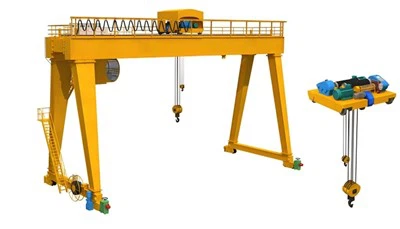
A Rubber Tire Gantry Crane (RTG) consists of several critical components that work together to enable efficient lifting, movement, and load handling. Below is a breakdown of the main structural and mechanical parts:
1. Main Structural Components
Gantry Frame (Bridge Girder)
The primary load-bearing structure, spanning the working area.
Typically made of high-strength steel (box girder or truss design).
Supports the trolley, hoist, and spreader.
 |
 |
Legs (End Carriages)
Vertical supports that hold the gantry frame.
Equipped with rubber tires for mobility.
Some models have hydraulic or mechanical outriggers for stability during lifting.
  |
Trolley & Hoist System
Trolley: Moves horizontally along the gantry beam.
Hoist: The lifting mechanism (wire rope or chain).
Electric or hydraulic motor-driven.
Includes brakes, drums, and sheaves for load control.
Crane wheel
1)Material: Typically made from forged steel or alloy steel with high tensile strength to handle heavy loads and resist wear.
2)Hardness: The wheel tread is usually hardened (heat-treated) to withstand continuous rolling and to reduce surface wear.
3)Type:
Flanged wheels: Prevent derailment by keeping the crane aligned on its rails.
Double-flanged or single-flanged: Depending on rail design and safety requirements.
Flat wheels (less common): Used if guided by external mechanisms.
4)Diameter:
Depends on the crane design, but for a 20-ton double girder goliath crane, wheel diameters generally range from 400 mm to 800 mm.
Bigger diameters are often used to reduce rolling resistance and wear.

Spreader (For Container Handling)
Attaches to the hoist for lifting shipping containers.
Adjustable for 20ft, 40ft, 45ft, and twin-lift operations.
May include twist locks for secure gripping.

2. Mobility & Drive Components
A. Rubber Tires & Wheels
Heavy-duty pneumatic or solid rubber tires.
Steering system (90°, 180°, or 360° steering modes).
Drive wheels (usually 4–16 wheels, depending on load capacity).
B. Drive Motors & Transmission
Electric or hydraulic motors powering the wheels.
Gearboxes & axles for torque distribution.
Regenerative braking (in electric models).
C. Steering System
Manual, hydraulic, or automated steering.
Crab steering (diagonal movement) for tight spaces.

.
Power & Control Systems
A. Power Source
Diesel engine (traditional RTGs).
Electric (cable-reel or battery-powered) for eco-friendly operation.
Hybrid (diesel + electric) for energy efficiency.
B. Control Cabin & Operator Interface
Pendant control, joystick, or remote operation.
Touchscreen panels with load monitoring.
Automated RTGs use PLC & sensor-based controls.
C. Safety & Automation Systems
Load Moment Indicator (LMI) – Prevents overloading.
Anti-sway system – Stabilizes loads during movement.
Collision avoidance sensors (LiDAR, cameras).
Emergency stop & fail-safe brakes.

Optional & Advanced Features
GPS & RFID tracking (for automated container handling).
Self-propelled or towable configurations.
Laser-guided positioning for precision stacking.
Outriggers & stabilizers for extra support.
RTG cranes are complex machines integrating structural strength, mobility, and smart controls. Their modular design allows customization for different industries, from ports to heavy construction.

SKETCH

Main technical

Advantages
Key Advantages of RTG Cranes
1. High Mobility & Flexibility
No fixed rails required – Operates on rubber tires, allowing movement on paved surfaces.
360° steering capability – Can maneuver in tight spaces (unlike Rail-Mounted Gantry Cranes).
Ideal for temporary job sites – Easily relocated without infrastructure changes.
2. Cost-Effective Operation
Lower infrastructure cost – No need for expensive rail tracks.
Energy-efficient options – Hybrid and electric RTGs reduce fuel costs.
Reduced labor dependency – Automated RTGs improve productivity.
3. Strong Lifting Capacity
Handles 20–200+ tons (some heavy-duty models lift up to 1,500 tons).
Wide span coverage (18–48m) for large work areas.
4. Smart & Automated Features
Automated container stacking (in ports).
Anti-sway & load control systems for precision lifting.
Remote monitoring & diagnostics for predictive maintenance.
5. Versatile Applications
Suitable for ports, construction, shipyards, and logistics.
Can be customized with different spreaders and attachments.
Application
Major Applications of RTG Cranes
1. Ports & Container Terminals
Stacking and moving shipping containers (20ft, 40ft, 45ft).
Loading/unloading from trucks and rail cars.
Automated RTGs improve terminal efficiency.
2. Shipbuilding & Heavy Industry
Handling ship blocks, steel plates, and heavy machinery.
Turning and positioning large components in shipyards.
3. Railway & Highway Construction
Lifting precast concrete beams (T-girders).
Transporting heavy materials in bridge and tunnel projects.
4. Wind Energy & Power Plants
Assembling wind turbine towers and blades.
Moving large generators and transformers.
5. Warehousing & Logistics
Handling oversized cargo (steel coils, heavy pallets).
Flexible movement in storage yards.
Crane production procedure
1. Design & Engineering
Client requirements collection (capacity, span, lifting height, duty class).
Structural design of double girders, legs (portal frame), trolley, and hoisting system.
Finite Element Analysis (FEA) for structural integrity and load distribution.
Electrical system design (control panels, VFD, PLC, safety devices).
Final approval of drawings and BOM (Bill of Materials).
2. Raw Material Procurement
Sourcing of high-tensile structural steel (Q345B, Q355B, or equivalent).
Procurement of standard components (motors, gearboxes, brakes, bearings, electrical components, etc.).
Purchasing of special components (limit switches, alarms, rail clamps, etc.).
3. Steel Structure Fabrication
Cutting: CNC plasma or laser cutting of steel plates and profiles.
Beveling & Edge Preparation: For proper welding joints.
Welding:
Welding of double girders (box type or I-beam type).
Welding of gantry legs, end carriages, and trolley frames.
Use of automatic submerged arc welding (SAW) or MIG/MAG processes.
Non-Destructive Testing (NDT):
Ultrasonic testing (UT), Magnetic Particle Inspection (MPI) on welded seams.
Radiographic inspection for critical joints.
4. Machining & Finishing
Machining of wheels, trolley frames, drum shafts, and gearboxes as per tolerances.
Boring & Drilling of assembly holes (e.g., for rail tracks on girders and trolley beams).
Surface Grinding: For contact surfaces (e.g., trolley rail seats on girders).
5. Surface Treatment
Shot blasting of all fabricated steel structures to Sa2.5 standard.
Application of anti-corrosion primer and topcoat painting (e.g., epoxy or polyurethane paint).
Paint thickness typically 80-120 microns depending on site environment (marine, industrial, etc.).
6. Mechanical Assembly
Installation of wheels, end trucks, travel motors, gearboxes, and drive shafts on the gantry legs.
Assembly of trolley/hoist unit, including:
Wire rope drum, hook block, hoisting motor, reducer, brake.
Trolley traveling mechanism (cross travel motor, wheel groups).
Mounting of rail clamps or storm brakes (if outdoor use).
7. Electrical Assembly
Wiring of control panels (MCC and PLC).
Installation of limit switches, overload protection, and emergency stop buttons.
Fitting of cables, cable festoons, or energy chains for trolley power supply.
Integration of VFDs, soft starters, and remote-control systems.
8. Pre-Assembly & Testing in Workshop
Pre-assemble girder and leg structure to ensure accurate bolt alignment.
Function test of trolley travel, hoist, and long travel drive systems.
Testing of limit switches, alarms, emergency stops, and overload protection.
Trial operation using no-load or test loads (typically 25%-100% of rated capacity).
9. Disassembly & Packing
Disassemble into transportable sections (girders, legs, trolley unit, etc.).
Anti-corrosion treatment for mating surfaces.
Pack electrical components and motors in protective crates.
Label all parts for easy re-assembly at the installation site.
10. Delivery & Site Installation
Transport by flatbed trucks or containers.
On-site erection of gantry structure using mobile cranes.
Rail alignment, crane re-assembly, and final commissioning.
11. Load Testing & Commissioning
Conduct static load test (usually 125% of rated load).
Dynamic load test (with 100% load to verify functionality).
Adjustments to brake torque, limit switches, and VFD parameters.
12. Handover & Training
Final inspection with the client.
Provide operation manual, maintenance guide, and training to operators and maintenance staff.

Workshop view:
The company has installed an intelligent equipment management platform, and has installed 310 sets (sets) of handling and welding robots. After the completion of the plan, there will be more than 500 sets (sets), and the equipment networking rate will reach 95%. 32 welding lines have been put into use, 50 are planned to be installed, and the automation rate of the entire product line has reached 85%.


Hot Tags: rubber tire gantry crane, China rubber tire gantry crane manufacturers, suppliers, factory, Double Girder Overhead Travelling Crane, Ladle Foundry and Casting Steel Mill Overhead Crane, Crane Parts, Double Girder Overhead Crane, Single Beam Explosion Proof Overhead Crane, Double Beam Explosion Proof Overhead Crane
Previous
Cantilever Gantry Crane HoistYou Might Also Like



Send Inquiry