









Electric Trackless Gantry Crane
Products Description
Key Advantages
The trackless nature of this crane provides unique benefits:
Ultimate Flexibility and Mobility: Its biggest advantage. It can be used anywhere you have a firm, level floor-inside, outside, between buildings, or across multiple work cells. It is not tied to a fixed runway.
No Installation Cost: There is no need for expensive runway engineering, structural steel support, or installation. You simply position the crane and it's ready to use.
Ideal for Outdoor Use: Perfect for yards, loading areas, and construction sites where installing an overhead runway is impossible or impractical.
Space-Saving: Does not require support from building columns, freeing up the entire layout of a facility.
Cost-Effective for Specific Needs: For a single work cell or a multi-use area, a mobile gantry is far cheaper than installing a full overhead crane system.
Comparison: Trackless Gantry vs. Single Girder Overhead Crane
| Feature | Electric Trackless Gantry Crane | Electric Single Girder Overhead Crane |
|---|---|---|
| Support Structure | Self-supported on its own legs | Supported by the building structure |
| Mobility | High: Moves anywhere on the floor | Fixed: Limited to the runway path |
| Installation | None required; plug-and-play | Significant; requires engineered runway |
| Cost | Lower initial investment for mobility | Higher initial investment (crane + installation) |
| Floor Space | Requires clear floor paths for movement | Uses overhead space; floor is clear |
| Ideal For | Outdoor use, changing layouts, multiple cells | Repetitive tasks in a fixed path, high-use areas |
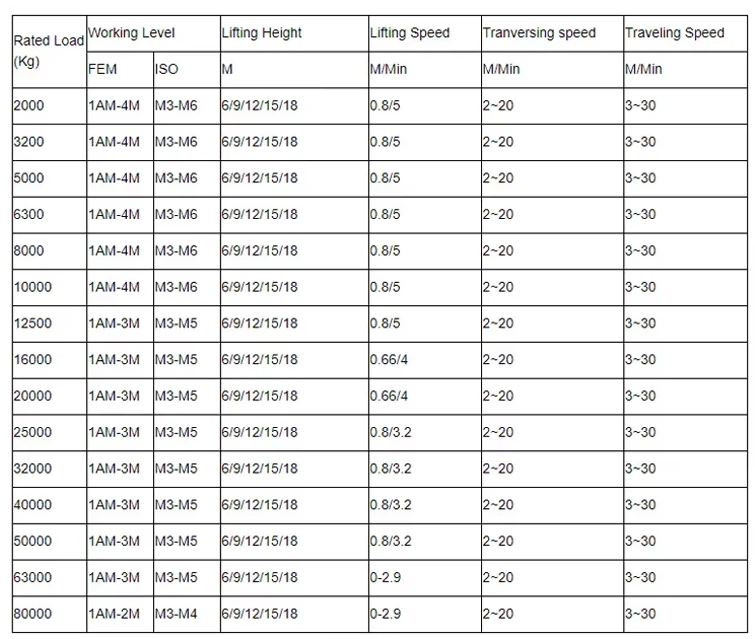
Lifting Capacity 320 tons
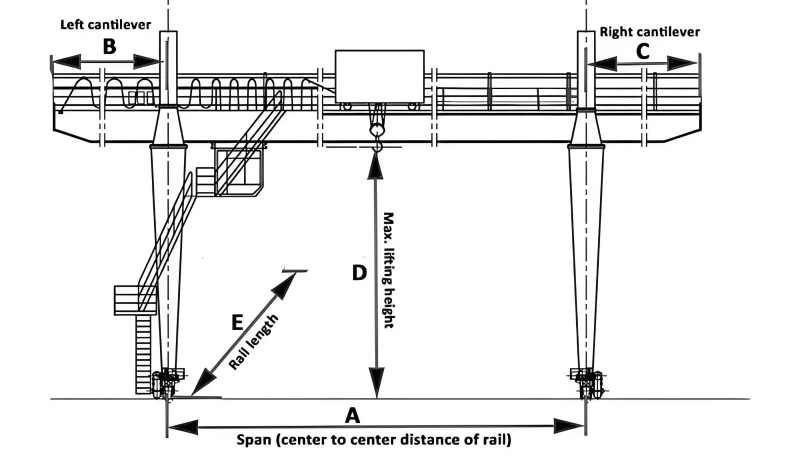
Span (Width) 3 - 12 meters (adjustable)
Lifting Height 3 - 10 meters
Working Class A3-A5 (light to medium duty)
Hoisting Speed 0.5 - 8 m/min (variable)
Main Beam Type Single/double girder (box-type)
Power Supply 220V/380V 3-phase or manual
Control Mode Pendant control/wireless remote
Hoist Type Electric chain hoist/wire rope hoist
Travel Drive Manual push or motorized
Corrosion Protection Hot-dip galvanized or marine-grade paint
Wind Resistance Up to Beaufort scale 6 (for outdoor use)
Operating Temp -20°C to +50°C

Pictures & Componen
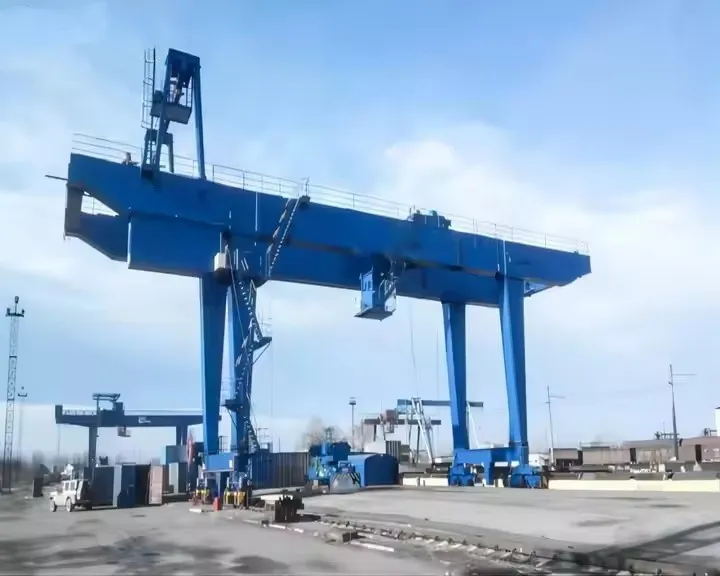
An Electric Trackless Gantry Crane is a self-contained, portable lifting system. Its components are designed for mobility, self-sufficiency, and stability on a floor surface rather than on an elevated runway.
1. Structural Components
These parts form the rigid, load-bearing frame of the crane.
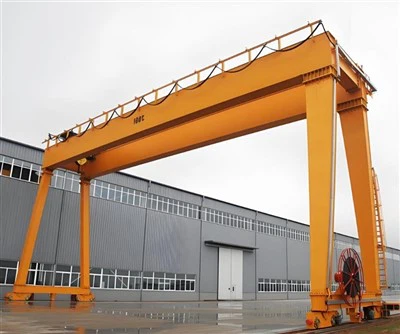
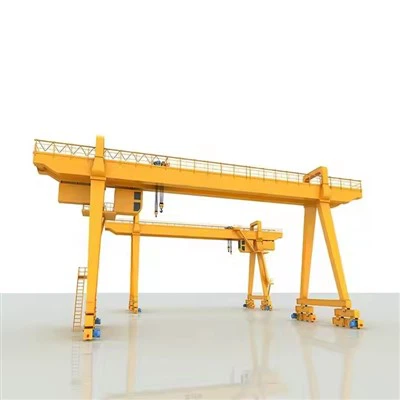
Bridge Girder(s): The primary horizontal beam that spans the work area. It can be a single girder (for lighter capacities) or a double girder (for heavier loads and longer spans). The hoist trolley travels along this girder.
Upright Legs: Two vertical columns that support the bridge girder at each end. Their height determines the lifting height under the hook.
End Trucks (or End Frames): The assemblies that connect the legs to the drive system. They house the wheels, motors, and steering mechanisms.
Cross Braces: Diagonal or horizontal structural members that connect the legs to each other, providing critical rigidity and preventing the frame from racking or twisting during movement and lifting.
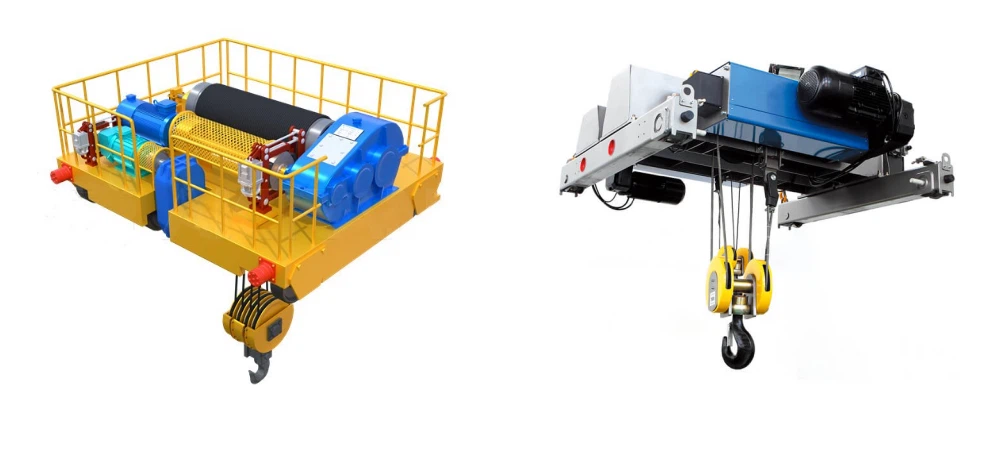
2. Drive and Mobility System
This system enables the crane to move freely across the floor.
Drive Wheels: Powered wheels that provide the motion for the entire crane. Gantry cranes can have drive wheels on one leg (usually with a passive steering leg) or on both legs for more powerful and coordinated movement.
Steer Wheels: Non-powered wheels that can be manually or electrically turned to change the crane's direction. Advanced models have all-wheel power steering controlled remotely.
Drive Motors: Electric motors (often AC or DC) dedicated to powering the drive wheels. They are typically equipped with built-in brakes.

Steering Motors: On more sophisticated models, these motors automatically adjust the angle of the steer wheels based on commands from the remote control.
Floor Locks / Stabilizing Jacks: Perhaps the most critical safety component for a gantry crane. These are mechanical screw-down pads or hydraulic jacks located at the base of each leg. They are deployed before any lift to take the weight off the wheels, stabilize the crane, and prevent any movement during lifting operations.

3. Lifting System
This system is responsible for the actual lifting, lowering, and horizontal movement of the load.
Electric Hoist: The workhorse of the lifting system. It can be a chain hoist (compact, cost-effective for lower capacities) or a wire rope hoist (for higher capacities and speeds). It contains its own motor, braking system, and lifting medium.
Trolley: The assembly that carries the hoist along the length of the bridge girder.
Manual Trolley: Pushed by hand (common on lighter-capacity gantries).
Motorized Trolley: Powered by an electric motor, allowing for precise load positioning via the control system.
Hook Block: The assembly that connects to the load, featuring a swivel hook for easy attachment and alignment.

4. Power System
Since the crane is trackless and mobile, it requires a self-contained power source.
Battery Pack: The most common and flexible solution. A large, rechargeable battery (often 24V, 48V, or 72V DC) is housed on the crane's structure. This allows for completely cordless operation.
Battery Charger: An external unit used to recharge the battery pack when the crane is not in use.
Cable Reel (Alternative to Battery): For applications where the crane operates in a very confined area, a long, heavy-duty power cable on a spring-retracted reel can be used. This is less common due to the trip hazard and limited range.


5. Control and Safety Systems
These systems allow the operator to control the crane safely.
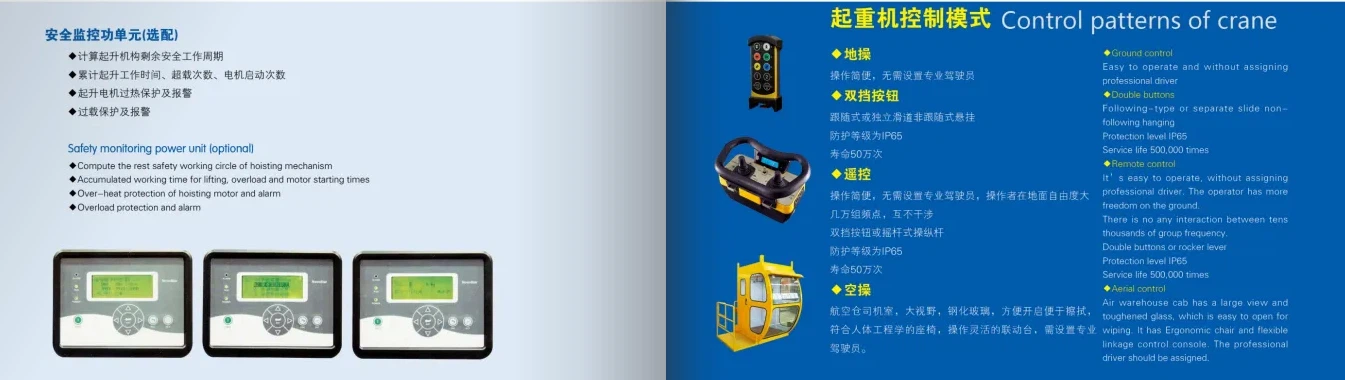
Radio Remote Control: The standard and safest control method. A handheld wireless transmitter allows the operator to control all crane functions-hoist up/down, trolley travel, bridge travel, and steering-from a safe distance with a clear view of the load.
Pendant Control (Less Common): A wired pendant station that hangs from the crane. This limits the operator's mobility and is less safe than a radio remote.
Control Panel / Cabinet: An enclosure on the crane that houses the electrical components: contactors, variable frequency drives (VFDs) for smooth movement, receivers, and programmable logic controllers (PLCs).

Safety Devices:
Overload Limit Switch: Prevents the hoist from lifting a load beyond the crane's rated capacity.
Upper/Lower Limit Switches: Automatically stop the hoist at its maximum safe upper and lower positions.
Emergency Stop Buttons: Located on the control pendant and often on the crane itself for immediate shutdown.
Anti-Collision Sensors: On large systems where multiple gantries might operate, sensors can prevent them from running into each other.
Warning Beacon and Buzzer: Alerts personnel that the crane is in operation.
SKETCH
Main technical
Advantages
The defining feature of a trackless gantry crane is its mobility and self-sufficiency. This leads to a unique set of advantages that fixed cranes cannot offer.
1. Ultimate Flexibility and Mobility
Go-Anywhere Lifting: This is the single biggest advantage. The crane can be used anywhere you have a firm, level floor-inside a workshop, outside in a yard, between buildings, or even across a parking lot. It is not confined to a fixed runway path.
Ideal for Multiple Work Cells: One gantry crane can serve multiple workstations or assembly bays. Simply drive it to where it's needed, eliminating the cost of multiple fixed cranes.
2. No Installation or Infrastructure Cost
Plug-and-Play Operation: There is no need for expensive engineering, reinforced concrete foundations, or the installation of steel runway beams and conductors. This saves significant capital investment, time, and construction disruption.
No Building Modifications: It does not place any load on the building's structure, making it perfect for facilities with roof structures that cannot support a traditional overhead crane.
3. Ideal for Outdoor and Rough Terrain Use
Unconstrained Operation: Perfect for storage yards, shipping ports, construction sites, and lumber yards where a fixed overhead crane is impractical or impossible to install.
Weatherproof Options: Many models are built with weather-resistant components (e.g., IP54 or higher ratings) for reliable performance outdoors.
4. Space Efficiency
Frees Up Overhead Space: It does not require any permanent overhead infrastructure, keeping the ceiling clear for other uses like lighting, ventilation, or piping.
Can Be Moved Aside: When not in use, the crane can be easily moved to a corner or storage area, completely freeing up the floor space for other activities.
5. High Cost-Effectiveness for Variable Needs
Lower Initial Investment: For a single work cell or a multi-use area, a mobile gantry is often far cheaper than designing and installing a full overhead crane system, especially when considering the saved infrastructure costs.
Reusable Asset: If the facility layout changes or the company moves locations, the gantry crane can simply be driven onto a truck and relocated. A fixed crane is a permanent installation.
6. Enhanced Safety with Remote Control
Operator Positioning: Using a radio remote control, the operator can position themselves in the safest possible location with the best view of the load, away from pinch points and potential danger zones.
Stability Systems: Equipped with floor locks or stabilizing jacks that are deployed before lifting, ensuring the crane is solid and immobile during critical operations.
Application
These cranes are the go-to solution for versatile and mobile lifting where fixed infrastructure is absent, impractical, or too expensive.
1. Manufacturing and Assembly
Aerospace: Moving and positioning large, lightweight components like aircraft wings, fuselage sections, and tail assemblies within a hangar.
Automotive: Lifting vehicle frames, engines, and battery packs in assembly lines or prototyping shops where layout flexibility is key.
Machinery Installation: Positioning heavy CNC machines, injection molding machines, and presses on the factory floor.
2. Warehousing, Logistics, and Shipping
Loading Docks: Unloading heavy or awkward items from trucks and containers and moving them to a staging area. One crane can serve multiple dock doors.
Container Handling: Stacking and moving lightweight containers and storage units in a yard.
Staging Areas: Rearranging heavy goods and pallets in a flexible warehouse environment.
3. Construction and Infrastructure
Precast Concrete: Handling and placing concrete panels, beams, and other prefabricated elements on a construction site.
Utilities: Lifting and placing large pipes, pumps, generators, and transformers during installation or maintenance.
4. Maintenance, Repair, and Overhaul (MRO)
Industrial Maintenance: Removing large motors, turbines, gearboxes, and presses for repair. The crane can be brought directly to the malfunctioning equipment.
Shipping and Rail: Engine and wheel assembly changes for locomotives and large vessels in repair bays.
Data Centers: Installing and replacing large, heavy uninterruptible power supplies (UPS) and backup generators.
5. Specialized and General Use
Event Staging: Installing and rigging heavy sound systems, lighting trusses, and stage components for concerts and conferences.
Workshops: The quintessential "shop crane" for any facility that occasionally needs to lift heavy items-from fabrication shops to school workshops.
Crane production process
The production process of a 200-ton mobile boat/marine lift crane involves several stages, from design and engineering to fabrication, assembly, and testing. Below is a detailed breakdown of the typical production process:
1. Design & Engineering
Conceptual Design: Engineers create initial sketches and 3D models based on load capacity (200 tons), reach, mobility, and environmental conditions (marine use).
Structural Analysis: Finite Element Analysis (FEA) ensures the crane can handle dynamic loads, wind, and wave forces.
Hydraulic & Electrical Systems: Design of hydraulic cylinders, winches, and control systems for smooth lifting operations.
Material Selection: High-strength steel (e.g., ASTM A514) for corrosion resistance in marine environments.
Regulatory Compliance: Meets standards like DNV-GL, ABS, or Lloyd's Register for marine cranes.
2. Material Procurement
Steel Plates & Beams: Sourced for the boom, chassis, and structural framework.
Hydraulic Components: Pumps, cylinders, hoses, and valves from certified suppliers.
Electrical Systems: Motors, sensors, and control panels (often waterproof for marine use).
Wire Ropes & Sheaves: High-grade steel cables for lifting.
3. Fabrication
A. Structural Fabrication
Cutting & Shaping: CNC plasma/laser cutting for precision parts.
Welding: Automated and manual welding (Submerged Arc Welding for thick sections).
Boom Construction: Lattice or telescopic design for strength and mobility.
Chassis & Outriggers: Reinforced for stability during lifts.
B. Hydraulic & Mechanical Assembly
Hydraulic System: Installation of pumps, cylinders, and hoses.
Winches & Drums: Mounted for lifting and lowering operations.
Slewing Mechanism: Allows 360° rotation (if applicable).
C. Electrical & Control Systems
Control Cabin: Waterproof operator station with joysticks/sensors.
Load Monitoring: Load cells and limit switches for safety.
Power Supply: Diesel engine or electric motor (marine-grade).
4. Assembly & Integration
Boom Installation: Mounted onto the chassis with pivot points.
Counterweights: Added for balance (if required).
Final Wiring & Plumbing: Connecting hydraulic and electrical systems.
Painting & Coating: Anti-corrosion paint (epoxy or zinc coatings).
5. Testing & Quality Control
Load Testing: Lifting 200 tons (+25% overload test, per standards).
Functional Tests: Checking hydraulic movements, rotation, and stability.
Environmental Tests: Salt spray tests for marine durability.
Safety Checks: Emergency stop systems, overload alarms.
6. Delivery & Commissioning
Transport: Disassembled for shipping or delivered as a mobile unit.
On-Site Assembly: Reassembled at the dock or shipyard.
Operator Training: Handling and safety protocols.

Workshop view:
The company has installed an intelligent equipment management platform, and has installed 310 sets (sets) of handling and welding robots. After the completion of the plan, there will be more than 500 sets (sets), and the equipment networking rate will reach 95%. 32 welding lines have been put into use, 50 are planned to be installed, and the automation rate of the entire product line has reached 85%.




Hot Tags: electric trackless gantry crane, China electric trackless gantry crane manufacturers, suppliers, factory
You Might Also Like



Send Inquiry