










Construction Industry Gantry Crane
Products Description
What is a Construction Gantry Crane?
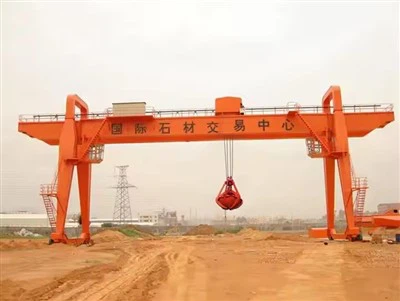
A construction gantry crane is a heavy-duty lifting machine that features a horizontal beam (the bridge) supported by two freestanding, upright legs that move on wheels or rails along the ground. This "straddling" design allows it to move materials over a defined area without needing permanent overhead runway supports, making it ideal for temporary, dynamic construction sites.
They are a fundamental piece of equipment for moving heavy loads like precast concrete, steel beams, and machinery.
Types of Gantry Cranes in Construction
Different projects require different types of gantry cranes:
| Type of Gantry Crane | Description | Common Construction Uses |
|---|---|---|
| Full Gantry Crane | Two robust legs that run on ground-level tracks. Offers the highest stability and lifting capacity. | Major Infrastructure: Bridge building, erecting large precast concrete structures, power plant construction. |
| Semi-Gantry Crane | One leg runs on a ground rail; the other end runs on an elevated runway attached to a building support. | Hybrid Sites: Ideal for areas partly under a structure (e.g., a building entrance, a prefab yard with a roof). |
| Portable Gantry Crane | Lightweight, often adjustable in height and width. Can be moved by hand or forklift. | Small Sites & Workshops: On-site fabrication, lifting machinery, unloading materials from trucks, assisting with tool assembly. |
| Rubber-Tired Gantry (RTG) | A large, mobile crane that runs on rubber tires, offering high mobility without fixed tracks. | Major Projects: Handling massive prefabricated sections like bridge segments and tunnel liners on large, prepared sites. |
Advantages of Using Gantry Cranes in Construction
No Permanent Infrastructure Needed: Their biggest advantage. They operate on ground tracks, making them perfect for outdoor and greenfield sites where installing an overhead crane is impossible.
High Mobility and Flexibility: They can be easily relocated around the site as work progresses, adapting to different phases of the project.
Exceptional for Heavy, Prefabricated Elements: Designed to handle the immense weight of modern building components like precast concrete walls and steel girders with precision.
Cost-Effective: For a temporary project, using a gantry crane is far more economical than constructing the building support system required for an overhead crane.
Creates a Dedicated Work Bay: They establish a safe, controlled area for repetitive lifting tasks, such as assembling formwork or loading materials.
Safety: Provides stable, controlled lifts, reducing the risks associated with less stable lifting methods.
Lifting Capacity 320 tons
Span (Width) 3 - 12 meters (adjustable)
Lifting Height 3 - 10 meters
Working Class A3-A5 (light to medium duty)
Hoisting Speed 0.5 - 8 m/min (variable)
Main Beam Type Single/double girder (box-type)
Power Supply 220V/380V 3-phase or manual
Control Mode Pendant control/wireless remote
Hoist Type Electric chain hoist/wire rope hoist
Travel Drive Manual push or motorized
Corrosion Protection Hot-dip galvanized or marine-grade paint
Wind Resistance Up to Beaufort scale 6 (for outdoor use)
Operating Temp -20°C to +50°C

Pictures & Components
Here is a detailed breakdown of the components of a gantry crane as used in the construction industry.
Understanding these components is crucial for safe operation and maintenance on a dynamic construction site.
High-Level Overview
A gantry crane is composed of four main systems:
The Leg/Support System: The vertical structures that transfer the load to the ground.
The Bridge Girder System: The horizontal beam that carries the load across the span.
The Hoist & Trolley System: The mechanism that lifts the load and moves it side-to-side.
The Drive & Control System: The components that make the crane move and allow the operator to control it.
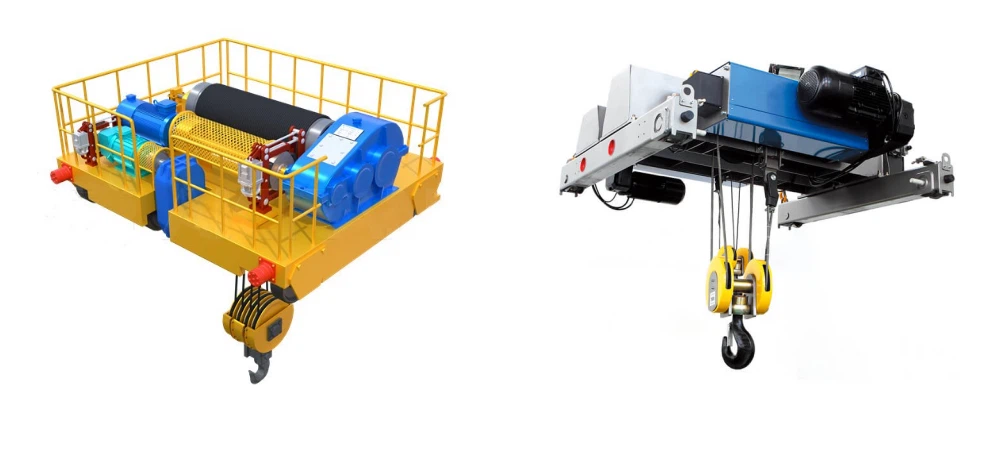
Detailed Component Breakdown
1. Leg & Support System
This system forms the crane's foundation, providing stability and mobility.
Legs (Gantries): The vertical structures at each end of the crane. They can be fixed or adjustable in height to accommodate different site conditions.
End Trucks: The assemblies mounted at the top and bottom of the legs. They house the wheels, motors, and gears for moving the entire crane.
Travel Wheels/Tracks: The wheels that engage with the ground rails or runway. Larger cranes may use steel rails, while rubber-tired gantries (RTGs) have robust pneumatic or solid tires.
Outriggers/Stabilizers: (Especially on rubber-tired models) Hydraulic or mechanical arms that extend to the ground to provide extra stability during a lift, preventing the crane from tipping.

2. Bridge Girder System
This is the primary load-bearing horizontal structure.
Bridge Girder(s): The main horizontal beam that spans the work area.
Single Girder: One beam, used for lighter capacities (common with portable gantries).
Double Girder: Two parallel beams, offering higher lifting capacity, better hook height, and greater stability for heavy construction lifts (e.g., precast concrete, steel beams).
End Connections: The robust connections (often welded or bolted) that join the bridge girder to the top of the leg assemblies.

3. Hoist & Trolley System
This system performs the actual lifting and precise positioning of the load.
Trolley Frame: The structure that moves back and forth (cross travel) along the bridge girder on its own set of wheels.
Hoist Unit: The core lifting mechanism, mounted on the trolley. It consists of:
Hoist Motor: Provides the power for lifting and lowering.
Hoist Drum: The cylindrical drum around which the wire rope is wound.
Wire Rope: The high-strength cable that lifts the load.
Brakes: Automatic, fail-safe brakes that engage if power is lost.

Hook Block: The assembly that connects the wire rope to the load. It may have a single hook or multiple hooks (a block) for spreading the load.
Trolley Drive Motor: The motor that powers the trolley wheels to move the load along the length of the bridge.


4. Drive & Control System
This system powers and controls the crane's movements.
Bridge Drive Motors: The motors located in the end trucks that power the travel wheels to move the entire crane along the runway (long travel).
Operator's Control Station:
Pendant Station: A handheld or floor-mounted control unit that allows the operator to control the crane from the ground. Common for smaller or portable gantries.
Operator's Cab: An enclosed cabin mounted on the crane itself, providing the operator with a clear view of the lift, especially for large, complex cranes.

Power Delivery System:
Cable Reel: A drum that pays out and retracts the main power cable as the crane moves.
Conductor Bar (Festoon System): A system of electrified bars that sliding collectors on the crane connect to, providing continuous power.
Safety Devices:
Bumpers: Rubber or spring-loaded buffers on the end trucks and trolley to absorb impact if the crane reaches the end of its runway.
Limit Switches: Automatically cut power to a motor to prevent the hoist block or trolley from over-traveling.
Anemometer: On large outdoor cranes, this measures wind speed and will alarm or shut down operations if winds become dangerous.
Load Moment Indicator (LMI): A critical system that monitors the load weight and crane configuration to prevent overloads.
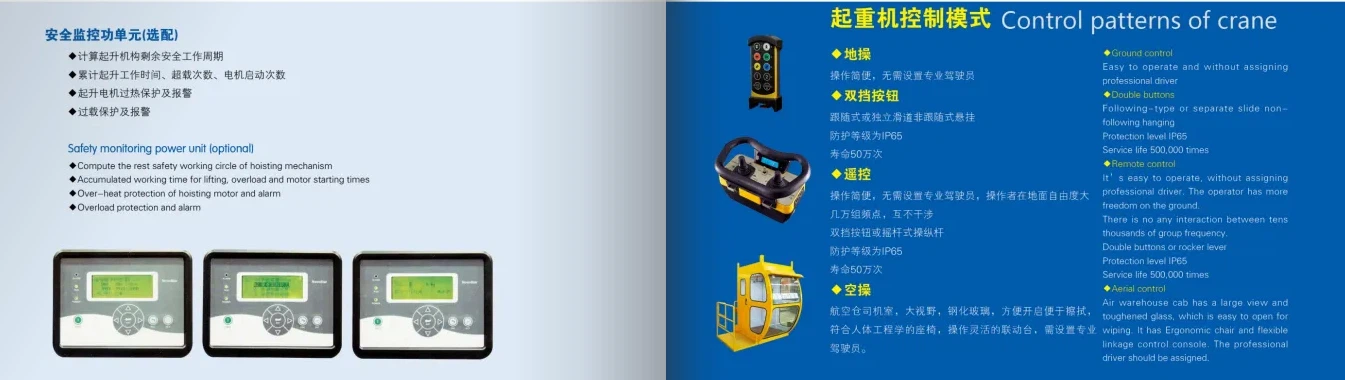
SKETCH
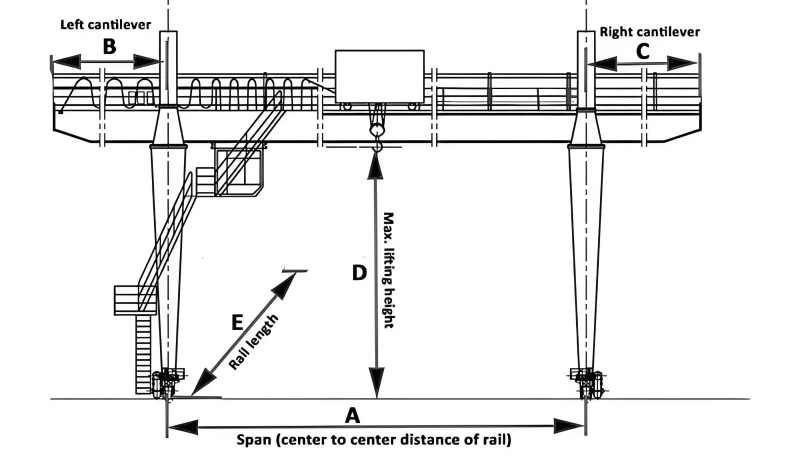
Main technical
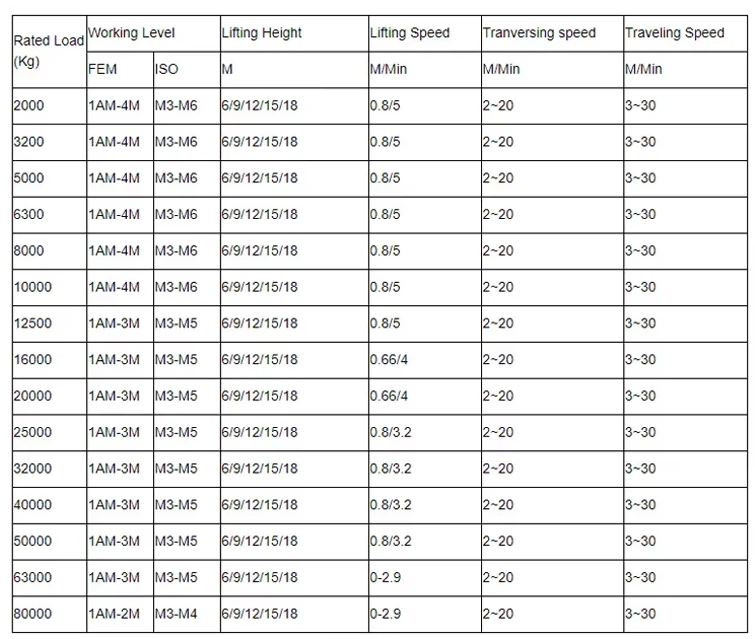
Advantages
Advantages of Gantry Cranes in Construction
Gantry cranes are uniquely suited to the demands of construction sites, offering a blend of power, flexibility, and cost-effectiveness.
1. Unmatched Site Flexibility and Mobility
No Permanent Infrastructure Needed: This is their biggest advantage. Unlike overhead cranes that require building-supported runways, gantry cranes are freestanding and operate on ground-level tracks or wheels. This makes them perfect for outdoor, greenfield, and temporary sites.
Relocatable: They can be disassembled and moved to different locations on the site as the project progresses through various phases, from groundwork to structural erection.
2. High Capacity for Heavy Lifts
Designed for Heavy Loads: Gantry cranes are engineered to handle the immense weights common in modern construction, such as massive precast concrete panels, steel girders, and large-scale mechanical units.
Superior Stability: The wide-legged base provides excellent stability during lifts, reducing swing and allowing for precise placement of heavy and expensive materials.
3. Cost-Effectiveness
Lower Initial Investment: For a temporary project, using a gantry crane is far more economical than constructing the permanent support structure required for an overhead crane.
Operational Efficiency: They enable faster material handling than relying solely on mobile cranes for repetitive tasks, saving time and labor costs.
Versatility: One gantry crane can handle a wide range of tasks-from unloading trucks to positioning structural elements-reducing the need for multiple specialized machines.
4. Enhanced Safety and Control
Dedicated Work Area: They create a controlled "lift zone" where pedestrian and vehicle traffic can be restricted, enhancing site safety.
Precise Load Placement: The operator can control all three directions of movement (lifting, cross-travel, long-travel) with great precision, which is crucial for setting beams or panels into exact positions.
Reduced Ground Obstruction: Unlike mobile cranes that require extensive clear ground space for setup and outriggers, gantry cranes have a smaller and more defined footprint.
5. Ideal for Prefabricated Elements
The Perfect Match for Modern Methods: As construction increasingly relies on prefabricated components (like precast concrete and modular units), gantry cranes are the ideal tool for handling these large, heavy, and often delicate items efficiently and safely.
Application
Applications of Gantry Cranes in Construction
Gantry cranes are indispensable across a wide range of construction projects.
1. Bridge Construction
Application: This is a classic application. Large, custom-designed launching gantries are used to lift and place precast segments for the deck of viaducts and bridges in a method called incremental launching or segmental bridge construction.
Advantage in Action: The gantry crane travels along the already-constructed sections of the bridge, placing the next segment with millimeter precision.
2. Precast Concrete Erection
Application: Erecting precast concrete elements such as wall panels, hollow-core slabs, double-tee floors, columns, and bridge beams.
Advantage in Action: A gantry crane at a precast yard or on-site can efficiently lift these components directly from the delivery truck and position them exactly where needed, minimizing handling and risk of damage.
3. Steel Frame Erection
Application: Lifting and placing structural steel elements-I-beams, columns, trusses-for the frameworks of commercial buildings, industrial facilities, and stadiums.
Advantage in Action: The crane's ability to move along the work area allows it to pick a beam from a staging area and place it sequentially along the grid of the building.
4. Major Industrial and Power Projects
Application: Used in the construction of power plants, refineries, and large industrial facilities to place heavy machinery, turbines, reactors, and large-diameter pipes.
Advantage in Action: Their high capacity and stability are essential for these critical, one-of-a-kind lifts that cannot afford error.
5. Material Handling and Logistics
Application: On almost every large site, smaller gantry cranes (including portable gantries) are used for:
Unloading materials (rebar, lumber, pipes) from trucks.
Transporting materials from storage areas to the point of use.
Supporting on-site fabrication workshops (e.g., bending rebar, assembling formwork).
Advantage in Action: They free up larger, more expensive cranes (like tower cranes) for critical path lifting tasks, optimizing overall site efficiency.
6. Tunnel Construction
Application: Specialized gantry systems are used to handle Tunnel Boring Machine (TBM) components and to place the concrete segments that form the tunnel lining.
Advantage in Action: The gantry operates within the confined space of the tunnel, moving forward as the TBM advances.
Crane production process
The production process for a Container Rail Mounted Gantry Crane (RMG) is a complex, multi-stage project that combines heavy steel fabrication, precision machining, sophisticated electrical assembly, and rigorous testing. It is typically carried out in a controlled factory environment by specialized engineers and technicians before being shipped to the terminal for final assembly.
Here is a detailed, phase-by-phase breakdown of the production process.
Phase 1: Design & Engineering (The Digital Blueprint)
This is the most critical phase, where the entire crane is virtually created and validated.
Conceptual & Detailed Design:
Client Specifications: Engineers work with the terminal operator to define all requirements: lifting capacity (e.g., 40 tons under spreader, 50 tons for twin-lift), span (distance between legs), lift height, runway length, and operating conditions (wind speed, seismic zone, temperature).
3D Modeling: Every single component is designed in 3D using CAD software (e.g., AutoCAD, SolidWorks, Tekla). This includes the main girders, end carriages, trolley, and hoist frame.
Structural Analysis (FEA): Finite Element Analysis (FEA) software simulates stresses, deflections, and dynamic loads to ensure the design can handle the rated capacity with a significant safety factor (as per FEM or ISO standards).
Electrical & Control Design: Schematics are created for the power distribution, drive systems (VFDs), PLC controls, and safety circuits. The integration with the Terminal Operating System (TOS) for automation is also designed here.
Phase 2: Procurement & Sourcing
Raw Material Procurement: High-quality steel (e.g., S355J2) is ordered in the form of plates, profiles, and tubes.
Major Component Procurement: Key subsystems are sourced from specialized suppliers:
Mechanical: Wheels, axles, bearings, gearboxes, brakes, wire ropes, and the spreader.
Electrical: Motors, Variable Frequency Drives (VFDs), Programmable Logic Controllers (PLCs), conductor bars, cable reels.
Safety & Automation: Anemometers, anti-collision sensors, Laser Range Finders (LRF), optical character recognition (OCR) systems for container identification, and Load Moment Indicators (LMI).
Phase 3: Fabrication & Manufacturing (The Physical Build)
This phase transforms raw materials into the crane's structural components.
Steel Cutting and Preparation:
Steel plates are cut to size using CNC plasma or laser cutting machines for precision. Beams are cut and prepared for welding.
Welding and Assembly of Main Structure:
Main Girders: The two primary bridge girders are fabricated, often as robust box girders. This involves welding stiffeners and plates. Welding is performed by certified welders, frequently using automated Submerged Arc Welding (SAW) for consistency and strength.
End Carriages (Legs): The supporting legs that house the travel wheels and drive units are fabricated.
Trolley Frame: The frame that carries the hoist across the bridge is built.
Quality Control (QC): All critical welds are inspected via Non-Destructive Testing (NDT) methods like Ultrasonic Testing (UT) or Magnetic Particle Inspection (MPI) to ensure they are free of defects.
Machining and Drilling:
Critical connection points (e.g., where the legs connect to the girders) are machined on large boring mills to ensure perfectly flat, level, and aligned surfaces. Holes are precision-drilled for high-strength bolts.
Shot Blasting and Painting (Corrosion Protection):
Shot Blasting: Every steel component is blasted to remove mill scale and rust, creating an ideal surface for paint adhesion.
Priming and Painting: A high-quality, corrosion-inhibitive primer is applied immediately. This is followed by multiple coats of specialized industrial paint (e.g., epoxy intermediate coat, polyurethane topcoat) designed to withstand harsh marine environments.
Phase 4: Pre-Assembly & Electrical Installation
Mechanical Pre-Assembly:
The main girders are bolted together on the factory floor to check for alignment. The end carriages are fitted with wheels, axles, and travel drive motors.
Electrical Installation:
Cabling: Electricians run power and control cables throughout the structure in cable trays and conduits.
Component Mounting: Drives, PLC panels, resistor banks, and control cabinets are installed in their designated, protected locations.
Sensor Installation: Limit switches, absolute encoders, and position sensors are mounted and connected.
Testing: Electrical circuits are meticulously checked for continuity, proper grounding, and insulation resistance before power is applied.
Phase 5: Factory Acceptance Testing (FAT)
The crane is tested under load in the factory to verify performance before disassembly and shipping.
Dimensional Check: Verification that all critical dimensions match the design drawings.
No-Load Test: All functions (hoist, trolley, gantry travel) are operated without a load to check for smooth operation, abnormal noise, and basic functionality.
Load Test (Critical Safety Step):
Static Load Test: The crane is tested to 125% of its rated capacity. The load is lifted just off the ground and held to check for structural integrity and brake holding capability.
Dynamic Load Test: The crane is tested to 110% of its rated capacity. All motions are operated under this load to ensure performance under stress.
Functionality & Safety Test: All safety systems (E-stops, overload protection, limit switches, anemometer) are rigorously tested. The automation system (if applicable) is put through its paces.
Phase 6: Dismantling, Packaging, and Shipping
Dismantling: The crane is carefully disassembled into transportable modules (girders, legs, trolley, etc.). All components are clearly marked.
Packaging: Components are crated and protected for long-distance transport, often by sea. Electrical components are shielded from moisture.
Shipping: All parts are shipped to the customer's site along with detailed assembly drawings, manuals, and a team of erection supervisors.
Phase 7: Site Erection & Commissioning
Runway Preparation: The customer prepares the foundation and installs the parallel rails with extreme precision (alignment and levelness are critical).
Erection: A team of erectors uses large mobile cranes to assemble the RMG on its runway.
Final Connection: All mechanical, electrical, and pneumatic connections are made. The power supply (conductor bars) is installed along the runway.
Site Acceptance Testing (SAT): The entire FAT is repeated on-site to ensure the crane performs perfectly in its final operating environment. Operator training is conducted.

Workshop view:
The company has installed an intelligent equipment management platform, and has installed 310 sets (sets) of handling and welding robots. After the completion of the plan, there will be more than 500 sets (sets), and the equipment networking rate will reach 95%. 32 welding lines have been put into use, 50 are planned to be installed, and the automation rate of the entire product line has reached 85%.




Hot Tags: construction industry gantry crane, China construction industry gantry crane manufacturers, suppliers, factory
You Might Also Like


Send Inquiry