







A Type Box Type Double Girder Gantry Crane
Product Introduction
An A-Type Box Type Double Girder Gantry Crane is a heavy-duty gantry crane commonly used in outdoor yards and large industrial sites. Here's a clear breakdown of what the term means and what the crane is used for:
What the Name Means
A-Type
The crane legs are shaped like the letter "A", giving strong lateral stability and allowing better load distribution.
Box Type
The main girders and legs use box-section welded steel structures, which provide:
High strength and rigidity
Better resistance to bending and torsion
Reduced vibration under heavy loads
Double Girder
Two main girders support the trolley, allowing:
Higher lifting capacity
Greater lifting height
Better stability for heavy or wide loads
Gantry Crane
The crane runs on ground rails (not fixed to a building), making it ideal for outdoor or semi-outdoor operations.
A-Type vs. L-Type (Straight Leg) Gantry
| Parameter | A-Type Gantry | L-Type Gantry |
|---|---|---|
| Lateral Stability | ★★★★★ (Excellent) | ★★★☆☆ (Good) |
| Wind Resistance | ★★★★★ | ★★★☆☆ |
| Foundation Requirements | More horizontal component | Primarily vertical loads |
| Fabrication Complexity | Higher (more welds, angles) | Lower (simpler geometry) |
| Transportability | More challenging (bulkier) | Easier to transport |
| Clear Working Width | Slightly reduced by sloping legs | Full width available |
A-Type vs. Semi-Gantry Crane
| Aspect | A-Type Full Gantry | Semi-Gantry |
|---|---|---|
| Coverage Area | Full area under crane | One side against building |
| Installation Independence | Completely independent | Requires building support |
| Flexibility | Can be relocated | Fixed to building |
| Cost | Higher initial cost | Lower (uses existing structure) |
| Maintenance Access | All-around access | Limited on building side |
TECHNICAL DATA SHEET EXAMPLE
Model: A-Type Gantry Crane A-50/35
Capacity: 50 metric tons (main hook)
Span: 35 meters (rail center to center)
Lifting Height: 18 meters (hook above rail)
Lifting Speeds:
Main hoist: 5 m/min (full load), 10 m/min (light load)
Auxiliary hoist: 15 m/min
Travel Speeds:
Crane travel: 20 m/min
Trolley travel: 15 m/min
Duty Class: A6 (heavy duty, ~300 starts/hour)
Control System: Operator cabin with ergonomic controls
Power Supply: 380V, 3-phase, 50Hz, 200A supply

Pictures & Components
An A-Type Box Type Double Girder Gantry Crane consists of several major structural, mechanical, and electrical components. Below is a clear, industry-standard breakdown of its components:
1. Main Structural Components
1.1 Main Girders (Double Girder – Box Type)
Two welded box-section girders
Support the hoisting trolley
Designed for high rigidity and minimal deflection
 .
.
1.2 Gantry Legs (A-Type)
Two A-shaped rigid legs (or one rigid + one hinged, depending on design)
Transfer loads to the ground rails
Provide lateral and longitudinal stability
1.3 End Carriages (Traveling Trucks)
Located at the bottom of the legs
Contain:
Traveling wheels
Bearings
Axles
Enable crane long-travel motion
1.4 Ground Rail System
Steel rails fixed on concrete foundations
Guide crane movement along the yard


2. Lifting Mechanism
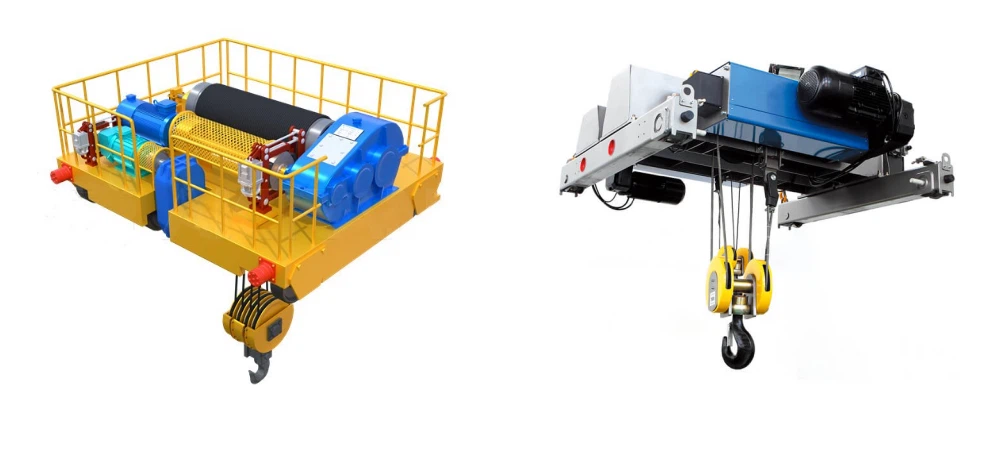
2.1 Hoisting Trolley
Mounted on top of the double girders
Travels transversely along the crane span
2.2 Hoist Unit
Includes:
Hoist motor
Gearbox
Wire rope drum
Wire ropes
Hook block (or spreader/grab/magnet)
 |
 |
 |
3. Traveling Mechanisms
3.1 Crane Traveling Mechanism (Long Travel)
Motors and gearboxes mounted on end carriages
Drives the crane along ground rails
3.2 Trolley Traveling Mechanism (Cross Travel)
Motor and reducer drive the trolley across the girders
 |
 |
 |
4. Electrical System
4.1 Power Supply System
Cable reel system or conductor bar
Supplies power to crane traveling mechanism
4.2 Control System
PLC or relay-based control
Control options:
Cabin control
Pendant control
Remote control
4.3 Electrical Panels
Main control cabinet
Protection devices (MCB, overload relays, contactors)

5. Safety Devices
Overload limiter
Limit switches (hoisting, traveling)
Emergency stop
Rail clamps / wind clamps
Buffer stops
Anti-collision system
Anemometer (wind speed sensor – outdoor cranes)
.
6. Operator Facilities
6.1 Operator Cabin (Optional)
Air-conditioned cabin
Ergonomic control console
Safety glass
6.2 Access Systems
Ladders
Platforms
Handrails

7. Auxiliary Components
Festoon cable system
Lighting system
Warning alarms
Maintenance platforms
Paint and corrosion protection system

Sketch

Main technical

Advantages
1. High Load Capacity
Double girder and box-type construction provide excellent strength
Capable of handling heavy and ultra-heavy loads
Suitable for high duty cycles (FEM / ISO heavy-duty classes)
2. Superior Structural Stability
A-type leg design offers strong lateral stability
Box-section girders reduce deflection and vibration
Safe operation even with wide or off-center loads
3. Large Span and Lifting Height
Easily designed for large spans and high lifting heights
Ideal for handling oversized components
4. Excellent Outdoor Performance
Designed to withstand wind loads and harsh weather
Can be equipped with wind clamps, rail clamps, and anemometers
Long service life in outdoor environments
5. High Operational Efficiency
Smooth and precise lifting and traveling motions
Faster material handling improves productivity
Compatible with automation and remote control systems
6. Versatile Load Handling
Can be fitted with:
Hook
Grab bucket
Electromagnet
Spreader beam
Adaptable to multiple industries and materials
7. Easy Maintenance
Box-type structure allows easy inspection
Durable components reduce maintenance frequency
Standardized spare parts availability
Application:
1. Shipyards and Ports
Handling ship sections and heavy marine components
Container and cargo handling in open yards
2. Steel Mills
Transporting steel coils, plates, billets, and slabs
Suitable for high-temperature and heavy-duty operations
3. Power Plants
Installation and maintenance of turbines and generators
Handling heavy equipment during construction
4. Precast Concrete Yards
Lifting beams, slabs, pipes, and columns
Efficient movement of large concrete elements
5. Construction and Infrastructure Projects
Handling bridge segments and large structural components
Used in metro, highway, and bridge construction yards
6. Heavy Manufacturing Industries
Assembly and handling of heavy machinery
Equipment fabrication and storage yards
7. Mining and Material Stockyards
Handling bulk materials with grabs or magnets
Reliable performance in dusty and rough environments
Crane production procedure
1. Engineering Design & Planning
Load calculation (SWL, impact, wind, seismic)
Span, lifting height, and duty class determination (ISO / FEM / CMAA)
Structural design of box girders and A-type legs
Selection of hoisting, traveling, and electrical components
Preparation of:
General arrangement drawings
Fabrication drawings
Electrical schematics
Design review and customer approval
2. Raw Material Procurement & Inspection
Procurement of structural steel plates and profiles
Inspection of:
Material grade and thickness
Mill test certificates (MTC)
Storage under controlled conditions to prevent corrosion
3. Steel Cutting & Preparation
CNC flame cutting / plasma cutting of steel plates
Edge preparation for welding
Shot blasting for surface cleanliness (Sa 2.5 standard)
Marking and identification of components
4. Box Girder Fabrication
Assembly of top plate, bottom plate, and side plates
Automatic submerged arc welding (SAW)
Camber control and deflection correction
Internal stiffener installation
Non-destructive testing (UT, MT)
5. A-Type Leg Fabrication
Fabrication of rigid and hinged legs (box structure)
Welding of bracings and stiffeners
Machining of connection plates
Dimensional inspection and NDT testing
6. End Carriage Manufacturing
Fabrication of end carriage frames
Installation of:
Wheels
Bearings
Axles
Alignment and load distribution checks
7. Machining & Assembly of Mechanical Components
Machining of:
Wheel seats
Shaft holes
Connection surfaces
Assembly of:
Hoist unit
Trolley frame
Gearboxes and couplings
8. Surface Treatment & Painting
Final shot blasting of all structural parts
Application of:
Primer coat
Intermediate coat
Finish coat
Paint thickness inspection (DFT)
Corrosion protection per environment class
9. Electrical System Installation
Installation of motors, brakes, and limit switches
Wiring of control panels and junction boxes
Installation of:
Cable festoon or conductor bars
Control cabin or remote control system
Electrical continuity and insulation testing
10. Pre-Assembly & Factory Trial
Trial assembly of main girders, legs, and end carriages
Alignment and dimensional verification
No-load functional testing:
Hoisting
Trolley travel
Crane travel
11. Load Testing & Quality Inspection
Static load test (125% of rated load)
Dynamic load test (110% of rated load)
Safety device testing
Final inspection per standards
12. Dismantling, Packing & Dispatch
Dismantling into transportable sections
Protective packing for long-distance shipment
Documentation preparation:
Test certificates
Quality reports
Operation & maintenance manuals
13. Site Installation & Commissioning (Optional)
Rail alignment verification
Crane erection and bolting
Electrical connection and system calibration
Final load testing and handover

Workshop view
Material Inspection
Quality Inspection: Strict quality inspection is carried out on the purchased raw materials to ensure that they meet the design requirements and national standards.
Material Storage: Qualified materials are stored according to classification to prevent corrosion or damage.
Cutting and Forming
Steel Cutting: Use plasma cutting, laser cutting or flame cutting and other technologies to cut the steel according to the size of the design drawing.
Forming Processing: Form the steel plate through bending, rolling, welding and other processes to manufacture the main beam, end beam and other structural parts.
Welding
Component Welding: The cut and formed steel parts are welded into the main structures such as the main beam, end beam and trolley. The welding process needs to be strictly controlled to ensure the structural strength and welding quality.
Weld Inspection: Use non-destructive testing technology (such as ultrasonic testing, radiographic testing) to inspect the welds to ensure that there are no cracks or other defects.
Machining
Precision Machining: Precision machining is performed on the key components of the crane, such as wheel sets, bearing seats, pulleys, etc., to ensure their dimensional accuracy and surface quality.
Assembly of the whole machine
General assembly: On the basis of pre-assembly, the overall assembly of the crane is carried out, including the final installation of the main beam, end beam, lifting mechanism, walking mechanism, etc.
Commissioning and testing
Under dynamic conditions, the operating performance of the crane is tested, including the testing of lifting, walking, steering and other functions. The overall size of the assembled bridge crane is checked to ensure that all dimensions meet the design requirements.
Spraying and anti-corrosion treatment
Surface treatment Rust removal: Rust removal on the surface of the crane, common methods include sandblasting, pickling, etc. Primer spraying: Spray anti-corrosion primer on the treated surface to prevent metal oxidation and corrosion. Topcoat spraying Color spraying: Spray topcoat according to customer requirements or industry standards to give the crane a protective and decorative effect. Marking: After spraying, mark the crane's identification information in accordance with the specifications, such as model, rated load, etc.
Factory and installation
Packaging and transportation
Packaging protection: Protectively package the key components of the crane to prevent damage during transportation. Transportation arrangement: According to the equipment size and transportation conditions, select a suitable transportation method to transport the crane to the customer's site.
Acceptance and delivery
Customer acceptance
On-site acceptance: The customer conducts on-site acceptance of the crane according to the contract requirements and technical specifications to check the performance and quality of the equipment.
Problem rectification: If any problems are found, the manufacturer needs to rectify them in time to ensure that the equipment fully meets the customer's requirements. Delivery and use Operation training: The manufacturer usually trains the customer's operators to ensure that they can operate the crane correctly and safely.


Hot Tags: a type box type double girder gantry crane, China a type box type double girder gantry crane manufacturers, suppliers, factory
You Might Also Like


Send Inquiry