








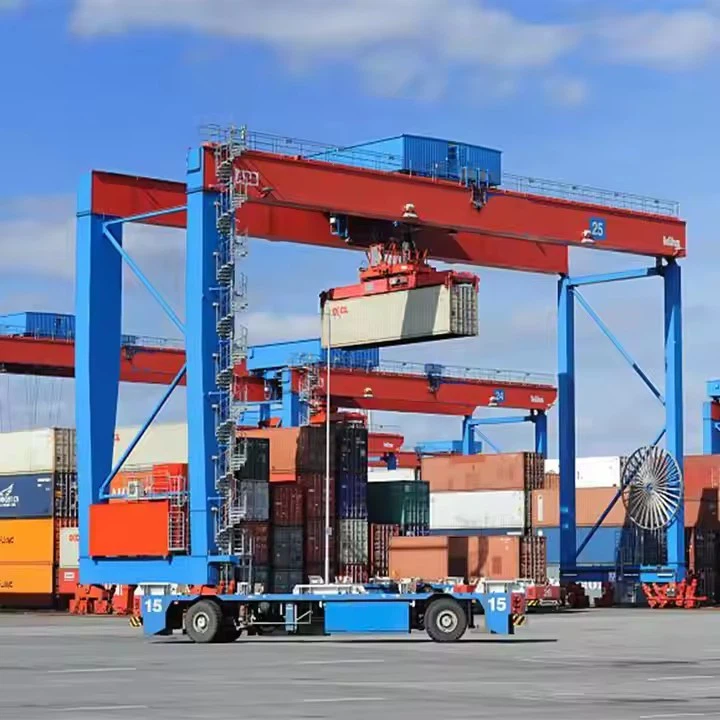

35 Ton Rubber Tire Gantry Crane
Products Description
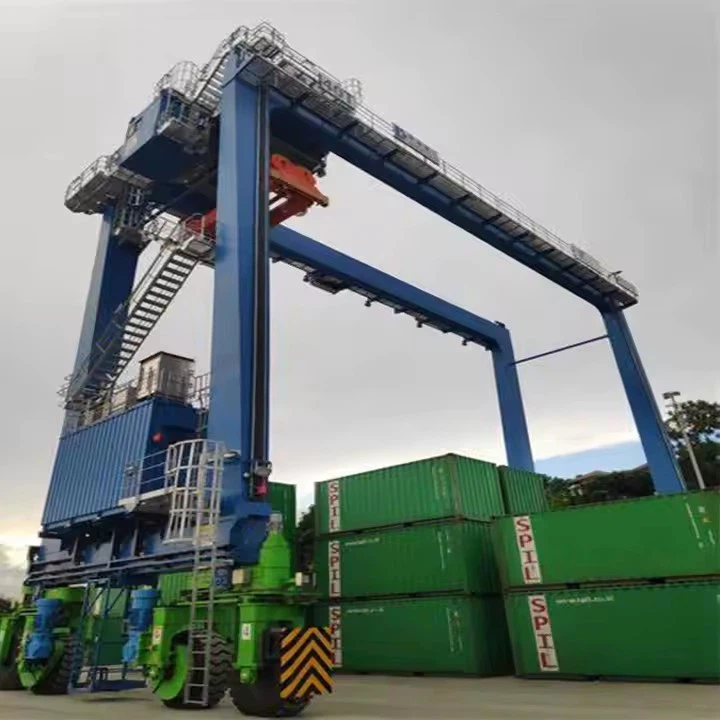
A 35-ton Rubber Tire Gantry Crane (RTG) is a type of mobile gantry crane used primarily in container terminals, ports, and intermodal yards for stacking and moving shipping containers. Here's an overview of its key features, components, and applications:
Key Features:
Lifting Capacity: 35 metric tons (typically under spreader), suitable for handling 20ft, 40ft, and 45ft containers.
Mobility: Equipped with rubber tires, allowing it to move freely around the yard without the need for fixed rails.
Span Width: Can typically span 6+1 (6 container rows + 1 truck lane) or 5+1 configurations.
Hoisting Height: Usually around 18m (1-over-5 stacking) or higher, depending on requirements.
Power Source:
Diesel-electric (common)
Hybrid (diesel + battery)
Fully electric (with conductor bars or battery systems for eco-friendly operations)
Automation: Modern RTGs may feature semi-automated or fully automated stacking.
Comparison with Other Gantry Cranes:
| Feature | RTG (Rubber Tyre) | RMG (Rail-Mounted) | STS (Ship-to-Shore) |
|---|---|---|---|
| Mobility | High (rubber tires) | Fixed (rails) | Fixed (rails) |
| Use Case | Yard operations | Yard/rail ops | Ship loading/unloading |
| Power | Diesel/Electric/Hybrid | Electric | Electric |
| Stacking | 4–6 high | 5–7 high | N/A |
Lifting Capacity: 35 metric tons (35,000 kg)
Span: 10m–35m (customizable)
Lifting Height: 6m–20m (adjustable)
Hoist Type: Double-girder with electric wire rope hoist (QD-type)
Travel System: Motorized (rail-guided or rubber-tired)
Wheel Type: Steel wheels (for rails) / Pneumatic tires (floor use)
Control System: Cabin-operated or remote control
Power Supply: 380V/50Hz (3-phase)
Structural Steel: Q345B (high-strength) with corrosion-resistant coating

Pictures & Components
A 35-ton Rubber Tire Gantry Crane (RTG) is a mobile crane used primarily in container handling in ports and intermodal yards. Below are the key components of a 35-ton RTG crane:
1. Structural Components
Main Girder (Bridge): The horizontal beam that spans the width of the container stack, supporting the trolley and hoist.
Legs (End Frames): Vertical structures that support the main girder and house the wheels for mobility.
Portal Frame: The entire structure consisting of the main girder and legs, allowing the crane to straddle containers.
Trolley Frame: The moving structure that carries the hoist and spreader along the main girder.
2. Lifting & Handling Components
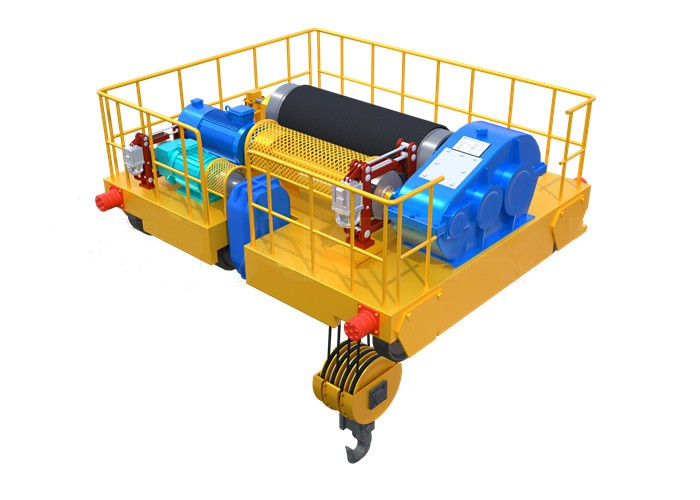
Hoist Unit: The mechanism that lifts and lowers containers, typically equipped with wire ropes or chains.
Spreader: An adjustable lifting attachment that locks onto containers (20ft, 40ft, 45ft, etc.).
Trolley: The assembly that moves the hoist and spreader along the main girder for precise positioning.

3. Mobility & Drive System
Rubber Tires: Large, heavy-duty tires (usually 8 or more) that allow the crane to move smoothly on paved surfaces.
Drive Motors: Electric or diesel-hydraulic motors powering the wheels.
Steering System: Allows the crane to maneuver in tight spaces (crab steering, 90-degree steering, etc.).
Braking System: Hydraulic or electric brakes for safe stopping.
4. Power Supply
Diesel Generator: Provides power for electric motors (common in older models).
Electric Power (Hybrid/Full Electric): Newer models may use a hybrid system or direct electric power from a grid (via cable reel or conductor bar).
Battery System (Optional): Some modern RTGs use battery packs for energy storage and emission-free operation.
 |
 |
5. Control & Automation
Operator Cabin: A climate-controlled cabin with joysticks, screens, and controls for manual operation.
Remote Control (Optional): Allows operators to control the crane from the ground.
Automation Systems (Optional): GPS, anti-sway, and auto-positioning for semi or fully automated operation.
6. Safety & Auxiliary Systems
Anti-Collision System: Prevents collisions with other cranes or obstacles.
Load Limiter & Weighing System: Ensures the crane does not exceed its rated capacity.
Anemometer & Wind Alarm: Detects high wind speeds and alerts the operator.
Outriggers / Stabilizers (Optional): Used for additional stability during lifting.
Lighting & Warning Systems: LED lights and alarms for safe operation in low visibility.

|
 |
7. Hydraulic & Electrical Systems
Hydraulic Pump & Cylinders: Used for steering, braking, and stabilizers (if equipped).
Control Panels & PLCs: Manage electrical functions and automation.
Cable Reels (if electric): For power supply in electric RTGs.

8. Optional Features
GPS & RFID Tracking: For container positioning and yard management.
Remote Monitoring: Allows real-time diagnostics and maintenance tracking.
Regenerative Power Recovery: Captures energy during lowering/braking (in hybrid/electric models).


9. Safety Systems
Includes overload limiters, anti-collision systems, emergency stops, limit switches, wind speed alarms, fire extinguishing systems, and CCTV.

Optional Advanced Features
Automated Guided Vehicle (AGV) Compatibility – For fully automated ports.
Hybrid/Electric Conversion Kits – To reduce emissions.
Remote Monitoring (IoT Sensors) – For predictive maintenance.

SKETCH

Main technical

Advantages
A 35-ton Rubber Tire Gantry Crane (RTG) is a versatile and mobile lifting solution commonly used in ports, container terminals, and heavy industrial applications. Here are its key advantages:
1. High Mobility & Flexibility
Rubber tires allow easy movement without the need for fixed rails.
Can operate in large open areas, such as container yards, and be repositioned as needed.
Ideal for operations requiring frequent relocation.
2. Cost-Effective Compared to Rail-Mounted Gantries (RMG)
Lower infrastructure costs since it doesn't require rails or fixed tracks.
Reduced installation and maintenance expenses compared to rail-bound systems.
3. Efficient Container Handling
Designed for intermodal container stacking and handling (typically 1-over-3 or 1-over-4 high).
Can straddle multiple rows of containers, optimizing yard space.
4. Environmentally Friendly Options
Modern RTGs can be electric-powered (ERTG) or hybrid, reducing diesel emissions and noise.
Regenerative braking systems improve energy efficiency.
5. Adaptability to Different Work Environments
Suitable for ports, logistics hubs, and industrial yards.
Can handle containers, heavy machinery, and bulk materials.
6. High Lifting Capacity & Reach
The 35-ton capacity is ideal for heavy container handling (20ft, 40ft, 45ft).
Wide span (typically 6+ container rows) for efficient yard operations.
7. Automated & Remote Operation Options
Can be integrated with automated stacking systems (ASCs) for smart port operations.
Remote control and semi-automated features enhance safety and efficiency.
8. Reduced Ground Pressure
Rubber tires distribute weight evenly, minimizing damage to pavement compared to rail systems.
9. Quick Deployment
Faster setup compared to fixed cranes, allowing rapid operational readiness.
10. Safety Features
Anti-collision systems, load moment indicators, and sway control for safe operations.
Conclusion:
A 35-ton RTG crane offers mobility, cost savings, and high efficiency, making it a preferred choice for dynamic cargo-handling environments. Its adaptability to automation and electric power further enhances its value in modern logistics.
Application:
A 35-ton Rubber Tire Gantry Crane (RTG) is a versatile mobile gantry crane commonly used in ports, intermodal terminals, and heavy industrial applications for lifting and transporting heavy loads. Here's a detailed look at its key applications and features:
Key Applications:
Container Handling in Ports & Terminals
Used in container yards to stack and move shipping containers (20ft, 40ft, 45ft).
Can operate in tight spaces without fixed rails, offering flexibility in yard logistics.
Often used alongside straddle carriers and reach stackers.
Intermodal Freight Transport
Transfers containers between trucks, trains, and storage areas in rail yards and logistics hubs.
Enables efficient loading/unloading of double-stacked containers.
Heavy Industrial & Manufacturing
Handles large machinery, steel coils, and heavy components in factories and warehouses.
Supports assembly lines and material handling in shipbuilding, steel mills, and construction.
Project Cargo & Breakbulk Handling
Lifts oversized cargo like wind turbine blades, transformers, and industrial modules.
Used in project sites where mobility and high load capacity are required.
Temporary & Mobile Lifting Solutions
Deployed in construction sites for bridge building, power plant erection, and infrastructure projects.
Can be relocated easily compared to fixed cranes.
Crane production procedure
The production of a 35-ton Rubber Tire Gantry Crane (RTG) involves several key stages, from design and material procurement to assembly, testing, and commissioning. Below is a detailed production procedure:
1. Design & Engineering
Conceptual Design: Determine crane specifications (span, lifting height, power system, etc.).
Structural Analysis: Use CAD/CAE software (e.g., SolidWorks, ANSYS) to ensure load-bearing capacity and stability.
Electrical & Hydraulic Design: Plan power distribution, control systems, and motion mechanisms.
Regulatory Compliance: Ensure adherence to standards (ISO, FEM, OSHA, etc.).
2. Material Procurement
Steel Fabrication: High-quality steel (Q345B or equivalent) for beams, legs, and girders.
Rubber Tires & Bogies: Heavy-duty, non-marking rubber tires with a swivel mechanism.
Hoist & Trolley: 35-ton electric or hydraulic hoist with anti-sway technology.
Electrical Components: Motors, PLCs, sensors, and cables.
Hydraulic System (if applicable): Pumps, cylinders, and valves.
3. Fabrication of Major Components
A. Gantry Frame Fabrication
Cut and weld steel plates/beams to form the legs, girders, and end carriages.
Machine mating surfaces for precise assembly.
Shot-blast and prime surfaces for corrosion protection.
B. Trolley & Hoist Assembly
Assemble the trolley frame with wheels, motors, and gearboxes.
Mount the 35-ton hoist (wire rope or chain) with brakes and limit switches.
C. Rubber Tire Bogies
Fabricate wheel bogies with swivel and locking mechanisms.
Install hydraulic or electric drive motors for travel.
4. Electrical & Control Systems
Install PLC-based control system for smooth operation.
Wire power supply, sensors, and safety devices (e.g., overload protection, emergency stop).
Test radio remote control or cabin-operated system.
5. Assembly & Integration
Erect the gantry structure (legs and top beam).
Mount the trolley and hoist onto the girders.
Install bogies and rubber tires (ensure proper alignment).
Connect electrical and hydraulic systems.
6. Testing & Quality Control
A. Load Testing
Static Load Test: 1.25 × rated capacity (43.75 tons) to check structural integrity.
Dynamic Load Test: Verify performance under operational conditions.
B. Functional Tests
Travel Test: Check smooth movement along the runway.
Lifting & Lowering: Ensure precision and safety.
Safety Checks: Verify limit switches, brakes, and emergency stops.
C. Paint & Finishing
Apply final anti-corrosion paint (typically epoxy-based).
7. Commissioning & Delivery
On-site assembly (if shipped in modules).
Operator training for safe usage.
Final inspection & handover.


Workshop view
Material Inspection
Quality Inspection: Strict quality inspection is carried out on the purchased raw materials to ensure that they meet the design requirements and national standards.
Material Storage: Qualified materials are stored according to classification to prevent corrosion or damage.
Cutting and Forming
Steel Cutting: Use plasma cutting, laser cutting or flame cutting and other technologies to cut the steel according to the size of the design drawing.
Forming Processing: Form the steel plate through bending, rolling, welding and other processes to manufacture the main beam, end beam and other structural parts.
Welding
Component Welding: The cut and formed steel parts are welded into the main structures such as the main beam, end beam and trolley. The welding process needs to be strictly controlled to ensure the structural strength and welding quality.
Weld Inspection: Use non-destructive testing technology (such as ultrasonic testing, radiographic testing) to inspect the welds to ensure that there are no cracks or other defects.
Machining
Precision Machining: Precision machining is performed on the key components of the crane, such as wheel sets, bearing seats, pulleys, etc., to ensure their dimensional accuracy and surface quality.
Assembly of the whole machine
General assembly: On the basis of pre-assembly, the overall assembly of the crane is carried out, including the final installation of the main beam, end beam, lifting mechanism, walking mechanism, etc.
Commissioning and testing
Under dynamic conditions, the operating performance of the crane is tested, including the testing of lifting, walking, steering and other functions. The overall size of the assembled bridge crane is checked to ensure that all dimensions meet the design requirements.
Spraying and anti-corrosion treatment
Surface treatment Rust removal: Rust removal on the surface of the crane, common methods include sandblasting, pickling, etc. Primer spraying: Spray anti-corrosion primer on the treated surface to prevent metal oxidation and corrosion. Topcoat spraying Color spraying: Spray topcoat according to customer requirements or industry standards to give the crane a protective and decorative effect. Marking: After spraying, mark the crane's identification information in accordance with the specifications, such as model, rated load, etc.
Factory and installation
Packaging and transportation
Packaging protection: Protectively package the key components of the crane to prevent damage during transportation. Transportation arrangement: According to the equipment size and transportation conditions, select a suitable transportation method to transport the crane to the customer's site.
Acceptance and delivery
Customer acceptance
On-site acceptance: The customer conducts on-site acceptance of the crane according to the contract requirements and technical specifications to check the performance and quality of the equipment.
Problem rectification: If any problems are found, the manufacturer needs to rectify them in time to ensure that the equipment fully meets the customer's requirements. Delivery and use Operation training: The manufacturer usually trains the customer's operators to ensure that they can operate the crane correctly and safely.


Hot Tags: 35 ton rubber tire gantry crane, China 35 ton rubber tire gantry crane manufacturers, suppliers, factory
Previous
50Ton Rubber Tire Gantry CraneYou Might Also Like


Send Inquiry