










Qdy Model Electric Hook Double Girder Bridge Crane
Products Description
Decoding the Model Designation: QDY
In the Chinese crane model coding system (often based on JB/T 1306 standard), QDY breaks down as follows:
Q (Qi Zhong Ji / 起重机): Overhead Crane
D (Double / 双梁): Double Girder (indicating two main load-bearing beams)
Y (Yuan Zhu / 圆柱): "Cylindrical" – This is the key identifier. It traditionally refers to cranes where the trolley and hoist unit run on cylindrical rails or tracks mounted on top of the main girders, as opposed to square rails or flanged wheels on flat surfaces. In modern usage, "Y" has come to broadly represent a standard, general-purpose electric hook double girder crane.
Thus, QDY = Standard Electric Hook Double Girder Bridge Crane.
Core Characteristics & Design Philosophy
The QDY is designed as a robust, reliable, and cost-effective workhorse for general factory and warehouse duty. It is the Chinese industry's equivalent to the global EOT (Electric Overhead Traveling) Crane.
Double Girder Box Structure: Uses two welded box girders for high strength, minimal deflection, and suitability for medium to heavy loads (typically 5 to 50/80 tons) and medium to long spans (10.5m to 31.5m+).
Electric Hoist as Trolley: Unlike cranes with a separate trolley frame and drum hoist, the QDY typically uses a standardized electric wire rope hoist (like the CD/MD or similar models) mounted on a simple trolley frame. This hoist serves as both the lifting mechanism and the trolley's cross-travel drive unit.
Trolley Running Mechanism: The hoist/trolley unit runs on rails mounted on top of the main girders. The drive is usually via a separate motor and gearbox on the trolley frame, driving wheels that engage the rail.
Bridge Travel (Long Travel): The entire bridge moves on end trucks along runway rails. The drive is typically a "separate drive" system, with a motor and gearbox on each end truck.
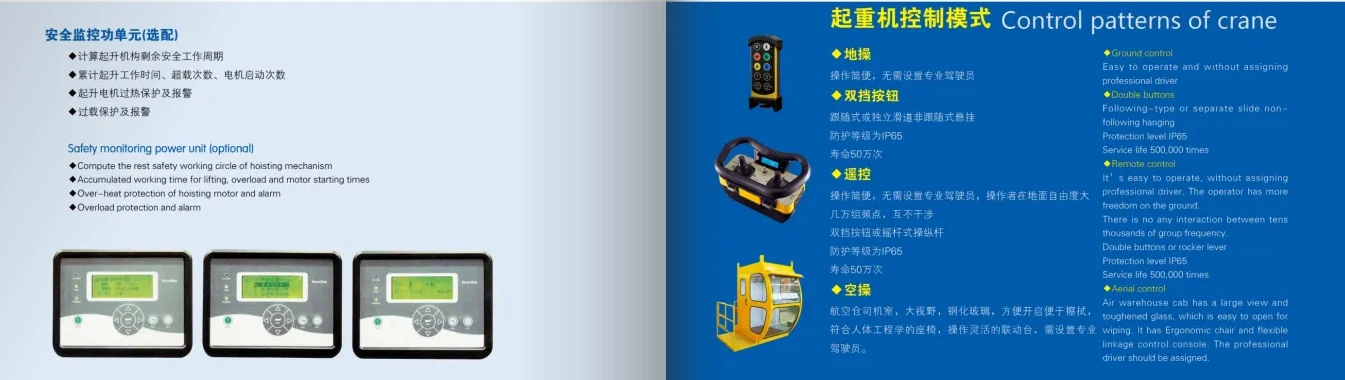
Control: Standard operation is from a pendant push-button station suspended from the crane. Cab operation or radio remote control are common options.
Advantages of QDY Cranes
Cost-Effective: Standardized design and use of mass-produced hoists keep costs lower than custom-engineered cranes.
Reliable & Proven: Simple, time-tested mechanical and electrical design ensures dependable operation.
Easy Maintenance: Components like the hoist are standard and readily available, making repairs and part replacement straightforward.
Good Load Capacity & Span: The double girder design handles heavier loads and longer spans more effectively than single girder (LD-type) cranes.
Modular & Customizable: While standard, options can be added for specific needs (higher duty class, different controls, special safety features).
Important Distinctions from Other Models
QDY vs. QD (or European-style EOT):
QD often refers to a heavier-duty double girder crane with a separate trolley and drum hoist. The QD's trolley is more robust, and its drum hoist is built for higher duty cycles (A5-A7). The QDY, with its standardized hoist, is generally for lighter-duty applications.
QDY vs. LD (Single Girder):
LD is a single girder crane with a hoist running underneath the beam. It's cheaper and suitable for light loads (<20t) and short spans (<~22.5m). QDY is for heavier/higher/longer requirements.
QDY vs. Grab Bucket Crane:
This is the fundamental difference. QDY uses a HOOK. It is for lifting discrete, unitized loads. The grab bucket crane replaces the hook with a clamshell bucket for bulk, granular materials (coal, grain, sand).
Key Technical Parameters (Typical Range)
| Parameter | Common Range | Notes |
|---|---|---|
| Lifting Capacity | 5, 10, 16/20, 32, 50 tons | Standard ratings up to 80t or more. |
| Span (S) | 10.5m to 31.5m | In increments of 3m or 0.5m. Longer spans possible with reinforced design. |
| Lifting Height (H) | 6m, 9m, 12m, 18m, 24m, 30m | Custom heights available. |
| Work Duty | A3, A4, A5 | Defined by number of starts per hour and load spectrum. |
| Hoist Speed | ~7-8 m/min (main) / ~0.8-2 m/min (aux) | Varies with capacity. Dual-speed hoists common. |
| Travel Speed | ~20 m/min (Trolley) / ~30 m/min (Bridge) | Crane travel speed typically 20-40 m/min. |
| Power Supply | 3-Phase, 380V, 50Hz | Standard for Chinese market. Other voltages available. |

Pictures & Components
Here is a comprehensive breakdown of all major components for the standard QDY crane, organized by system and function.
1. BRIDGE STRUCTURE
1.1 Main Girders
Primary Function: The two main load-bearing beams that span the workshop.
Design: Welded box girders made from steel plates (typically Q235B or Q345B).
Key Features:
Pre-cambered: Manufactured with an upward curve to counteract deflection under full load.
Trolley Rails: The top surface has precisely aligned steel rails (usually P-type or QU-type) for the trolley to run on.
Diaphragms: Internal stiffening plates to prevent buckling and torsion.
Connection Plates: At each end, with machined holes for bolting to the end trucks.
1.2 End Trucks
Primary Function: Wheeled assemblies that support the bridge girders and enable long travel along the runway.
Components:
End Truck Frame: Rigid, fabricated steel box structure.
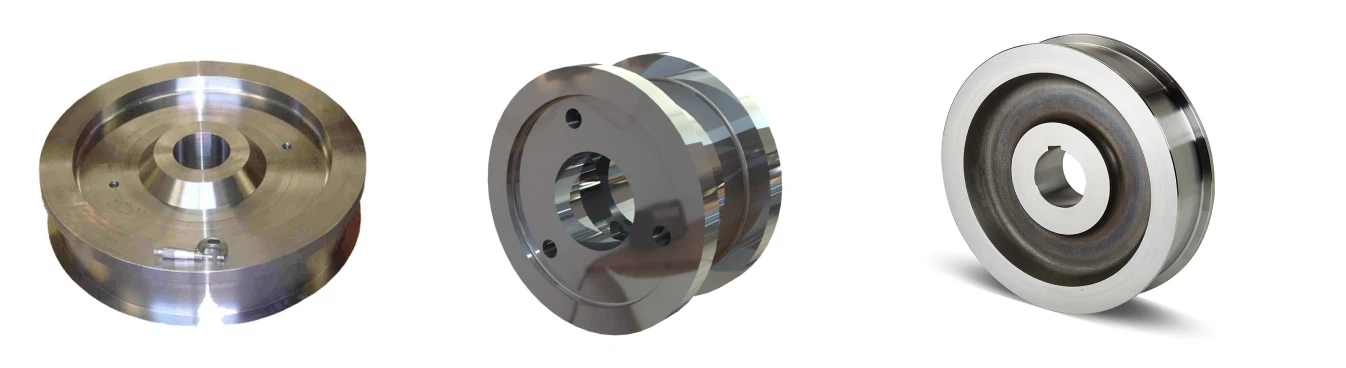
Wheels (Travel Wheels): Double-flanged forged steel wheels that run on the runway rails. Usually 4 or 8 wheels total.
Axle & Bearings: Wheels are mounted on axles with heavy-duty spherical roller bearings.
Drive Assembly: For driven end trucks.
Buffer (Bumper): Rubber or polyurethane shock absorbers at each end to absorb impact.

2. TROLLEY & HOISTING SYSTEM
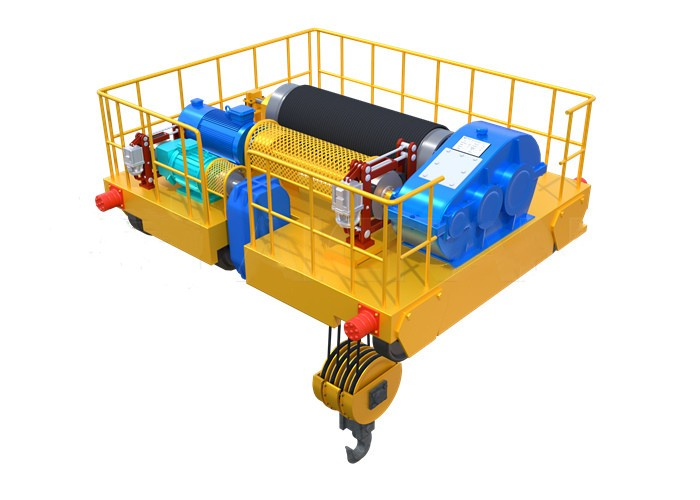
In a QDY, the trolley is essentially the carrier for a standardized electric hoist.
2.1 Trolley Frame
A rigid steel frame with four (or eight) running wheels that engage the rails on the main girders.
2.2 Trolley Travel Drive
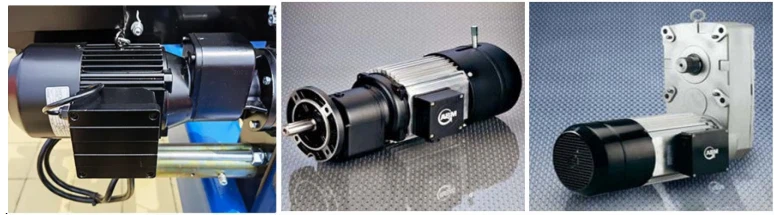
Drive Motor: A separate, flange-mounted three-phase brake motor.
Gearbox: A small reduction gearbox connected to the drive wheels.
Drive Wheels: Usually 2 of the trolley's wheels are driven.
 |
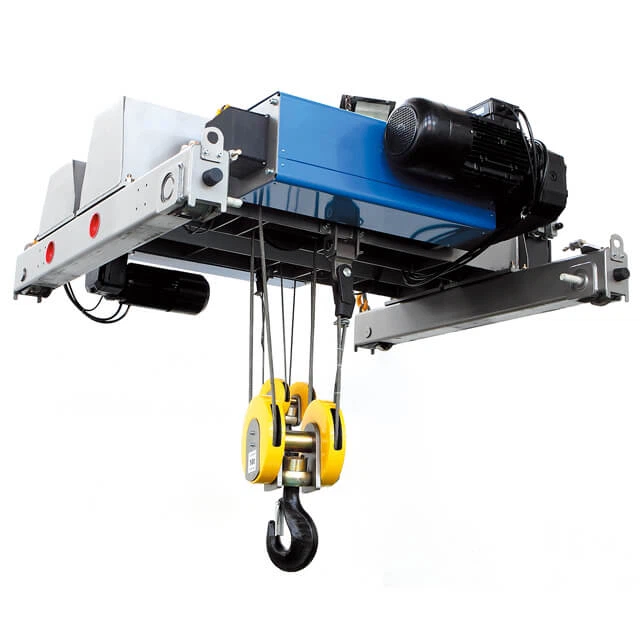 |
2.3 Electric Wire Rope Hoist
This is the core lifting component, mounted centrally on the trolley frame.
Hoist Motor: Dual-speed conical rotor motor (e.g., ZD/YZD series). Provides main (fast) and micro (slow) lifting speeds.
Conical Rotor Design: The brake is integrated; when power is cut, a spring pushes the rotor into a conical stator, creating an instant mechanical brake.
Gear Train: Multi-stage helical or planetary gears inside the hoist housing for speed reduction.
Drum: A grooved steel drum around which the wire rope is wound.
Wire Rope: 6x37 or 6x19 class steel wire rope with a fiber core (FC) or independent wire rope core (IWRC). Fitted with a hook block.
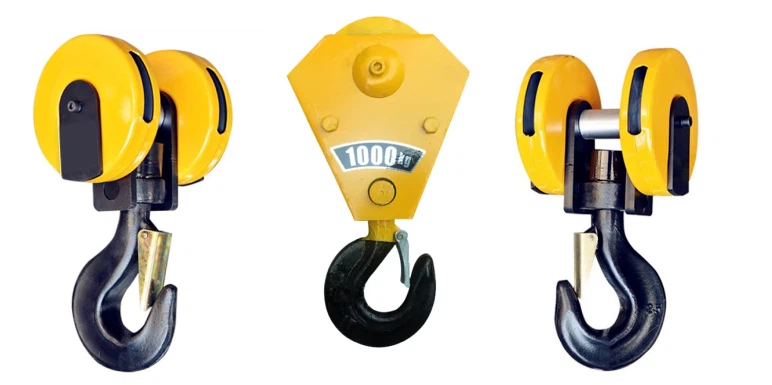
Hook Block: The lower assembly containing the swivel hook (Grade 80 alloy steel), sheaves, and overload safety latch.
Upper/Lower Limit Switches: Mechanical or rotary limit switches that automatically cut power at the top and bottom safe limits.
 |
 |
3. TRAVEL DRIVE SYSTEM
3.1 Bridge (Long) Travel Drive
Drive Configuration: Separate Drive is most common for QDY. Each end truck has its own drive unit, synchronized electrically.
Drive Unit: Modern QDY cranes use "Three-in-One" Drive Units.
This is an integrated package combining the brake motor, hardened helical gear reducer, and wheel coupling into a compact, flange-mounted unit. It's reliable and easy to maintain.
Alternative: Traditional separate motor, coupling, and gearbox setups are also used.
4. ELECTRICAL & CONTROL SYSTEM
4.1 Power Supply System
Main Power Source: 380V, 3-Phase, 50Hz AC (Standard China Industrial).
Power Feeding to Crane:
Flexible Cable (Drag Cable) Method: A heavy-duty rubber-sheathed cable suspended in loops, dragged by the crane. Common for smaller spans.
Cable Reel or Festoon System: More common for QDY. A spring-driven or motorized reel manages the power cable. Slip Ring Collector systems are used for clean power transmission to the moving crane.
Main Circuit Breaker: Located in the Main Electrical Panel on the bridge, provides short-circuit and overload protection for the entire crane.
4.2 Control System
Control Voltage: Typically 36V or 48V safety extra-low voltage (SELV) for the operator's controls.
Control Panel: Houses:
Contactors & Relays: For controlling motor directions (up/down, left/right, forward/back).
Overload Current Relays: Protects each motor from current overload.
Transformer: Steps down 380V to the control voltage.
Operator's Pendant:
A suspended, sealed metal or plastic box with mushroom-head emergency stop button and directional push buttons (Up/Down, Left/Right, Forward/Back).
Connected to the crane via a flexible control cable.

4.3 Safety & Limit Devices
Travel Limit Switches:
For Bridge Travel: Lever-arm type limit switches mounted at both ends of the bridge girder. Strikers on the runway building activate them to cut power.
For Trolley Travel: Similar lever-arm switches mounted on the trolley frame, activated by strikers on the main girders.
Hoist Limit Switches: Integral to the electric hoist (as mentioned above).
Emergency Stop Buttons: On the pendant and often also on the control panel.
5. SAFETY & AUXILIARY COMPONENTS
Buffers & Bumpers: Rubber, polyurethane, or hydraulic buffers on the end trucks and trolley.
Rail Sweeps: Metal plates attached ahead of the bridge wheels to clear debris from the runway rail.
Walkways & Guardrails: Service platforms with handrails along one side of the bridge for maintenance access.
Ladder & Access Platform: Fixed ladder from the ground to the walkway level.
Warning Device: An electric bell or buzzer, often activated automatically when the crane starts moving.
Lighting: A floodlight on the bridge to illuminate the work area below.

6. SUPPORTING INFRASTRUCTURE
These are typically supplied by the building contractor, not the crane manufacturer, but are critical.
Runway Beams: Steel or concrete beams that support the rails. Must be designed for the crane's wheel loads.
Crane Rails: P-type (P38, P43, P50) or QU-type (QU70, QU80, QU100) steel rails. Secured to the runway beam with rail clips and bolts.
Rail End Stops: Heavy steel stops at the physical end of the runway rails to prevent the crane from running off.
Sketch

Main technical

Advantages
Advantages of QDY Model Electric Hook Double Girder Bridge Crane
1. Heavy-Duty Load Capacity
Double box girder structure provides high strength and rigidity
Suitable for large tonnage lifting (generally 20–250 tons)
Designed for high working classes such as A5–A8
2. Stable and Reliable Operation
Winch trolley ensures smooth lifting and lowering
Reduced deflection and vibration during operation
Suitable for long-span and high-load conditions
3. High Lifting Height & Wide Span
Trolley runs on rails mounted on top of girders
Allows large lifting heights and customized spans
Ideal for high-bay workshops and heavy industrial plants
4. Strong Adaptability to Harsh Environments
Can operate under:
High temperature
Dusty conditions
High humidity
Optional heat-resistant, dust-proof, or corrosion-resistant designs available
5. High Working Efficiency
High lifting speed and travel speed options
Suitable for continuous and frequent lifting operations
Improves production efficiency in heavy manufacturing
6. Flexible Control Methods
Operator cabin (standard for large tonnage cranes)
Pendant control
Wireless remote control (optional)
Frequency inverter (VFD) for smooth speed control
7. Complete Safety Protection
Overload limiter
Upper and lower lifting limit switches
Emergency stop system
Buffers and rail sweepers
Anti-derailment devices
Optional monitoring and anti-sway systems
8. Long Service Life & Easy Maintenance
Robust structural design and high-quality components
Easy access to trolley, motors, and electrical systems
Lower maintenance cost over long-term use
Application:
Applications of QDY Model Electric Hook Double Girder Bridge Crane
The QDY crane is widely used in heavy industry and large-scale manufacturing facilities.
1. Metallurgical Industry
Steel mills and foundries
Handling molten metal equipment (non-ladle use)
Lifting steel slabs, billets, and large castings
2. Machinery Manufacturing
Assembly and handling of heavy machinery
Lifting large machine tools, presses, and molds
3. Power Plants
Installation and maintenance of generators and turbines
Handling transformers and heavy electrical equipment
4. Shipbuilding & Heavy Equipment Workshops
Handling ship components and large steel structures
Assembly operations in large fabrication halls
5. Construction Material Plants
Handling large prefabricated components
Lifting concrete molds and heavy production equipment
6. Railway & Transportation Industry
Lifting locomotives, wagons, and rail components
Maintenance and repair workshops
Crane production procedure
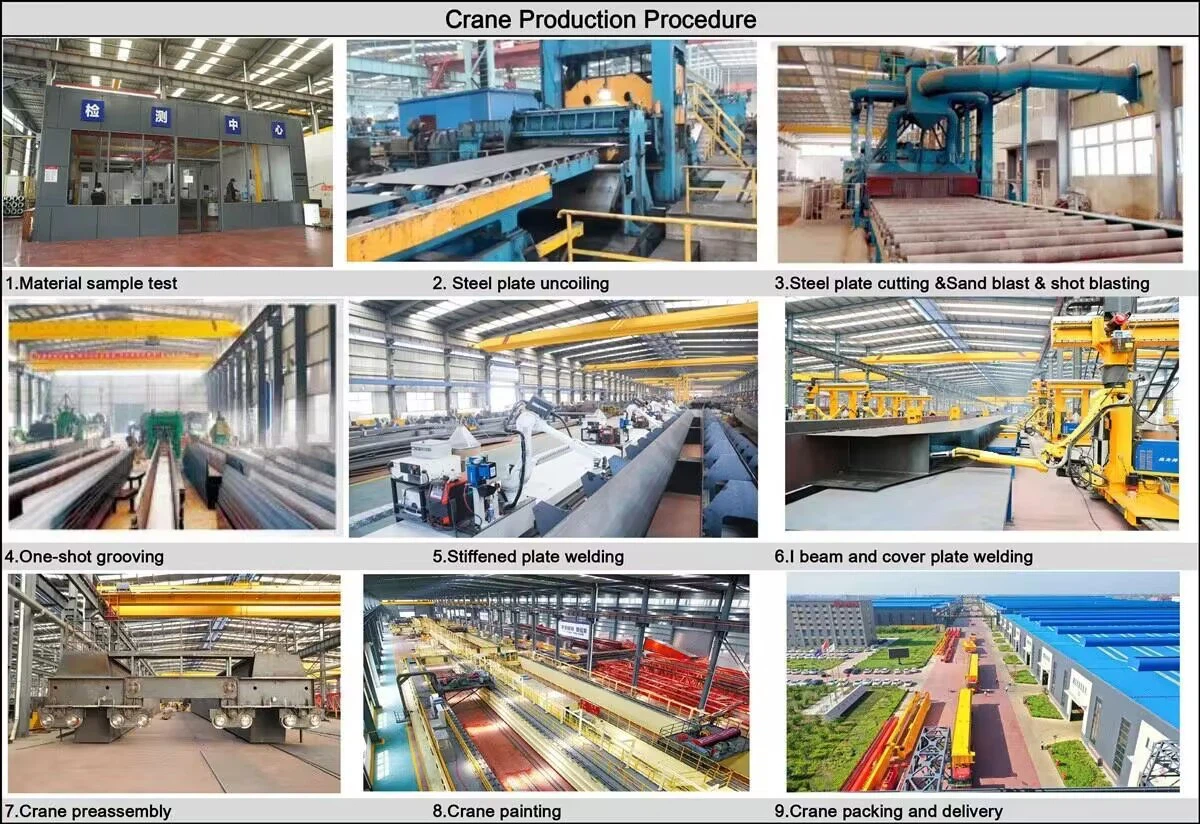
The QDY Model Electric Hook Double Girder Bridge Crane is a heavy-duty overhead crane equipped with a winch trolley, designed for large lifting capacity, high working duty, and continuous industrial operation. The production process follows strict quality and safety standards such as GB/T, FEM, ISO, and CE.
1. Engineering Design & Planning
Load capacity, span, lifting height, and duty class confirmation
Structural calculation and FEM analysis
Selection of winch trolley, motors, reducers, and brakes
Electrical system and safety device configuration
2. Raw Material Selection & Inspection
High-strength structural steel (Q235B / Q345B or equivalent)
Verification of steel certificates and mechanical properties
Ultrasonic testing for internal defects
Shot blasting or surface cleaning before fabrication
3. CNC Cutting & Component Preparation
CNC plasma or flame cutting of girder plates, stiffeners, diaphragms
Edge beveling for welding
Dimensional inspection and part identification
4. Double Girder Fabrication
4.1 Box Girder Assembly
Assembly of web plates, flange plates, and internal diaphragms
Use of special fixtures to ensure correct camber and alignment
4.2 Automatic Welding
Submerged arc welding for longitudinal seams
CO₂ gas-shielded welding for joints and reinforcements
4.3 Stress Relief & Straightening
Heat or vibration stress relief treatment
Mechanical straightening to correct deformation
4.4 Non-Destructive Testing
Ultrasonic Testing (UT)
Magnetic Particle Testing (MT)
Visual inspection of all welds
5. End Carriage Manufacturing
Welding of box-type end beams
CNC machining of wheel mounting surfaces
Installation of:
Crane wheels
Travel motors
Gear reducers
Braking systems
Wheel alignment and running tests
6. Winch Trolley & Hoisting Mechanism Assembly
Fabrication of trolley frame
Installation of:
Hoisting motor
Gear reducer
Wire rope drum
Hook block and pulley system
Installation of overload limiter and lifting limit switches
Trolley traveling motor and brake installation
7. Electrical System Assembly
Electrical control cabinet manufacturing
Installation of contactors, relays, PLC, VFD (optional)
Wiring of hoisting, trolley, and crane travel systems
Installation of safety protection devices
8. Surface Treatment & Painting
8.1 Shot Blasting
Steel structures blasted to Sa2.5 standard
8.2 Painting Process
Epoxy zinc-rich primer
Epoxy intermediate coating
Polyurethane topcoat
Color and coating thickness customized per requirements
9. Crane Assembly & Pre-Commissioning
Assembly of double girders and end carriages
Installation of winch trolley on girder rails
Power supply system installation (busbar or festoon cable)
Electrical wiring and functional checks
10. Factory Acceptance Testing (FAT)
Testing Includes:
No-load operation test
Static load test (125% rated capacity)
Dynamic load test (110% rated capacity)
Braking performance and speed tests
Verification of safety devices and limit switches
11. Packing & Transportation
Electrical components packed in wooden crates
Trolley protected with steel supports
Girders wrapped with moisture-proof materials
Transported by container or bulk shipment
12. On-Site Installation & Commissioning
Installation on runway beams
Electrical connection and grounding
Final load testing and safety verification
Operator training and handover
13. Final Inspection & Documentation
Performance acceptance and sign-off
Delivery of certificates, manuals, and test reports
Warranty and after-sales support
Workshop view:
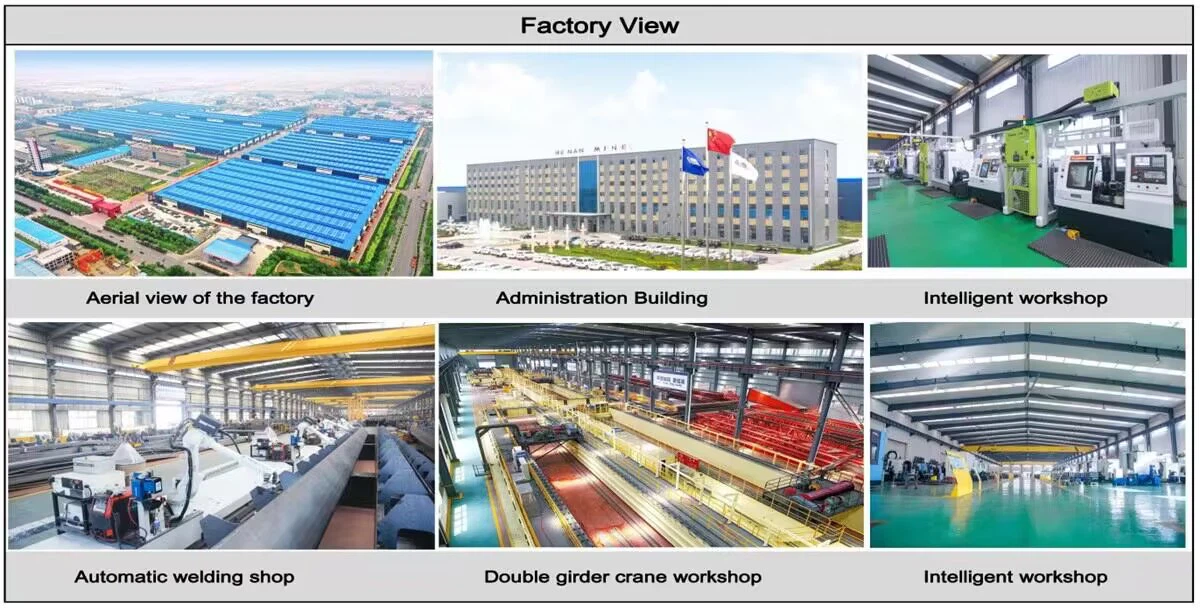
The company has installed an intelligent equipment management platform, and has installed 310 sets (sets) of handling and welding robots. After the completion of the plan, there will be more than 500 sets (sets), and the equipment networking rate will reach 95%. 32 welding lines have been put into use, 50 are planned to be installed, and the automation rate of the entire product line has reached 85%.


Hot Tags: qdy model electric hook double girder bridge crane, China qdy model electric hook double girder bridge crane manufacturers, suppliers, factory, Double Girder Overhead Crane, Double Girder Overhead Travelling Crane
You Might Also Like


Send Inquiry