


Wall Travelling Jib Crane for Welding Workshop Efficiency
Most Important Takeaway
A wall travelling jib crane is a space-saving workshop lifting system designed to improve welding production flow by enabling fast, controlled movement of pipes, steel structures, and fabricated assemblies between welding stations, rotators, and assembly benches without blocking floor space.
Optimizes welding workshop material handling and workflow efficiency
Enables fast transfer between pipe welding stations, assembly benches, and inspection areas
Reduces forklift dependency in narrow fabrication layouts
Improves safety and precision when positioning heavy steel components
Best suited for 1–5 ton welding and steel fabrication applications
Works with welding rotators, fixtures, and pipe positioning systems
Key Questions This Guide Solves
When planning a welding workshop or upgrading a fabrication line, the main concern is usually not the crane itself, but how smoothly material moves between welding stages. These questions reflect the real decisions buyers face on the shop floor.
+What is the best crane for welding workshop material handling?
+How does a wall travelling jib crane improve welding production efficiency?
+Can it handle pipe welding, steel frames, and fabrication parts safely?
+What capacity (1 ton, 2 ton, 3 ton, 5 ton) is suitable for my workshop?
+How do I move heavy steel parts between welding stations efficiently?
+Is a wall mounted jib crane better than overhead cranes in small workshops?
In practical terms, these questions focus on one point: how to build a stable, safe, and continuous material flow inside a welding workshop without unnecessary handling steps or production delays.
Welding Workshop Material Handling Challenges
Welding workshops are usually tight spaces. Pipe welding, steel fabrication, and assembly work often sit very close to each other. It keeps production compact, but movement becomes difficult.
Material does not stay still in a welding workshop. It moves step by step:
+Material flow between cutting and welding stations
+Movement from welding to fixture or rotator
+Transfer to inspection or finishing stage
This repeated transfer creates delays. Not always big delays, but enough to slow down the flow.
Forklifts are not always suitable inside these narrow areas. They take space, and turning is limited. Manual handling is another option, but it becomes slow and unsafe when parts are heavy or awkward in shape, like long pipes or welded frames.
What actually happens on the shop floor
In many workshops, operators end up waiting for material to arrive. Or they spend extra time adjusting position before welding starts. It breaks rhythm.
Over time, this reduces station efficiency. Not because of welding itself, but because of material movement between stations.
Where a wall travelling jib crane fits in
A wall travelling jib crane is built for this kind of layout.
It moves along the workshop wall and covers multiple workstations in a straight line. It does not take floor space, so aisles stay open for people and equipment.
In practice, it helps like this:
+Direct lifting to welding stations
+Transfer between fixtures and workbenches
+Continuous production line material flow
No extra repositioning. No blocking of the floor area.
It simply supports steady movement from one welding step to the next, which is exactly what compact fabrication workshops need.
What Is a Wall Travelling Jib Crane in Welding Applications
A wall travelling jib crane is a wall-mounted lifting system that runs along a fixed runway beam installed on the workshop structure. It has a jib arm that can lift, rotate, and travel horizontally along the wall.
So instead of working in one fixed position, it can serve several welding stations in a row. Short movement distance. Repeated lifting tasks. That's the main idea.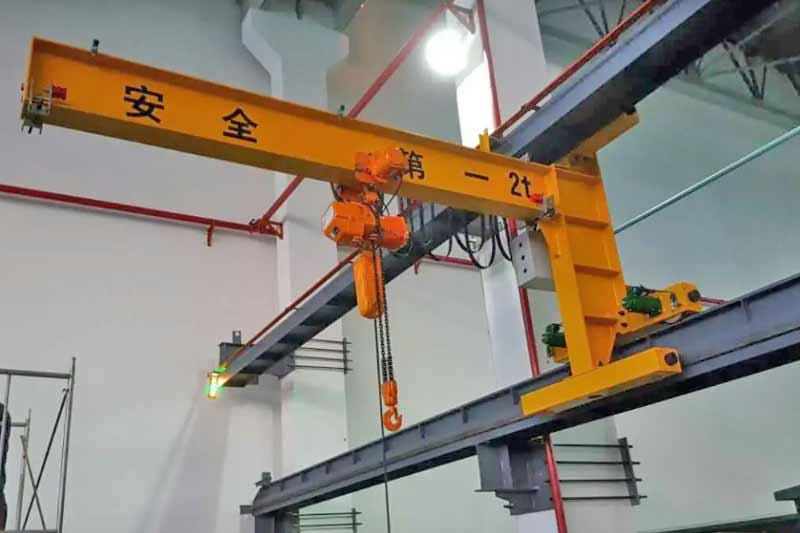
Wall travelling Jib Crane for Sale
How it is used in real welding work
In welding workshops, this type of crane is usually used for practical handling tasks like:
Moving pipe sections and positioning them for welding
Handling steel structures during fabrication and assembly work
Feeding materials directly onto welding rotators and fixtures
Transferring finished weldments to the next production stage
Nothing complicated in concept. It simply supports the flow of parts between each welding step.
Why it matters in fabrication lines
In many steel and pipe fabrication shops, work is arranged in a sequence. One station prepares, another welds, another checks.
A wall travelling jib crane supports that sequence. It keeps material moving along the same line without needing forklifts or manual dragging.
In simple terms, it acts as a local handling system for welding workshops. It sits close to the work, follows the station layout, and helps operators move heavy parts with less effort and more control.
Best Application Areas in Welding and Fabrication Workshops
A wall travelling jib crane is not used everywhere. It fits best where welding work follows a clear flow, station by station, instead of random handling.
In real workshops, you usually see it installed where production is repetitive and movement between stations happens all the time.
Where it works best in practice
It is commonly used in:
Pipe welding production lines
Long pipes, spools, and sections need frequent lifting and precise positioning along multiple welding points.
Steel fabrication workshops
Beams, frames, and structural parts move continuously between cutting, welding, and assembly areas.
Welding rotator and positioner stations
Heavy cylindrical parts need to be lifted onto rotators and adjusted during welding.
Structural steel assembly lines
Large fabricated components are moved step by step as they are built.
Multi-station welding workshop layouts
Several welding benches arranged in a row, each needing quick material supply.
When it performs best
You get the most value when the workshop is arranged in a straight or semi-linear flow. One station feeds into the next. No random movement, no scattered layout.
In that kind of setup, the crane supports steady material flow. Parts move forward through the welding process without interruption, from one stage to another.
Recommended Crane Types for Workshop Layouts (Application-Focused)
In welding and fabrication workshops, crane selection is not about the machine first. It is about what work is being done, and how material moves between stations.
Different layouts need different lifting behavior. Some need line feeding, some need point lifting, and some need full workshop coverage.
+Wall Travelling Jib Crane → Multi-Station Welding Workflow
+Wall Mounted Jib Crane (Fixed Type) → Single Workstation Welding
+Freestanding Jib Crane → Flexible Workshop or Open Area Use
+Overhead Bridge Crane → Full Workshop Heavy Fabrication Handling
Practical Workshop Reality
In most welding and fabrication shops, these cranes are not used separately.
A common setup is:
Wall travelling jib crane → handles station-level movement
Overhead bridge crane → handles heavy lifting and long-distance transfer
Together, they support a smoother material flow from raw steel handling to final welding and inspection.
Capacity Selection for Welding Workshop Applications
Capacity selection is not just a technical detail. In welding workshops, it directly affects how smoothly material moves between stations and how safely operators can work.
The right choice usually depends on the size of steel parts, pipe sections, and how often lifting is repeated during production.
+Wall Jib Crane → Light Welding and Small Parts
+Jib Crane → Most Common Welding Workshop Choice
+Jib Crane → Structural Steel and Heavy Assembly Work
+Jib Crane → Heavy Fabrication and Large Welding Structures
Practical Selection Insight
In real welding workshop practice, most buyers do not go for extremes.
The majority choose 2 ton or 3 ton wall travelling jib cranes because:
They cover most pipe welding and steel fabrication needs
They handle daily production loads without overdesign
They fit better with typical workshop layouts and station spacing
In short, capacity is matched to workflow, not just maximum weight.
Typical Loads in Welding Workshop Material Handling
In welding and fabrication workshops, a wall travelling jib crane is mainly used for parts that are heavy, awkward in shape, and need repeated positioning between stations. It is not just about lifting weight. It is about placing the workpiece exactly where welding starts.
Common loads handled in daily production
Pipe spools and pipeline sections
Long and sometimes unbalanced. Often need careful positioning onto welding rotators or supports.
Steel frames and structural beams
Large welded structures used in construction and industrial fabrication. These usually move from assembly to welding in stages.
Welding fixtures and assembly jigs
Repetitive use items. They need frequent lifting, repositioning, and adjustment during production changes.
Cylindrical tanks and rollers
Heavy and unstable if not balanced properly. Usually require controlled rotation and precise placement.
Steel plates and cut components
Flat but heavy. Often lifted in batches or moved to cutting and welding stations.
Fabricated brackets and welded assemblies
Smaller components, but handled frequently throughout production cycles.
Why controlled movement matters
These materials are not simple loads. Most of them are long, uneven, or sensitive to positioning.
In welding work, even a small misalignment can affect weld quality. That is why smooth lifting and accurate placement matter more than speed.
A wall travelling jib crane helps operators position each part directly at the welding point, without repeated adjustment or manual pushing.
In practice, it supports one simple requirement on the shop floor: place the right part in the right position, without extra handling steps.
Why It Improves Welding Workshop Efficiency
In a welding workshop, most delays do not come from welding itself. They come from moving materials between stations, waiting for lifting equipment, or adjusting workpieces before welding starts. A wall travelling jib crane is used to reduce these small interruptions that build up during daily production.
How it improves real workshop flow
Reduces waiting time between welding stations
Materials move directly along the production line. No long waiting for forklifts or manual lifting. Workpieces reach the next station faster, so operators stay active instead of waiting.
Removes unnecessary forklift movement inside aisles
Forklifts are often used for heavy lifting, but inside welding workshops they can slow down traffic and block narrow spaces. A wall travelling jib crane keeps lifting along the wall, away from main working paths.
Improves positioning at welding rotators and fixtures
Pipe sections, steel frames, and tanks need to sit in the right position before welding starts. Controlled crane movement helps place them accurately without repeated adjustments.
Supports a continuous production flow
From cutting, to welding, to assembly, and then inspection, the material moves step by step. The crane keeps this sequence smooth without breaking the workflow between stations.
Increases welding station utilization
When materials arrive on time, welding stations spend less time idle. Operators can focus on welding work instead of waiting for parts to be delivered or repositioned.
Practical outcome on the shop floor
In real use, the benefit is simple. Work does not stop between steps.
Steel parts move in a steady direction. Pipe sections go from one welding point to the next without delay. Operators spend more time welding and less time handling or waiting.
That is where efficiency comes from in welding workshops-not faster lifting alone, but smoother movement between processes.
Key Design and Safety Considerations
In welding workshop environments, the crane is working close to heat sources, metal sparks, and constantly changing load positions. So the design is not only about lifting capacity, but also about how stable and safe the system remains during daily production cycles.
A wall travelling jib crane must be planned with real workshop conditions in mind-tight spaces, rotating equipment, and continuous movement between stations. If these factors are ignored, problems usually show up later in vibration, wear, or unsafe operation.
For welding workshop environments, key factors include:
Heat-resistant cables for welding zone exposure
Strong wall or runway beam structure for dynamic loads
Safe clearance around welding rotators and fixtures
Protection from welding sparks and spatter
Stable load control for precise welding positioning
Each of these points directly affects how the crane performs in daily use. For example, proper clearance prevents collision with rotators, while stable load control helps operators place steel pipes and frames accurately before welding starts. Heat and spark protection also extends the service life of electrical components in harsh working zones.
Proper design ensures long-term reliability in fabrication environments.
In practical terms, a well-designed system reduces unplanned downtime, keeps movement smooth along the workshop wall, and supports safe, repeatable operation in welding production lines.
Control System and Operational Performance
In welding workshops, control system choice directly affects how smoothly material moves between stations. The environment is often noisy, hot, and space-limited, so operators need simple and reliable control during frequent lifting cycles.
A wall travelling jib crane is usually operated many times per shift, not occasionally. That means the control system must support repeated starts, stops, and precise positioning without causing load swing or operator fatigue.
For welding workshop use, recommended systems include:
Wireless remote control system
safer operation away from heat and arc zones
VFD (Variable Frequency Drive) control
smooth acceleration and reduced load swing
improved positioning accuracy on welding fixtures
Wireless control is widely used in fabrication shops because it allows the operator to stand at a safe distance from welding heat, sparks, and rotating equipment. It also gives better visibility when aligning pipe sections or steel frames into position.
VFD control focuses on movement quality. Instead of sudden starts or stops, the crane moves in a controlled way. This helps reduce shaking of long pipes or unstable steel assemblies during lifting and lowering.
Better operator control during repetitive welding cycles.
In real workshop conditions, this means less correction work, faster positioning at each station, and more stable handling during continuous production. The result is smoother workflow between welding, assembly, and inspection stages.
Workshop Integration with Welding Production Lines
In welding workshops, lifting equipment is most useful when it is not working alone, but connected directly to the production flow. A wall travelling jib crane is typically installed along the main welding line so it can support each stage of fabrication without interrupting the process.
It does not only lift materials. It supports how work actually moves through the workshop-from raw steel to finished welded parts.
A wall travelling jib crane integrates into welding workflow in a practical way:
Feeding raw material into welding stations
Positioning workpieces on rotators and fixtures
Supporting active welding and repositioning
Transferring finished components to inspection or storage
Each step follows the real sequence of production. Steel sections come in first, then are placed at welding stations. During welding, the crane may be used again for adjustment or repositioning. After welding, the same system moves the finished structure to the next stage.
This keeps the material flow consistent along the workshop line. No unnecessary backtracking. No repeated manual handling.
This creates a continuous welding workshop material handling system.
In practical operation, it means welding stations stay supplied, operators spend less time waiting, and the movement between cutting, welding, assembly, and inspection becomes more stable and predictable.
Conclusion
A wall travelling jib crane is a highly effective material handling solution for welding workshops and steel fabrication facilities where space is limited and workflow efficiency is critical. By enabling fast, controlled movement of pipe welding components, steel structures, and fabricated assemblies between stations, it significantly improves production flow, reduces manual handling, and enhances safety.
For buyers, the most important decision factors are application type (pipe welding or fabrication), workshop layout, and selecting the correct capacity (typically 2–3 ton) to match real production loads and workflow demands.


