


Drives shall be provided with mechanical brakes. If in exceptional cases the drive is through a self-locking gear, the brake may be omitted, provided it has been ensured that no excessive stresses or movements can occur.
Brake mechanisms shall be easy to inspect. Brake springs shall be of the compression type.
Brakes must be adjustable and brake linings must be replaceable.
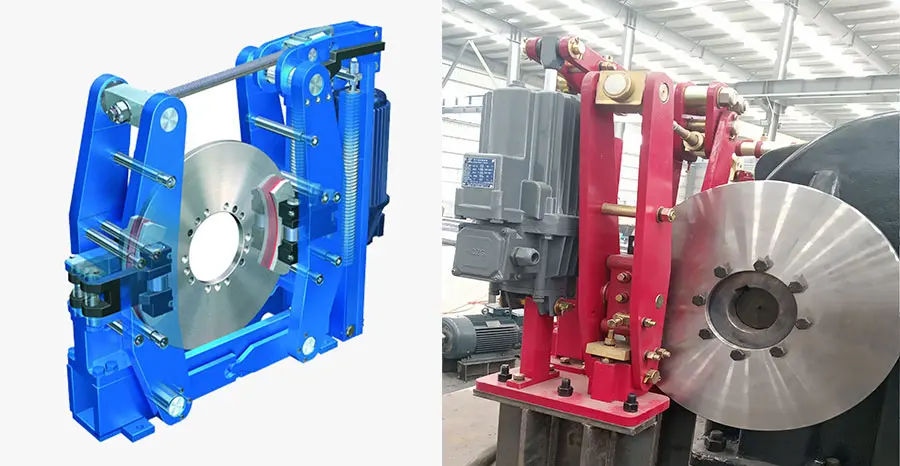
Cranes use several types of brakes depending on the function-hoisting, travel, or parking/storm safety. The most common are spring-applied, electrically or hydraulically released brakes for fail-safe operation.
Hoist units must be provided with brakes which are automatically applied and which can safely hold the test load in the event of switching off or failure of the hoist drive.
Brake systems shall be designed for 1.6 times the hoist load and they shall be capable of braking the dynamic test load without a damaging snatch effect and without unacceptable overheating.
Brakes of hoist units shall be arranged so that there is a positive mechanical link between the winch components which, on the one hand, generate the braking moment and, on the other hand, support the load.
Hoist units for carrying molten materials shall be provided with two mechanical brakes which operate independently of each other, each of which shall meet the preceding requirements ; the second brake shall be applied with a time lag in relation to the first one.
In special critical cases where failure of a driving unit must be catered for the second brake shall act on the rope drum ; this brake shall be so controlled that it is applied automatically, not later than the instant a speed of 1.5 times the nominal lowering speed has been reached. In such cases the control gear of the crane shall include an emergency stop which shall also activate the brake.
These are typically electromagnetic shoe brakes or disc brakes mounted on the hoist motor or gearbox shaft. They are spring-applied and electrically released: when power is cut, the spring engages the brake to hold the load safely . For heavier duty, spring-applied safety brakes (electromagnetic release) are used in hoisting and trolley applications .

Power driven travel drives of cranes and trolley shall be equipped with an automatic brake, or a brake which may be operated from the control position. Excluded from this category are cranes not subjected to wind, operating on a horizontal track at a speed not exceeding 40 m/min., or when on wheels with antifriction bearings, not exceeding 20 m/min. For cranes intended to carry molten materials, a brake is required independently of speed.
The brakes must be so designed that the crane or trolley can be brought to rest in a suitable time and held stationary in all operating conditions, under wind load when applicable and also in the case of power failure.
Non-automatic travel brakes of cranes and trolley exposed to the wind shall be provided with a clamping device.
Automatic travel brakes or anchoring devices shall be designed with a factor of safety not less than 1.1 against the maximum forces in out of service conditions.
Power driven slewing drives shall be provided with brakes designed to bring to a halt, in a suitable time and to hold the slewing part stationary in all service conditions, under wind load when applicable and in the event of power failure.

Luffing systems shall be provided with brakes designed so that in the event of shut down or failure of the luffing gear drive they shall be applied automatically and safely hold the jib with the test load in the most unfavourable position.
Brake mechanisms shall be designed for a minimum braking moment equivalent to 1.6 times the moment due to the hook load and the dead weight of the jib system plus 1.0 times the moment due to the wind load, in the most unfavourable operating configuration (i.e. maximum wind load in service).
For the crane out of service this shall be at least 1.1 times the moment due to the dead weight of the jib system and due to the wind (max. out of service storm wind) in the most unfavourable jib position or in a specified out of service jib position.


