


Single vs Dual Gantry Crane Systems for Timber Handling and Log Logistics Yards
Most Important Takeaway
For timber storage yards, log handling facilities, lumber distribution centers, and sawmill operations, the choice between a single timber handling gantry crane and a dual gantry crane system directly impacts material flow efficiency, truck turnaround times, timber stockyard productivity, and long-term operational costs. While a single rail mounted gantry crane can efficiently manage moderate timber volumes, dual gantry crane configurations provide substantially higher throughput, improved log handling capacity, greater operational flexibility, and the ability to perform simultaneous or tandem lifting operations for large timber bundles and long wood products.
- Single timber handling gantry crane systems provide a cost-effective solution for small and medium lumber yards.
- Dual gantry crane systems significantly increase timber loading, unloading, stacking, and dispatch capacity.
- Two cranes can simultaneously manage inbound logs and outbound lumber shipments.
- Tandem lifting operations allow safer handling of long timber packs, poles, glulam beams, and oversized wood products.
- Dual crane configurations reduce truck waiting times and improve timber yard logistics.
- Rail mounted gantry cranes improve storage density and stockyard organization.
- Log handling gantry cranes can be configured for synchronized lifting of long loads.
- Operational redundancy minimizes downtime during maintenance activities.
- Higher investment costs are often justified by increased timber throughput and faster inventory turnover.
- Future yard expansion plans should be considered when selecting between single and dual crane systems.
Questions This Guide Solves
Introduction to Timber Handling Gantry Crane Systems
The Role of Gantry Cranes in Modern Timber Logistics Yards
Timber handling operations have changed considerably over the last two decades. Many timber yards that once relied heavily on wheel loaders, forklifts, and manual sorting now use dedicated timber handling gantry cranes to move logs, lumber bundles, utility poles, engineered wood products, and packaged timber throughout the yard.
As timber volumes increase, the challenge is no longer simply lifting heavy loads. The real challenge is moving materials quickly, safely, and consistently while keeping trucks, railcars, production lines, and storage areas operating without delays. This is where rail mounted gantry crane systems have become an important part of modern timber logistics.
A well-designed timber handling gantry crane allows operators to lift, stack, sort, retrieve, and load timber with predictable cycle times. The crane travels along fixed rails, covering large outdoor storage areas while minimizing ground traffic congestion.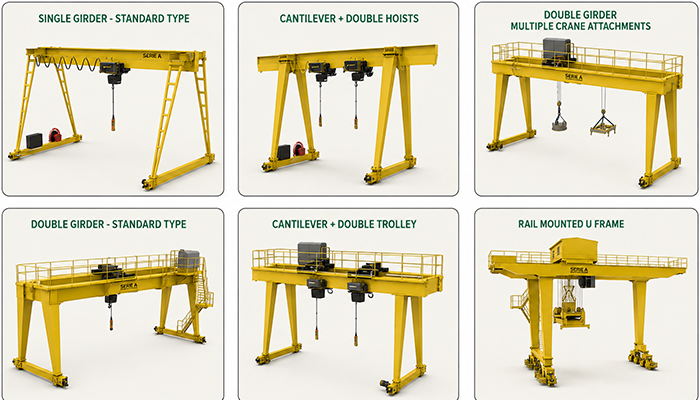
gantry crane systems for lumber, timber and log handling Timber Handling Gantry Cranes in Lumber Storage Facilities
Why Single vs Dual Gantry Crane Selection Matters
Choosing between a single gantry crane system and a dual gantry crane configuration is one of the most important planning decisions in a timber handling gantry crane project for sawmills, lumber storage yards, and timber logistics facilities.
This decision is not only about equipment quantity. It directly affects timber throughput, log handling gantry crane efficiency, truck loading speed, storage organization, and long-term yard expansion potential.
Many projects start by comparing purchase cost. In real timber yard operations, however, the long-term effect on material flow, congestion, and dispatch performance often has a much larger impact than the initial investment.
Impact on Timber Throughput Capacity
Single Timber Handling Gantry Crane Systems
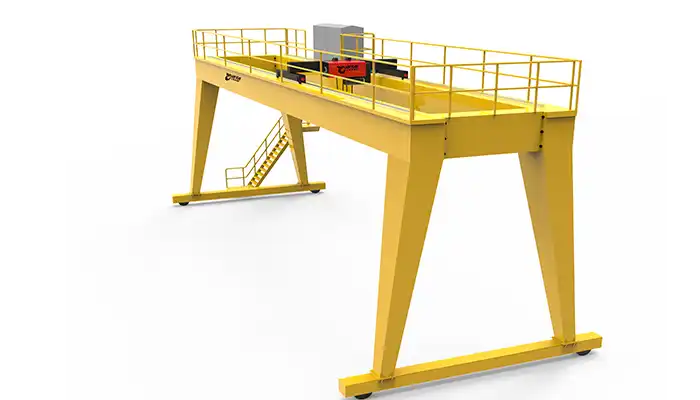
What Is a Single Gantry Crane Configuration?
A single gantry crane configuration uses one rail mounted gantry crane to perform all timber handling operations within a timber storage yard, sawmill, lumber distribution center, or wood processing facility. This includes movement of logs, lumber bundles, timber packs, poles, and engineered wood products across the yard.
This is one of the most widely used timber handling gantry crane solutions because it offers a balance between cost, simplicity, and coverage area. For many medium-scale operations, a single crane can support log handling gantry crane tasks, storage stacking, and truck loading in a controlled and predictable workflow.
The actual performance depends on crane capacity, span, travel speed, lifting speed, and timber yard layout. When storage zones and dispatch areas are properly planned, a single crane system can maintain stable material flow without major congestion.
Single Rail Mounted Gantry Crane Serving the Entire Timber Yard
Typical Applications
Single gantry crane systems are widely used in timber handling gantry crane projects across sawmills, lumber storage yards, and timber logistics facilities because they offer a practical balance between investment cost, operational simplicity, and material handling capability.
They are most suitable where daily log handling gantry crane workload remains within the capacity of one crane and where future expansion or dual gantry crane requirements are still uncertain.
In real timber yard operations, several facility types consistently adopt a single timber yard crane configuration due to stable and predictable material flow conditions.
Small Lumber Yards
Advantages of Single Timber Yard Crane Systems
The popularity of single gantry crane systems in timber handling gantry crane projects comes from their practical simplicity. They provide reliable log handling gantry crane capability while avoiding the higher complexity and cost of dual gantry crane systems in sawmills, lumber storage yards, and timber logistics facilities.
For many medium and small timber operations, a single rail mounted gantry crane offers a balanced solution between investment cost and daily material handling requirements.
Lower Initial Investment
Limitations of Single Log Handling Gantry Cranes
While a single gantry crane system is widely used in timber handling gantry crane applications across sawmills, lumber storage yards, and timber logistics operations, it also comes with practical limitations that become more visible as throughput demand increases.
These limitations are especially important when evaluating long-term capacity planning, log handling gantry crane workload growth, and potential future transition toward a dual gantry crane configuration.
Single Operational Bottleneck
Dual Gantry Crane Systems for Timber Logistics
What Is a Dual Gantry Crane Configuration?
As timber handling gantry crane demand increases in sawmills, lumber storage yards, and timber logistics operations, many facilities reach a point where a single log handling gantry crane can no longer maintain efficient loading, unloading, storage, and dispatch flow.
A dual gantry crane configuration uses two rail mounted gantry cranes operating within the same timber yard, lumber distribution center, or log handling facility. These cranes can operate independently or work in coordinated timber handling workflows depending on yard layout and production requirements.
The main purpose of a dual gantry crane system is to increase timber throughput capacity while reducing operational delays caused by competing crane tasks in high-volume environments.
Compared with a single crane system, dual configurations allow simultaneous timber handling operations, improving material flow stability across the entire yard.
In many large timber handling gantry crane projects, the decision to add a second crane is driven more by material flow constraints than by lifting capacity alone.
Two Timber Handling Gantry Cranes Operating Within One Yard
Types of Dual Crane Operations
Not all dual gantry crane systems in timber handling gantry crane applications operate in the same way. The configuration depends on timber size, log handling gantry crane requirements, storage layout, and overall throughput targets in sawmills, lumber storage yards, and timber logistics facilities.
Some systems run two cranes independently, while others use coordinated or tandem lifting operations to handle long timber bundles and heavy engineered wood products.
Understanding these operating modes helps determine which dual gantry crane configuration best fits real-world timber yard conditions.
Independent Crane Operations
Industries Using Dual Timber Handling Cranes
Dual gantry crane systems are commonly deployed in timber handling gantry crane applications where handling volume, timber size, or operational complexity exceeds the practical capacity of a single log handling gantry crane system.
These facilities typically prioritize continuous throughput, stable material flow, and reduced downtime in sawmill and timber logistics operations.
High-Capacity Sawmills
Throughput Comparison: Single vs Dual Log Handling Gantry Cranes
| Factor | Single Timber Handling Gantry Crane | Dual Timber Handling Gantry Crane System |
|---|---|---|
| Operating Method | One crane performs all tasks: • Log unloading • Lumber storage • Inventory movement • Truck loading | Two cranes share workloads: • Independent operation • Shared work zones • Simultaneous handling |
| Material Flow | Sequential workflow. One task often waits for another to finish. | Continuous material flow. Multiple tasks occur simultaneously. |
| Loading & Unloading | Loading and unloading compete for the same crane time. | One crane unloads logs while another loads trucks or railcars. |
| Timber Throughput | Limited by one crane's cycle time, travel speed, and lifting speed. | Higher throughput through parallel timber handling operations. |
| Logs Handled Per Hour | Suitable for low to medium log volumes. | Higher hourly log handling capacity. |
| Lumber Bundles Per Shift | Limited by available crane operating hours. | More bundles moved through simultaneous crane activity. |
| Truck Turnaround Time | Longer waiting times during busy periods. | Faster truck loading and unloading cycles. |
| Railcar Loading | Rail loading may interrupt normal yard operations. | Rail loading and yard handling can occur simultaneously. |
| Inventory Retrieval | Storage and retrieval may be delayed by loading priorities. | Inventory movement continues without affecting dispatch operations. |
| Stockyard Organization | Less time available for timber sorting and stock rotation. | Improved inventory rotation and storage management. |
| Harvest Season Demand | Greater risk of unloading queues and crane bottlenecks. | Handles increased log deliveries more efficiently. |
| Export Shipments | Large export orders may slow regular operations. | Export loading and routine handling proceed simultaneously. |
| Construction Season Peaks | Higher risk of dispatch delays. | Additional capacity supports increased lumber shipments. |
| High-Volume Dispatch | Truck queues become more common. | Faster loading improves dispatch performance. |
| Tandem Lifting Capability | Limited capability for very long loads. | Supports tandem lifting of: • Long timber bundles • Utility poles • Glulam beams • Engineered wood products |
| Operational Flexibility | Limited when multiple urgent tasks occur together. | Greater flexibility through workload sharing. |
| Maintenance Impact | Maintenance can stop most material handling activities. | One crane can continue operating during maintenance. |
| Redundancy | No backup lifting capacity. | Built-in backup improves operational reliability. |
| Scalability | Best for small and medium timber yards. | Suitable for expanding and high-volume timber logistics operations. |
| Typical Applications | • Small lumber yards • Medium sawmills • Timber treatment plants • Regional distribution centers | • High-capacity sawmills • Export timber terminals • Large lumber yards • Forestry logistics centers • Engineered wood plants |
| Overall Performance | Cost-effective solution for moderate timber handling volumes. | Maximum throughput for high-volume timber storage and dispatch operations. |
Tandem Lifting and Synchronized Crane Operations
What Is Tandem Lifting in Timber Handling?
As timber products in modern timber handling gantry crane systems become longer, heavier, and more value-sensitive, a single lifting point is often not enough to ensure safe and controlled handling. This is especially common in log handling gantry crane applications involving utility poles, glulam beams, engineered timber assemblies, long logs, and oversized lumber bundles.
Tandem lifting is a dual crane operation where two gantry cranes work together to lift, move, and position a single timber load. Instead of one crane carrying the full weight, the load is shared between two cranes to improve stability and reduce structural stress during lifting and transport.
In timber logistics yards, sawmills, and engineered wood facilities, tandem lifting is typically performed using dual gantry crane systems designed for synchronized operation across wide storage and handling areas.
The main purpose of tandem lifting is not simply increasing lifting capacity. In real timber yard practice, it is mainly used to improve load stability, control long-span timber deformation, and ensure safer movement of large timber products.
Two Gantry Cranes Lifting a Single Load Together
Benefits of Tandem Lifting Timber Loads
Tandem lifting in timber handling gantry crane and log handling gantry crane operations provides several practical advantages when dealing with long, heavy, or flexible timber products in sawmills, lumber yards, and timber logistics facilities.
These benefits become especially clear when materials exceed the safe single-point lifting range of a standard timber yard crane system.
Safer Handling of Long Timber Bundles
Timber Products Commonly Lifted in Tandem
Tandem lifting in timber handling gantry crane and log handling gantry crane operations is not required for every load. It is mainly used in sawmills, lumber yards, and timber logistics facilities when product length, weight distribution, or structural flexibility makes single-point lifting less stable.
In real timber yard practice, this method is applied selectively to improve safety and control during handling of oversized or high-value timber products.
Long Logs
Safety Considerations for Tandem Gantry Crane Operations
Tandem lifting in a timber logistics yard using dual gantry crane systems or rail mounted gantry crane equipment requires more control than standard single crane lifting. When two cranes operate together in a timber handling gantry crane environment, safety depends on coordination, load stability, and clear operating procedures.
Cost Analysis: Single vs Dual Timber Yard Crane Systems
Initial Capital Investment Comparison
When planning a timber handling gantry crane project in a timber logistics yard, the initial capital cost difference between a single system and a dual gantry crane configuration is usually the first point of evaluation. In practice, the decision is not only about purchase price, but also how the rail mounted gantry crane system supports long-term timber throughput, yard layout efficiency, and log handling gantry crane workflow requirements.
A single crane setup is generally simpler, with one lifting unit covering the full storage area. A dual crane system introduces additional equipment, coordination requirements, and a more developed timber yard crane infrastructure to support higher handling capacity and parallel operations.
Operating Cost Comparison
After installation, the real economics of a timber handling gantry crane system in a timber logistics yard are defined by operating cost rather than purchase price. These costs are directly influenced by utilization rate, cycle efficiency, and how well the rail mounted gantry crane system matches actual log handling gantry crane and timber yard crane workflows.
Cost per Ton of Timber Handled
In timber logistics, the most practical way to evaluate crane economics is not just total cost, but cost per ton of timber handled over time. This includes both capital cost distribution and operational efficiency.
Timber Yard Layout and Storage Optimization
Timber Stockyard Design Considerations
A timber handling gantry crane system is only as efficient as the yard layout it operates in. In many timber logistics yards, delays are not caused by crane capacity itself, but by poor storage planning, long travel distances, and unclear material flow between log receiving, storage, and dispatch areas.
When designing a timber stockyard for either a single or dual gantry crane system, the main goal is to keep material movement direct, predictable, and easy to manage under real operating conditions.
Dual Crane Coverage Planning
When a timber yard uses a dual gantry crane system, layout planning becomes more important because two cranes must operate within the same physical environment without interfering with each other.
The objective is to balance coverage, reduce overlap conflicts, and ensure smooth material flow across all storage and dispatch zones.
Optimizing Rail Mounted Gantry Crane Travel Paths
Optimizing crane travel paths is one of the most effective ways to improve performance in both single and dual timber handling gantry crane systems.
Even small improvements in travel efficiency can reduce cycle time and increase daily throughput.
Reliability, Redundancy, and Risk Management in Timber Handling Gantry Crane Systems
Downtime Risks with Single Crane Systems
In timber logistics yards, downtime risk is closely tied to how many cranes are available to support continuous material flow. A single timber handling gantry crane system, while cost-efficient and simple to operate, inherently carries a higher operational risk because all yard activities depend on one machine.
When that crane stops, the entire workflow is affected. This includes log receiving, lumber storage, truck loading, railcar dispatch, and inventory movement.
ROI Analysis for Timber Handling Gantry Crane Investments
When a Single Timber Handling Gantry Crane Is the Best Choice
A single timber handling gantry crane system delivers the strongest return on investment in operations where material flow is stable, moderate in volume, and not expected to expand rapidly. In these environments, the goal is not maximum throughput but controlled, predictable handling of logs, lumber bundles, and general timber storage movement.
A single log handling gantry crane works best when the yard does not experience constant pressure from simultaneous inbound and outbound logistics.
Typical conditions where a single crane provides optimal ROI include:
- Moderate timber volume with steady daily intake and dispatch
- Limited expansion plans for yard capacity or production scale
- Budget-sensitive operations where capital expenditure must be controlled
- Regional timber yards with predictable truck arrival schedules
- Small to mid-sized sawmills with balanced production and storage flow
In practical terms, a single crane system performs well when:
- Truck queues are minimal or manageable
- Storage movement does not interfere heavily with dispatch
- Peak demand periods are short and infrequent
- One crane can complete full cycle operations without frequent congestion
For many operators, this configuration provides a reasonable balance between investment cost and operational capability, especially when future scaling is not an immediate requirement.
When a Dual Gantry Crane System Delivers Maximum ROI
A dual gantry crane system becomes more economically efficient when throughput demand consistently exceeds the practical capacity of a single crane. In these cases, ROI is driven not by equipment cost alone but by how much additional timber volume can be processed, stored, and dispatched each day.
In high-intensity timber logistics environments, the ability to run parallel operations directly impacts revenue potential and delivery performance.
A dual timber handling gantry crane system typically delivers maximum ROI in:
- High-volume timber logistics centers handling continuous material flow
- Continuous sawmill production environments with steady output streams
- Export-oriented timber terminals with strict shipping schedules
- Heavy truck traffic yards with frequent inbound and outbound movement
- Large storage facilities managing multiple timber product categories
In these operations, two cranes allow:
- Simultaneous log unloading and lumber loading
- Continuous stockyard organization without interrupting dispatch
- Faster truck turnaround times during peak demand
- Reduced congestion at loading and staging areas
The financial return is not only based on cost reduction but also on increased handling capacity. When more tons of timber can be processed per day, the same yard space generates higher operational value.
In practice, dual crane systems often justify their higher initial investment through improved throughput stability and better ability to handle seasonal or export-driven demand spikes.
Throughput-Based Investment Evaluation
Summary Insight
From an ROI perspective, single timber handling gantry crane systems are best suited for controlled, moderate-volume operations where simplicity and lower capital cost are priorities. Dual gantry crane systems, however, provide stronger long-term returns in high-volume timber logistics environments where throughput, dispatch speed, and operational continuity directly determine business performance.
Buyer Specification Checklist for Single or Dual Gantry Crane Projects
Please fill in your project details below. Examples are provided to help you understand what kind of information is normally required for a timber handling gantry crane or dual gantry crane system in real timber yard operations.
Conclusion: Selecting the Right Timber Handling Gantry Crane Configuration
Choosing between a single timber handling gantry crane and a dual gantry crane system comes down to one key point: how smoothly timber must move through the yard under real operating pressure. Not just design capacity, but day-to-day flow in logs, lumber, storage, and dispatch.


