


Gantry Cranes in Industrial and Workshop Settings
Gantry cranes are a common sight in factories, warehouses, and heavy workshops. They may not always grab headlines, but they quietly do some of the heaviest lifting in industry. From moving steel beams in fabrication plants to handling machinery parts in assembly lines, gantry cranes keep operations smooth and efficient. Their ability to lift and transport heavy loads without the need for fixed overhead structures makes them especially useful in spaces where flexibility matters.
Ideal for workshops without permanent overhead crane runways
Can handle medium to very heavy loads depending on design
Used in industries like steel, automotive, machinery manufacturing, and shipbuilding
Why Choosing the Right Hoist Matters
Not all loads are the same. Some are compact and easy to lift, while others are long, flexible, or unevenly weighted. Choosing a crane with the wrong hoist setup can lead to slower operations, higher maintenance, or even safety risks. For example, a single-hoist crane might struggle to stabilize long beams, while a double-hoist setup might be overkill for smaller, routine lifts. Understanding the type of load you handle every day is the first step to picking the right crane configuration.
Single-hoist cranes are generally better for standard, shorter loads
Double-hoist cranes excel at stabilizing long, heavy, or awkward loads
Wrong configuration can lead to load sway, inefficiency, or downtime
Purpose of This Comparison
This guide is designed to help buyers and workshop managers make informed decisions. By comparing single-hoist and double-hoist gantry cranes, we'll break down the practical differences in handling, cost, and operational efficiency. Think of it as a roadmap: by the end, you'll have a clearer idea of which crane setup fits your daily work and long-term needs.
Helps buyers match crane type to load characteristics
Provides insight into operational efficiency and safety
Aims to reduce trial-and-error costs in crane selection
Gantry Crane Hoisting Configurations
Single-Hoist Gantry Cranes
A single-hoist gantry crane is the simplest type of gantry crane. It has one hoisting mechanism mounted on the bridge girder, which moves along the gantry frame to lift and transport loads. Despite its simplicity, it can handle a wide range of tasks efficiently. Its design is straightforward, making it easier to install, operate, and maintain compared to more complex cranes.
Typically consists of a single bridge, one trolley, and a single hoist
Can be powered electrically or manually depending on size
Simple structure reduces setup time and technical requirements

single hoist gantry cranes for sale, with customized spreader for long loads handling,
Typical Load Range and Applications
Single-hoist gantry cranes are versatile but best suited for moderate loads. They are ideal for everyday lifting tasks that don't involve long or unusually shaped items. Industries like small-scale manufacturing, maintenance workshops, and storage yards often rely on single-hoist cranes for their reliability and simplicity.
Load capacity usually ranges from 0.5 tons up to 20 tons
Common applications: lifting machinery parts, pallets, metal sheets, and smaller steel beams
Suitable for short-to-medium spans where high precision is not critical
Key Operational Features
Operationally, single-hoist gantry cranes are straightforward. Their limited moving parts mean less downtime and easier troubleshooting. However, operators should be aware that handling long, flexible, or uneven loads may require extra caution.
Easy to operate with minimal training
Lower maintenance costs due to simpler mechanics
Less precise for very long or flexible loads
Double-Hoist Gantry Cranes
A double-hoist gantry crane features two independent hoists on a single bridge or two hoists on separate trolleys. This configuration is designed to handle heavier, longer, or more complex loads that a single hoist cannot stabilize alone. While more complex, double-hoist cranes provide enhanced control and load stability, especially for industrial operations with specialized lifting needs.
Two hoists may work independently or in tandem depending on the design
Can be single or double girder, depending on load requirements
Offers greater flexibility in lifting and positioning long or heavy items
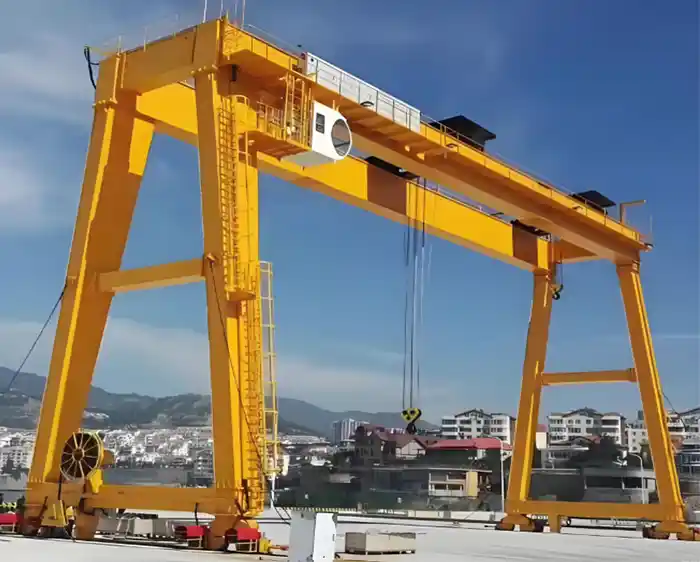
double hoist gantry crane for long loads handling
Typical Load Range and Applications
Double-hoist gantry cranes shine when handling uneven, oversized, or sensitive loads. They are common in steel mills, shipyards, and large fabrication workshops where precision and stability are critical. Their capacity allows for lifting items that a single-hoist crane cannot safely handle.
Load capacity can range from 5 tons up to 100 tons or more depending on design
Common applications: long steel beams, large molds, machinery, and modular structures
Ideal for operations requiring simultaneous lifts of multiple points on a single load
Key Operational Features
While double-hoist cranes offer more power and stability, they also require skilled operators and more careful maintenance. Synchronizing the hoists is essential for smooth operation and to prevent twisting or swaying of long loads.
High precision for lifting long or flexible items
Requires experienced operators for complex lifts
More maintenance-intensive due to additional moving parts
Load Handling Capabilities
Single-Hoist Advantages and Limitations
Advantages
Single-hoist gantry cranes are popular because they get the job done without unnecessary complexity. They are straightforward to operate, quick to set up, and cost-effective. For many workshops, these cranes handle daily lifting tasks efficiently without the need for heavy investment.
Simplicity: Easy to operate, even for less experienced workers
Lower Initial Cost: Affordable option for small to medium loads
Easy Maintenance: Fewer moving parts mean less downtime and lower repair costs
Limitations
While they are practical for many standard tasks, single-hoist cranes do have their limits. Handling long or flexible loads can be challenging, and precision placement of items isn't always guaranteed. This can become a concern in industries where accuracy and load stability are critical.
Limited Stability: Long beams or uneven loads may sway during lifting
Reduced Precision: Not ideal for tasks requiring exact load positioning
Less Versatile: May struggle with oversized or irregularly shaped items
Double-Hoist Advantages and Limitations
Advantages
Double-hoist gantry cranes are designed for more demanding lifting tasks. With two hoists, they can stabilize long, heavy, or awkwardly shaped loads, making them essential for industries that handle steel, large molds, or machinery components. They offer precision and control that a single hoist simply cannot match.
Improved Load Stability: Reduces sway and twisting for long or uneven items
Handles Complex Loads: Ideal for oversized, heavy, or sensitive items
Precise Positioning: Allows for careful placement even in tight spaces
Limitations
The added capability comes with trade-offs. Double-hoist cranes are more expensive upfront, require more skilled operators, and demand regular maintenance to keep both hoists synchronized. Without proper operation, the benefits can be lost or even cause safety risks.
Higher Cost: Larger investment for purchase and installation
More Complex Operation: Operators need training for synchronized hoist control
Increased Maintenance Needs: More moving parts require regular inspection and care
Safety and Risk Management
Load Stability and Risk of Load Sway
Safety is closely tied to load stability. Single-hoist cranes can struggle with long or flexible loads, increasing the risk of sway and potential accidents. Double-hoist cranes provide better stability by lifting multiple points on a single load, minimizing movement during transport. Proper crane selection can prevent costly mistakes and injuries.
Single-hoist: Good for compact, moderate loads; monitor long loads carefully
Double-hoist: Excellent stability for long, heavy, or uneven loads
Practical tip: Always inspect rigging and balance before lifting
Precision for Sensitive Operations
Some operations require very precise load placement, like assembling machinery or installing molds. Single-hoist cranes are adequate for general positioning, but double-hoist cranes allow for finer control and synchronized movement, reducing errors and potential damage to sensitive materials.
Single-hoist: Suitable for general positioning
Double-hoist: High precision for delicate or exact placements
Operational insight: Use double-hoist when exact load alignment is critical
Worker Safety and Accident Prevention
Worker safety should never be compromised. Choosing the correct hoist type can directly reduce hazards. Double-hoist cranes lower the risk of swinging loads and uneven lifting, but operators must be trained to handle the additional complexity. Single-hoist cranes are simpler and easier to operate safely but may require extra care with long or heavy items.
Single-hoist: Simple operation, easier to train operators
Double-hoist: Reduces load sway risks; requires skilled operation
Safety tip: Regular inspections, proper load calculations, and operator training are essential for both types
Practical Use Cases
Industries and Applications Suited for Single-Hoist Gantry Cranes
Single-hoist gantry cranes are the workhorses of workshops and small-to-medium industrial settings. They are ideal when loads are moderate in weight, reasonably sized, and uniform in shape. Their simplicity makes them a reliable choice for day-to-day operations where speed and ease of use are priorities.
Manufacturing workshops: Lifting machinery parts, pallets, and components
Storage and logistics: Moving crates, boxes, or metal sheets within warehouses
Maintenance yards: Handling tools, engines, or smaller equipment
Construction sites: Moving moderate-size construction materials without permanent overhead installation
Industries and Applications Suited for Double-Hoist Gantry Cranes
Double-hoist gantry cranes are best for heavy-duty, specialized operations where stability and precision are essential. They excel at handling long, heavy, or irregularly shaped items that would be difficult-or unsafe-for a single-hoist crane.
Steel mills: Lifting long beams, slabs, and large fabricated components
Shipbuilding: Moving heavy machinery, sections of hulls, or large molds
Large fabrication workshops: Handling oversized molds, machinery frames, or pre-assembled structures
Automotive and aerospace: Lifting and positioning heavy engine blocks or large panels with precision
Examples of Mixed-Load Operations and Hybrid Solutions
Some workshops face a mix of small, moderate, and large loads. In these environments, a single solution might not cover all needs efficiently. Hybrid approaches-such as having a double-hoist crane for heavy or long loads alongside a single-hoist crane for standard tasks-can optimize workflow and reduce bottlenecks.
Mixed-load operations: Use single-hoist for daily routine lifts; deploy double-hoist for occasional oversized or awkward loads
Hybrid solutions: Some double-hoist cranes can operate in single-hoist mode when only moderate loads are lifted, improving flexibility and efficiency
Practical insight: Planning the layout and workflow to match crane capabilities ensures safer and faster operations
Decision-Making Guide for Buyers
Key Questions to Ask
Before purchasing a gantry crane, it's important to ask the right questions. Understanding the loads you handle, how often they need lifting, and the level of precision required will guide your choice between single- and double-hoist cranes.
Load type: Are the items compact, uniform, or long and flexible?
Load weight: What is the heaviest item you plan to lift, and what is the typical load range?
Frequency: How often will lifts occur per day or per week?
Span and reach: What is the required coverage across the workshop or yard?
Precision needs: Does the operation require exact placement or careful alignment?
Load Calculation Tips and Safety Margin Considerations
Accurate load calculations are essential for both safety and efficiency. Always consider the maximum load, plus a safety margin to account for unexpected weight variations or dynamic effects during lifting. Overestimating slightly is better than underestimating-it prevents accidents and protects equipment.
Maximum load: Determine the heaviest expected load for your operation
Safety margin: Add 20–30% extra to account for unexpected factors
Dynamic effects: Consider load sway, lift height, and acceleration/deceleration forces
Regular review: Reassess load requirements periodically as production changes
When a Hybrid or Customized Solution May Be Ideal
Some operations have highly varied lifting needs that no single crane type can handle efficiently. In these cases, hybrid or customized solutions can provide the best balance between cost, flexibility, and safety.
Hybrid use: Combine single-hoist cranes for routine tasks with double-hoist cranes for long, heavy, or awkward loads
Customized solutions: Adjustable hoists, tandem hoist systems, or modular bridge designs to suit your specific workshop layout
Practical advice: Consult with a crane manufacturer or supplier to design a solution that matches your current and future needs
Conclusion
Summary of Key Differences and Advantages
Choosing between a single-hoist and a double-hoist gantry crane comes down to understanding your load requirements and operational needs. Single-hoist cranes are simple, cost-effective, and ideal for moderate, routine lifts. Double-hoist cranes, by contrast, provide greater stability, precision, and capacity for long, heavy, or awkward loads. Each type has clear advantages depending on the application.
Single-hoist: Lower cost, easy maintenance, suitable for consistent, moderate loads
Double-hoist: Higher stability, precise placement, ideal for long, heavy, or complex loads
Operational focus: Efficiency, safety, and load suitability differ between the two
Recommendations Based on Varied Load Handling Needs
Routine, moderate loads: Single-hoist cranes offer sufficient performance without overcomplicating operations
Long, heavy, or irregular loads: Double-hoist cranes are safer, more precise, and reduce the need for multiple lifts
Mixed-load environments: Consider hybrid or customizable solutions to cover both light and heavy lifting efficiently
Final Thoughts on Maximizing Efficiency, Safety, and Cost-Effectiveness
The right crane choice can significantly impact your workshop's productivity, safety, and costs. Take the time to evaluate your load types, lifting frequency, and future expansion plans. Proper planning ensures you invest in a crane that meets your current needs while providing flexibility for the future. Remember, a well-chosen gantry crane doesn't just lift loads-it keeps your operation running smoothly and safely.
Plan for growth: Anticipate changes in load types and sizes
Invest in training: Skilled operators make all the difference, especially with double-hoist cranes
Balance cost and performance: Consider total ownership cost, not just purchase price


