


Single Girder vs. Double Girder Overhead Cranes: The Decision Logic Most Buyers Miss
Main Takeaway (At the Top)
Choosing between single girder and double girder overhead cranes is not just about lifting capacity. The wrong choice can lead to higher costs, operational inefficiency, safety risks, and future limitations. Buyers must evaluate span, lifting height, duty cycle, frequency of use, maintenance, and future expansion, not just tonnage.
Key Questions This Article Answers
How do single girder and double girder cranes differ structurally and functionally?
When is a single girder crane sufficient, and when is double girder necessary?
What hidden factors do most buyers overlook when selecting an overhead crane?
How can I avoid over-specifying or under-specifying my crane?
Key Takeaways in Bullets
Capacity is only part of the decision – lifting tonnage alone is misleading.
Span matters – short spans usually suit single girder cranes; long spans require double girder cranes.
Lifting height is critical – double girder cranes allow higher hook positions.
Duty cycle and frequency of operation affect wear and maintenance costs – double girder cranes handle heavy or continuous use better.
Safety and rigidity – double girder cranes reduce sway and deflection for precise handling.
Maintenance and accessibility differ – single girder cranes are simpler to maintain.
Future growth and flexibility – double girder cranes adapt better to dual-hook configurations or increased load requirements.
Cost balance – weigh upfront cost vs. long-term operational efficiency.
Introduction
Overhead cranes are critical components in industrial material handling, widely used in steel mills, factories, workshops, and warehouses. They lift, transport, and position heavy loads safely and efficiently.
While many buyers focus primarily on crane capacity (tons), choosing the wrong girder configuration can create hidden costs, installation headaches, and operational inefficiencies over the crane's lifecycle.
This guide provides a practical decision framework for selecting the right crane type, highlighting the overlooked factors most buyers miss.
Structural Differences
Single Girder Overhead Crane
Design: One main girder with a trolley running on the top or bottom flange.
Best For: Light to medium loads, short to moderate spans, and medium hook heights.
Advantages:
Simpler installation
Lower upfront cost
Easier routine maintenance
Typical Applications: Small workshops, light-duty lifting projects, warehouses, or operations with low to moderate lifting frequency.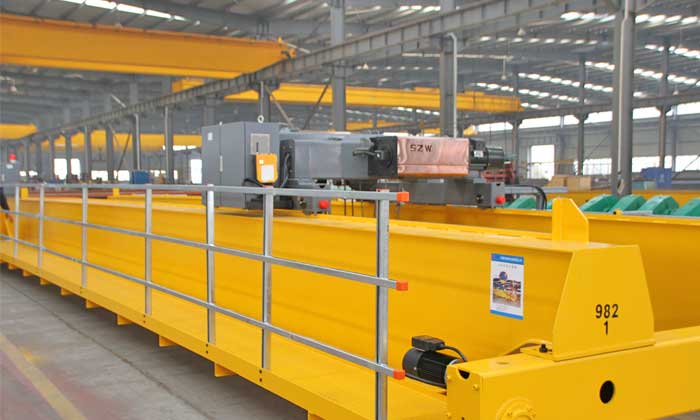
Double Girder Overhead Crane
Design: Two main girders with the trolley running between them.
Best For: Heavy loads, long spans, high hook heights, and continuous or high-frequency operations.
Advantages:
Structurally more stable
Supports heavier loads
Accommodates dual trolleys or multiple hooks
Typical Applications: Steel mills, heavy fabrication plants, precast yards, or high-demand lifting environments.
The Big Mistake Buyers Make: Focusing Only on Crane Capacity
TL;DR / Most Important Point:
Choosing a crane based solely on its maximum lifting tonnage is risky. The wrong configuration can lead to wasted costs, early wear, and operational bottlenecks-even if the crane's rated capacity is sufficient.
The Misconception
"If I need a 15-ton crane, a double girder crane is always the safe choice."
This thinking is common but incomplete. Many buyers overlook other critical factors that impact performance and cost.
Key Questions This Solves
Do I really need a double girder crane for my lifting project?
How does duty cycle affect crane lifespan?
Could my workflow be slowed by the wrong crane configuration?
What hidden costs am I ignoring if I only compare tonnage?
Smart Buyer Takeaways
Look Beyond Capacity: Evaluate span, hook height, and duty frequency.
Consider Total Cost of Ownership (TCO): Include installation, maintenance, and operational efficiency.
Match Crane Type to Application: Light-duty or low-frequency tasks may only need a single girder crane.
Plan for the Future: Think about upgrades, workflow changes, and operational growth.
Maximum load is just one number. The right crane choice balances capacity, workflow needs, frequency of use, and long-term cost. Avoid overbuilt solutions, plan properly, and your crane will not only lift materials-it will lift productivity and efficiency for years.
Critical Decision Factors Buyers Often Overlook
Most Important Takeaway (Up Front):
Choosing between single girder and double girder overhead cranes involves more than load capacity. Span, lifting height, duty cycle, operational safety, maintenance, future upgrades, and cost all play a critical role in ensuring efficiency, safety, and long-term ROI.
Key Takeaways & Questions Solved
Span Length: What crane type works for short vs long spans?
Lifting Height: Which configuration achieves required hook clearance?
Duty Cycle & Frequency: Can the crane handle your daily operational demands?
Operational Safety & Rigidity: How to reduce sway and improve precision?
Maintenance & Accessibility: Which crane is easier and cheaper to maintain?
Future Expansion: Can the crane adapt to heavier loads or dual hooks?
Cost vs Value: How to balance upfront cost with long-term efficiency and reliability?
Selecting the right overhead crane is a strategic decision that impacts workflow, safety, and ROI for years.
Single girder cranes are cost-effective and simple for light-duty, low-frequency applications.
Double girder cranes are built for heavy-duty, high-frequency, and expandable operations, offering better precision, stability, and long-term value.
Smart buyers evaluate all these factors upfront-span, lifting height, duty cycle, operational safety, maintenance, future flexibility, and cost-before making a purchase. This ensures your crane investment is efficient, safe, and future-ready.
Practical Buyer Scenarios: Choosing the Right Crane for Your Operation
Most Important Takeaway (Up Front):
There is no one-size-fits-all overhead crane. Your facility type, span, lifting height, and duty cycle determine whether a single or double girder crane is the smarter choice.
Key Takeaways & Questions Solved
Which crane fits my workshop size and load? Light-duty vs heavy-duty considerations.
How does lifting frequency affect crane selection? Avoid premature wear or overbuilt solutions.
How to balance cost and future expansion? Single girder may save upfront, double girder pays off long-term.
What operational factors matter most? Span, hook height, rigidity, and total cost of ownership.
Actionable Tips for Buyers
Ask your supplier the right questions:
Anticipated load frequency and duty cycle
Potential future expansion (dual hooks, heavier loads)
Facility layout and ceiling height constraints
Compare total cost of ownership (TCO):
Include installation, maintenance, downtime, energy use, and runway reinforcement-not just equipment price.
Evaluate structural and operational factors first:
Span length, lifting height, and rigidity can impact workflow and safety.
Selecting the right overhead crane depends on your facility type, lifting demands, and operational goals:
Single girder cranes are ideal for light-duty, short-span, or low-frequency tasks.
Double girder cranes are necessary for heavy-duty, high-frequency, or tall-span applications, providing stability, precision, and scalability.
Mixed-use or evolving facilities should analyze duty cycle, lifting height, and cost trade-offs to avoid overspending or future limitations.
Smart buyers plan early, ask the right questions, and consider long-term value over upfront price-ensuring the crane supports both current operations and future growth.
Quick Reference Table: Single vs Double Girder Cranes
Most Important Takeaway (Up Front):
Choosing between single and double girder cranes requires balancing load, span, lifting height, duty cycle, safety, maintenance, and flexibility-not just maximum tonnage.
Key Takeaways & Questions Solved
How do load and span requirements determine crane type?
What lifting height or hook clearance is needed for my facility?
How does operational frequency impact maintenance and lifespan?
Which crane offers better stability, rigidity, and future expansion options?
How to evaluate long-term cost versus upfront investment?
Single vs Double Girder Crane Comparison
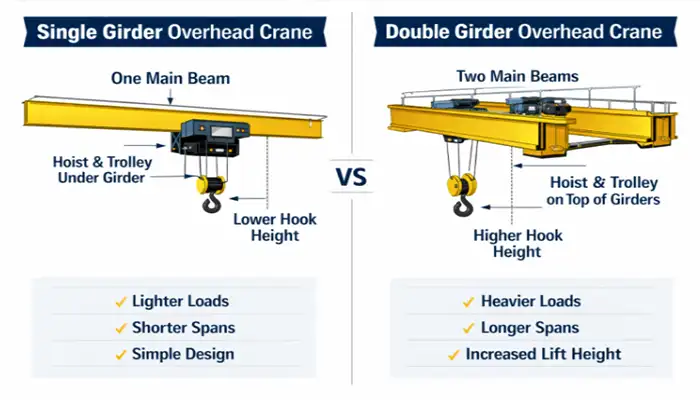
This quick reference table shows why load capacity alone is never enough for crane selection.
Single girder cranes are ideal for light-duty, short-span, and low-frequency operations.
Double girder cranes excel in heavy-duty, high-frequency, or high-clearance applications, offering rigidity, precision, and future-proof flexibility.
Smart buyers evaluate all factors-span, lifting height, duty cycle, safety, maintenance, and expansion potential-before making a purchase.
By using this framework, you can avoid overspending, reduce operational risk, and select a crane that supports both current needs and future growth.
FAQ: Single Girder vs Double Girder Overhead Cranes
Most Important Takeaway:
Choosing the right overhead crane is about more than maximum lifting capacity. Buyers must consider span, lifting height, duty cycle, rigidity, maintenance, and future expansion to avoid inefficiency, higher costs, and safety risks.
Overview
Choosing the right overhead crane is about more than maximum lifting capacity. Buyers must consider span, lifting height, duty cycle, rigidity, maintenance, and future expansion to avoid inefficiency, higher costs, and safety risks.
1. Structural and Functional Differences
Single girder cranes have one main beam; trolley runs on top or bottom flange. Best for light-to-medium loads, short spans, low-frequency lifting.
Double girder cranes have two main beams; trolley runs between them. Suitable for heavy loads, long spans, high hook heights, continuous operation, offering better rigidity, precision, and flexibility.
Buyer Insight: Structure, rigidity, and duty cycle impact performance and lifespan more than tonnage alone.
2. When to Use Single vs Double Girder
Single girder: Workshops, small factories, light-duty jobs, short spans (<25m).
Double girder: Steel mills, heavy fabrication, high-frequency operations, tall buildings, long spans, dual hooks, higher lifting heights.
Buyer Insight: Match crane type to layout, workflow, and future needs.
3. Hidden Factors Buyers Overlook
Span and hook height limitations
Load frequency / duty cycle
Operational safety and rigidity
Maintenance accessibility and complexity
Future flexibility for upgrades
Total cost of ownership (TCO)
Buyer Insight: Early planning avoids overspending, downtime, and operational bottlenecks.
4. Avoid Over- or Under-Specifying
Assess facility layout, lifting height, load distribution.
Evaluate duty cycle and frequency.
Compare TCO, not just price.
Plan for future expansion.
Use data-driven supplier advice, not tonnage-only quotes.
Buyer Insight: Systematic evaluation ensures cranes are fit-for-purpose, cost-effective, and scalable.
Final Buyer Tip
Systematically evaluate your operational requirements, production growth, and facility constraints.
Map your material handling workflow.
Identify lifting frequency, span, and hook height needs.
Consider maintenance accessibility and long-term cost.
Factor in upgrades or expansion.
By addressing these factors upfront, you ensure your overhead crane is efficient, safe, and scalable, delivering long-term value and reliable performance.
Conclusion: Making the Right Crane Choice
Most Important Takeaway (Up Front):
Choosing between a single girder and double girder overhead crane is about more than just maximum lifting capacity. Operational efficiency, safety, maintenance, cost, and future flexibility are equally critical.
Key Takeaways & Questions Solved
Load vs Application: Is the crane suited to your facility's span, lifting height, and material flow?
Frequency & Duty Cycle: Can the crane handle your operational demands without excessive wear?
Rigidity & Safety: Which design minimizes sway, improves precision, and enhances worker safety?
Maintenance & Accessibility: How easy is inspection, repair, and ongoing upkeep?
Total Cost vs Upfront Price: Will investing more now save money in downtime, upgrades, or replacements later?
Future Growth & Flexibility: Can the crane adapt to heavier loads, dual hooks, or plant expansion?


