


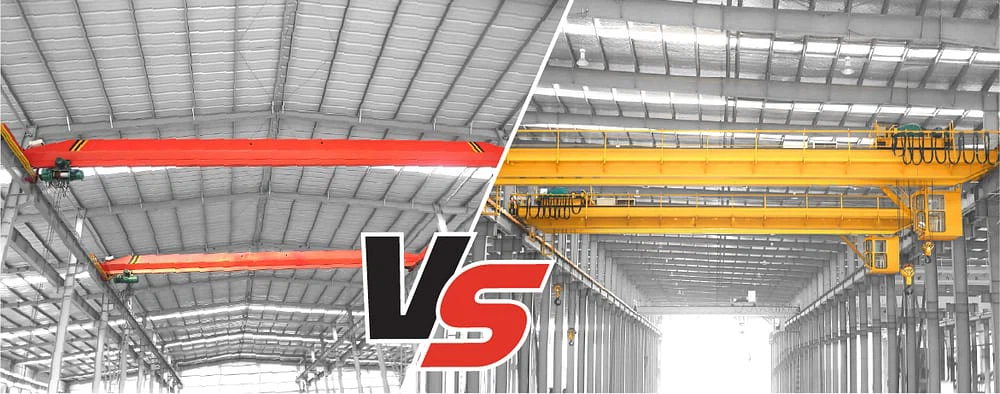
Overhead cranes play a crucial role in modern industry, serving as the backbone of material handling. Especially in various manufacturing workshops, these cranes ensure the smooth lifting and transportation of heavy loads. They not only significantly improve work efficiency but also ensure the safety of the workplace. Among various types of overhead cranes, single girder and double girder bridge cranes have attracted considerable attention due to their unique features and applications. Understanding their functions and suitability is crucial for making informed decisions when selecting the appropriate lifting solution. This article will delve into the comparison between single girder and double girder overhead cranes, helping you make wise decisions amidst numerous choices.
What is a Single Girder Overhead Crane?

A single girder overhead crane is a lifting machinery consisting of a single main girder, known for its simple and efficient design. This type of crane typically includes a beam spanning the workshop, with a running mechanism underneath for lateral movement of heavy loads. Equipped with wheels at its ends, the crane can move along tracks, facilitating material transport throughout the entire working area. The simplified structure of a single girder bridge crane is cost-effective in both manufacturing and maintenance.
Advantages and Applications of Single Girder Overhead Cranes
Single girder cranes are particularly suitable for scenarios with light to medium loads, such as small factories, warehouses, and specific production lines. Their design makes them ideal for environments with limited space or a need for rapid material movement. The main advantages lie in their lightweight structure, making installation and operation relatively simple while effectively reducing energy consumption.
Limitations and Scope of Single Girder Overhead Cranes
Despite various advantages, single girder bridge cranes have limitations. Due to their structural design, they are generally unsuitable for handling extremely heavy loads or complex lifting tasks. Their operating speed and lifting height may be lower compared to more complex double girder systems. Additionally, when high stability and load-carrying capacity are crucial in the working environment, single girder EOT cranes may fall short of meeting these requirements. Therefore, understanding the scope and limitations is crucial before choosing a single girder crane.
What is a Double Girder Overhead Crane?

A double girder overhead crane is composed of two parallel main girders, providing additional support and stability. This design allows the crane to carry heavier loads while maintaining a robust and durable structure. Double girder bridge cranes are typically equipped with more sophisticated lifting and running mechanisms, enabling operation over a wider range. Compared to single girder cranes, the double girder design allows for higher lifting speeds and larger spans, covering a larger working area.
Advantages and Applications of Double Girder Overhead Cranes
Double girder bridge cranes are indispensable in heavy industries, especially in environments requiring high load capacity and stability, such as large manufacturing plants, heavy industrial workshops, docks, and storage facilities. Their main advantages lie in the ability to handle heavy materials safely and efficiently, providing higher operational efficiency. The design of double girder EOT cranes allows them to operate over longer spans without sacrificing performance or safety.
Limitations and Scope of Double Girder Overhead Cranes
While double girder bridge cranes excel in performance, their complex design comes with higher costs, including installation, operation, and maintenance. Due to their weight and size, double girder cranes may require stronger support structures and larger working spaces. Additionally, compared to single girder designs, adjustments and repairs for double girder overhead cranes may be more complex and time-consuming. Therefore, for occasions that do not require frequent or heavy-duty material handling, the more economical and flexible single girder crane might be considered. Balancing the performance advantages and potential costs is crucial when choosing the appropriate type of crane.


