


From Workshop Survey to Final Operation: A Customized Mold Handling Solution
A Mexican injection molding factory needed two overhead cranes to improve its mold handling process.After expanding production capacity, the factory faced more frequent mold changes and heavier mold handling tasks. Moving molds manually became slower and created safety concerns.
The customer needed a safer and more efficient way to handle:
Heavy mold lifting
Mold replacement
Mold transfer between production stations
However, the customer had limited experience with crane systems. They needed support with crane selection, workshop measurement, installation planning, and final commissioning.Yuantai Cranes provided a complete project solution, starting from the first workshop survey:
Checked the existing building structure and installation conditions
Selected the suitable crane type based on the application
Designed a customized crane system
Manufactured and delivered the equipment
Supported installation and commissioning
Based on the actual workshop layout and lifting requirements, Yuantai Cranes supplied two HD single-girder overhead cranes for the Mexican injection molding workshop. The cranes are now operating reliably for daily mold handling operations.
Project Background
The customer is a Mexican injection molding manufacturer with multiple production lines.After expanding production capacity, the factory faced a new challenge.The number of mold changes increased.The mold weight also increased.Workers needed to frequently move molds between production stations.Manual handling became inefficient and created safety concerns.
The customer needed overhead cranes for:
Heavy mold lifting
Mold replacement
Mold flipping
Material transfer between production areas
However, the customer did not have crane engineering experience.They needed support with:
Workshop measurement
Crane structure selection
Installation planning
Operation requirements
Our engineers first studied the actual working conditions before designing the solution.
Site Survey: Problems Found Before Crane Design
Challenge 1: Existing Workshop Structure Was Not Ready for Crane Installation
During the workshop inspection, our engineers found that the existing building was not originally designed for overhead cranes.
+Problem: No Reserved Crane Installation Structure
+Can an overhead crane be installed in an existing factory without reserved supports?
+How was this challenge solved?
+Project Result
Challenge 2: Inclined Columns Reduced the Crane Working Area
During measurement, engineers found that the middle columns leaned inward. The available space in the center area was smaller than both ends.
+Problem: Standard Crane Span Could Not Match the Workshop
+Why cannot we simply use the workshop width as the crane span?
+What factors did the engineers consider?
+Project Result
Challenge 3: Uneven Support Heights Affected Rail Installation
In another workshop area, engineers found uneven concrete corbels.
+Problem: Different Elevations on Crane Supports
+Why does rail level accuracy matter for overhead cranes?
+What problems can uneven rails cause?
+Project Result
Customized Crane Design Solution
After the site survey, we did not directly choose a standard crane model.
The engineers reviewed the actual working conditions first:Workshop structure, Mold weight, Lifting frequency, Required lifting height, Operator working habits,
Because every workshop is different, the crane design also needed to be different.For example, the available space limited the crane layout. The mold handling process required stable positioning. The building structure also affected the crane load design.
Based on these factors, we designed two HD single-girder overhead cranes for the customer.
| Equipment | Quantity | Main Application |
|---|---|---|
| HD Single-Girder Overhead Crane | 1 Set | Heavy mold lifting and replacement |
| HD Single-Girder Overhead Crane | 1 Set | Mold positioning and transfer |
The final solution matched the customer's production process, workshop conditions, and daily operation needs.
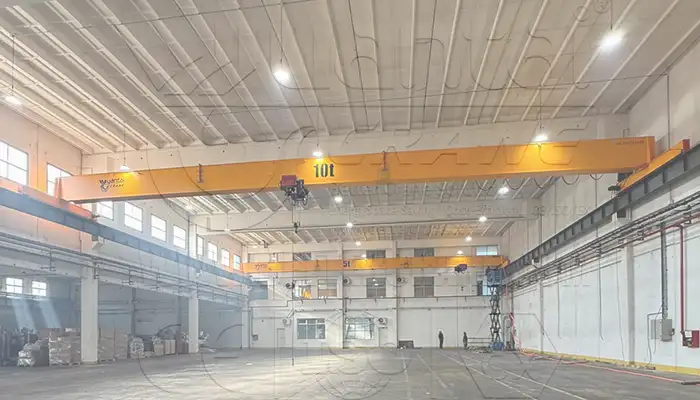
Similar overhead crane project for Agentina for your reference
Solution 1: 10 Ton HD Single-Girder Overhead Crane
After checking the workshop structure and production requirements, we selected a 10 ton HD single-girder overhead crane for the heavy-duty handling area.
The crane needed to handle large molds while reducing the load on the existing building structure. It also needed enough lifting height and smooth movement for daily mold replacement operations.
+Application
+Technical Specifications
+Why We Selected HD Crane Instead of Traditional LD Crane
+Project Result
Solution 2: 5 Ton HD Single-Girder Overhead Crane
After reviewing the workshop layout, we found that this working area had stricter space limitations.
The customer needed a crane for daily mold handling, but the workshop had limited headroom. The crane also needed to move smoothly and position molds accurately during production operations.
Based on these requirements, we selected a 5 ton HD single-girder overhead crane with a compact structure and better lifting height utilization.
+Application
+Technical Specifications
+Why HD Single-Girder Crane Fits Low Headroom Workshops
+Project Result
Mold Handling Requirement: Precision Control
During the workshop survey, we found that the customer frequently needed to flip molds during production.
The heaviest mold: Up to 7 tons
The mold needed to move between:
Horizontal position
Vertical position
This operation was not only about lifting capacity.
The crane also needed to provide:
Stable lifting
Smooth movement
Accurate positioning
For mold handling, precise control is important. A crane that only runs at one fixed speed may make the mold swing during movement and increase positioning time.
+Why Is Variable Speed Control Important for Injection Molding Cranes?


