


Introduction: Understanding Rail-Free Semi Gantry Cranes
What is a Rail-Free Semi Gantry Crane?
A rail-free semi gantry crane is a lifting crane that moves on wheels directly on the workshop floor. It does not need ground rails.
It is also called a mobile semi gantry crane or floor traveling gantry crane.
In simple terms: one side runs on a fixed beam or wall support, and the other side moves on the ground with wheels.
No rail tracks on the floor
One side fixed, one side moving on wheels
Can work indoors or outdoors
Easy to install and move
This type is often used when a full rail system is not available or not needed.
How It Is Different from Other Gantry Cranes
To choose correctly, it helps to compare it with other common crane types.
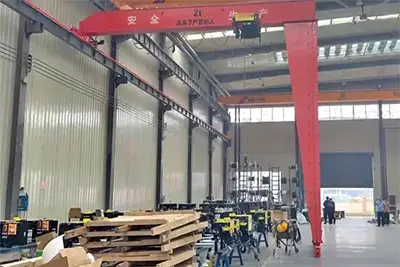 Semi gantry crane with no ground rail but with wheel travelling
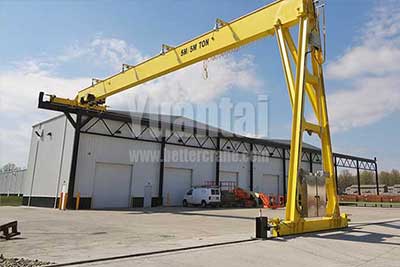 Semi gantry crane with ground embed rail , rail travelling
Rail-mounted semi gantry crane
Runs on fixed rails on the ground
Works best in fixed production lines
Movement is limited to one path
Full gantry crane
Has two legs running on rails
Used for heavy outdoor work and large yards
Needs strong civil foundation
Rail-free semi gantry crane
No ground rails needed
One side runs on wheels on the floor
Easy to move and adjust layout
In short, rail-based cranes follow a fixed path. Rail-free cranes do not.
Why Rail-Free Design Matters in Industrial Projects
In many real workshop or job site situations, layouts are not fixed. Machines move. Work zones change. Sometimes the project itself is temporary.
This is where rail-free semi gantry cranes are useful.
Main practical points:
No need to build runway beams or install rails
Faster setup for new workshops or job sites
Can be moved to different working areas
Good for places where layout changes often
Typical use cases include:
Steel fabrication workshops
Precast concrete yards
Maintenance and repair areas
Construction and temporary projects
In simple terms, this crane is chosen when you need lifting help, but you do not want to build a fixed rail system first.
Core Decision Factors for Selecting Rail-Free Configuration
+Lack of Existing Rail Infrastructure
+Frequently Changing Work Layouts
+Temporary or Semi-Permanent Operations
+Need for Multi-Area Material Handling
Industrial Application of Rail-Free Semi Gantry Crane
+Steel Fabrication Workshops (Flexible Production Layout)
+Precast Concrete Yards (Heavy and Irregular Load Handling)
+Maintenance and Repair Facilities (Flexible Heavy Equipment Handling)
+Construction and Outdoor Projects (Temporary Lifting Solutions)
Technical and Operational Advantages of Rail-Free Semi Gantry Crane
+High Mobility Without Rail Dependency
+Lower Installation Complexity
+Flexible Expansion Capability
Limitations and Constraints-Critical Buyer Considerations for Rail-Free Semi Gantry Crane
+Load Capacity Restrictions
+Reduced Positional Precision
+Floor Condition Dependency
+Travel Path Efficiency
Comparison With Rail-Mounted Semi Gantry Cranes
+Rail-Free vs Rail-Mounted Structure
+Cost Consideration
+Operational Efficiency
+Practical Selection Insight
Selection Decision Framework
+Production Layout Is Not Fixed or Changes Frequently
+Installation Time and Civil Cost Must Be Minimized
+Operation Is Project-Based, Not Continuous Production-Line Based
+Multiple Work Zones Must Be Served by One Crane
+Load Demands Fall Within Moderate Industrial Lifting Range
+Practical Summary for Buyers
Send Us an Inquiry for a Tailored Rail-Free Semi Gantry Crane (Wheel Travelling Design)
+Why Tailored Design Matters
+When Rail-Free Semi Gantry Crane Is the Right Direction
+Important Clarification for Buyers
+Final Selection Insight
+Get Technical Support and Quotation


