


Protect High-Value Molds with 5–30 t Overhead Cranes for Laser Repair Operations
Most Important Takeaway (Read This First)
High-value molds used in laser repair operations require cranes that prioritize precision, stability, and controlled movement-not just lifting capacity.: A properly selected 5–30 ton overhead, jib, or gantry crane with low-speed control and smooth hoisting significantly reduces mold damage, improves laser repair accuracy, and protects long-term tooling investment.
5–30 t cranes are ideal for most mold & die laser repair applications, covering small inserts to large automotive and injection molds.
Precision motion control (micro-speed lifting, VFD drives, smooth braking) is more critical than maximum lifting speed.
Overhead cranes, jib cranes, and gantry cranes each serve different laser repair workflows and layouts.
Poor crane selection leads directly to mold surface damage, misalignment, and costly downtime.
A crane designed for laser mold repair improves repair quality, operator safety, and production efficiency.
Protect High-Value Molds During Laser Repair Operations
Laser mold repair requires precision, control, and care. Even minor shocks or misalignment can damage molds and affect repair quality. Proper cranes, hoists, and lifting procedures are essential.
Why Mold Protection Is Critical
Laser mold repair is not forgiving.
Once a mold is under the laser head, position, stability, and surface condition all matter. A small bump during lifting or a slight shift while positioning can undo hours of prep work-and sometimes cause damage that is expensive or impossible to fully correct.
Unlike rough material handling, laser repair works in millimeters and fractions of a degree. That's why mold protection starts long before the laser is switched on. It starts with how the mold is lifted, moved, and set in place.
Small Lifting Errors Create Big Problems
Even minor lifting shocks or poor alignment can cause real issues in laser mold repair:
Damage to polished or functional surfaces: Mold faces, parting lines, and cavity surfaces are often hand-polished. A light impact or sliding contact during lifting can leave marks that require re-polishing or re-machining.
Distortion of critical geometry: Uneven lifting forces can stress the mold structure, especially on large or thin-section molds. This may cause slight distortion that affects final part accuracy.
Reduced laser welding accuracy: Laser repair relies on precise focus and stable weld paths. If the mold is not level or shifts during positioning, weld quality and penetration suffer.
More rework, scrap, and downtime: Every positioning correction or repair redo delays production and increases labor costs. In busy tool shops, this quickly adds up.
Why High-Value Molds Are Vulnerable
Most molds used in laser repair are not simple blocks. In real workshops, they usually have:
Complex shapes
Uneven weight distribution
Multiple lifting points or no clear center of gravity
At the same time, many high-value molds weigh between 5 and 30 tons, especially in industries such as:
Automotive tooling
Plastic injection molding
Die casting
Precision industrial tooling
This combination-high weight plus irregular geometry-makes mold handling risky without the right lifting control.
Controlled Lifting Is Mandatory
When molds reach this weight range, protection is no longer about being careful. It is about using equipment that allows:
Balanced lifting despite offset centers of gravity
Smooth, low-speed movement when approaching the laser station
Stable holding while positioning and aligning the mold
This is where properly selected cranes and hoists become part of the repair process, not just support equipment.
A crane that can lift the load but cannot control it precisely puts both the mold and the laser repair work at risk. In laser mold repair, control matters as much as capacity.Why 5–30 t Cranes Are Ideal for Laser Mold & Die Repair
In mold and die repair workshops, crane capacity is often misunderstood. It is not about choosing the biggest crane available. It is about choosing a crane that fits the real working loads, moves smoothly at low speed, and still leaves room for safe operation.For most laser mold repair environments, that capacity window is 5 to 30 tons.
Capacity That Matches Real Mold Weights
In practical shop conditions, mold weights tend to cluster into clear ranges. These are not theory-based numbers-they come from daily handling in automotive and industrial tool rooms.
Most laser mold repair work falls into the following categories:
5–10 tons: Used for mold inserts, smaller molds, die components, and tooling fixtures. These jobs often require frequent repositioning and very fine control under the laser head.
10–20 tons: Common for medium-size injection molds and die-casting molds. Weight is substantial, but precision remains critical, especially when welding cavities or parting surfaces.
20–30 tons: Typical for large automotive molds and multi-cavity molds. These molds are heavy, wide, and often have an uneven center of gravity, making stable lifting essential.
Choosing a crane outside this range usually means sacrificing either precision or safety.
Why a 5–30 t Crane Makes Practical Sense
A crane designed for 5–30 ton mold handling supports more than just the mold itself. In real repair work, extra weight is always involved.
Selecting a crane in this range allows for:
Adequate safety margins: Mold weight alone should never equal crane capacity. Additional margin protects against dynamic loads, uneven lifting, and unexpected shifts during positioning.
Handling of fixtures and accessories: Lifting beams, spreaders, rotators, clamps, and special rigging add weight that is often overlooked during the buying stage.
Room for future mold growth: Mold sizes tend to increase over time. A properly sized crane avoids early replacement when new or larger molds enter the repair schedule.
Capacity Alone Is Not Enough
One common mistake is selecting the right tonnage but the wrong performance profile. A 5–30 t crane for laser mold repair must also support:
Low-speed hoisting for precise alignment
Smooth starts and stops to avoid shock loads
Stable holding during repair setup
When these elements are combined with the right capacity, the crane becomes a reliable part of the laser repair process-not a risk factor.
Recommended Crane Types for Laser Repair Workshops
Laser mold repair workshops are not all laid out the same way. Some have multiple repair bays running in parallel. Others focus on a single high-precision laser station. The right crane type depends on how many molds are handled, how often they move, and how much positioning accuracy is required.
Below are the crane types most commonly used for laser mold and die repair, along with where each one works best in real shop conditions.
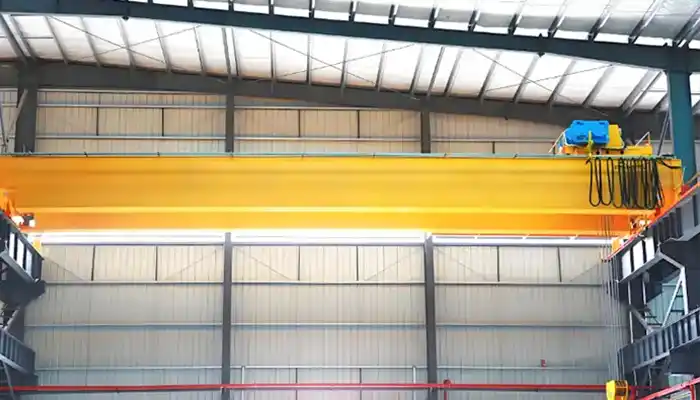
double girder overhead crane with capacity from 3 ton to 550 ton
Overhead Bridge Cranes (10–30 t)
Best suited for full-coverage mold repair shops
Overhead bridge cranes are the most common solution in established mold and die repair workshops. They run on fixed runway beams and provide full coverage across the working area. For shops handling large molds or multiple repair stations, this layout offers the most control and flexibility.
In daily operation, overhead cranes allow molds to be lifted from storage, moved across the workshop, and positioned directly under different laser repair stations without re-rigging.
Practical advantages include:
Coverage of multiple laser repair stations within one crane span
Smooth longitudinal and cross travel for precise mold positioning
Strong stability when handling large and heavy molds
Easy integration with mold rotators and lifting beams
Overhead bridge cranes are especially suitable for large automotive molds and multi-cavity molds that require repositioning several times during the repair process.
Jib Cranes (5–10 t)
Best suited for dedicated laser repair workstations
Jib cranesare typically installed at a fixed laser repair cell. Instead of covering the entire shop, they focus on one controlled working area, which allows for very accurate positioning.
In practice, jib cranes are often used for smaller molds, inserts, or tooling components that need frequent adjustment under the laser head.
Why many shops choose jib cranes:
High positioning accuracy within a fixed work zone
Short travel paths, which reduces swing and correction time
Lower installation cost compared to overhead cranes
Ideal for repetitive, localized mold welding tasks
For workshops adding laser repair capability to an existing tool room, jib cranes can be a practical and economical choice.
Gantry Cranes (5–20 t)
Best suited for flexible or temporary repair setups
Gantry cranes are often used when building modifications are limited or when workshop layouts change frequently. Because they do not rely on runway beams, gantry cranes can operate in spaces where overhead crane installation is not possible.
They are commonly found in rented buildings, temporary repair areas, or expanding workshops.
Typical applications include:
Mold handling in non-permanent repair zones
Workshops where structural ceiling support is unavailable
Situations requiring the crane to be relocated in the future
While gantry cranes generally move more slowly than overhead cranes, they still provide stable lifting and good positioning control when properly specified.
Choosing the Right Crane Type
Each crane type solves a different problem.
Overhead cranes offer full coverage and high capacity. Jib cranes deliver local precision at lower cost. Gantry cranes provide flexibility when permanent installation is not an option.
The best choice depends on mold weight, workshop layout, and how laser repair work is actually performed on the shop floor.
Crane & Hoist Features That Protect High-Value Molds
In laser mold repair, most damage does not happen during welding.
It happens while lifting, moving, or setting the mold in place. That is why crane and hoist selection deserves as much attention as the laser equipment itself.
A crane that looks fine on paper but lacks fine control can put polished surfaces, sharp edges, and critical dimensions at risk. Below are the key features that actually protect high-value molds in day-to-day repair work.
Wire Rope Electric Hoists for Smooth Lifting
For mold handling, wire rope electric hoists are generally preferred over chain hoists. The difference is noticeable the first time a heavy mold is positioned under a laser head.
Wire rope hoists provide:
Smoother vertical motion with less vibration
Better load stability, especially at higher weights
Improved drum and rope guidance for balanced lifting
This smoothness reduces micro-shocks that can mark mold surfaces or shift alignment during setup.
Variable Frequency Drives (VFDs)
Sudden movement is one of the main causes of mold damage.
Cranes equipped with VFD-controlled hoisting, trolley, and bridge travel move gradually instead of jerking into motion.
In practical terms, VFDs allow:
Soft acceleration when lifting heavy molds
Controlled deceleration when positioning close to fixtures
Reduced load swing during starts and stops
For laser repair operations, this kind of movement control is not a luxury-it is a requirement.
Ultra-Low Lifting Speeds
Laser mold repair often requires adjusting mold position by just a few millimeters. Standard factory crane speeds are usually too fast for this kind of work.
Ultra-low hoisting speeds make it possible to:
Align mold surfaces accurately with the laser focal point
Lower heavy molds slowly onto supports or rotation devices
Avoid repeated lift-and-adjust cycles that waste time
This is one of the most important features for achieving repeatable laser repair quality.
Stable Trolley Travel
Even when vertical lifting is smooth, poor trolley control can introduce swing. This is especially risky with molds that have an uneven center of gravity.
A crane designed for mold repair should offer:
Smooth, steady trolley travel at low speeds
Consistent response when reversing direction
Reduced lateral movement during fine positioning
Less swing means faster setup and less risk of accidental contact with surrounding equipment.
Precision Braking Systems
Braking performance matters most at the end of movement.
Precision braking systems ensure the load stops exactly where the operator intends-without drift or sudden descent.
Effective braking helps:
Hold molds securely during positioning
Protect lifting points, fixtures, and rigging
Prevent impact damage when stopping under load
When working with high-value molds, predictable stopping behavior is critical.
Why These Features Work Together
Each feature on its own adds value. Together, they create a precision crane system suited for laser mold repair-not general material handling.
When buyers look beyond capacity and focus on low-speed hoisting, smooth lifting systems, anti-sway control, and stable braking, they significantly reduce the risk of mold damage and improve overall repair efficiency.
Precision Positioning for Laser Welding Accuracy
In laser mold repair, the weld itself is only as good as the mold position beneath the laser.
Even a well-calibrated laser cannot compensate for a mold that is slightly tilted, drifting, or vibrating during welding. This is why positioning accuracy is one of the most critical factors in laser repair quality.
Cranes play a direct role here, not just by lifting the mold, but by allowing it to be placed and held exactly where it needs to be.
Wire Rope Electric Hoists for Smooth Lifting
For mold handling, wire rope electric hoists are generally preferred over chain hoists. The difference is noticeable the first time a heavy mold is positioned under a laser head.
Wire rope hoists provide:
Smoother vertical motion with less vibration
Better load stability, especially at higher weights
Improved drum and rope guidance for balanced lifting
This smoothness reduces micro-shocks that can mark mold surfaces or shift alignment during setup.
Variable Frequency Drives (VFDs)
Sudden movement is one of the main causes of mold damage.
Cranes equipped with VFD-controlled hoisting, trolley, and bridge travel move gradually instead of jerking into motion.
In practical terms, VFDs allow:
Soft acceleration when lifting heavy molds
Controlled deceleration when positioning close to fixtures
Reduced load swing during starts and stops
For laser repair operations, this kind of movement control is not a luxury-it is a requirement.
Ultra-Low Lifting Speeds
Laser mold repair often requires adjusting mold position by just a few millimeters. Standard factory crane speeds are usually too fast for this kind of work.
Ultra-low hoisting speeds make it possible to:
Align mold surfaces accurately with the laser focal point
Lower heavy molds slowly onto supports or rotation devices
Avoid repeated lift-and-adjust cycles that waste time
This is one of the most important features for achieving repeatable laser repair quality.
Stable Trolley Travel
Even when vertical lifting is smooth, poor trolley control can introduce swing. This is especially risky with molds that have an uneven center of gravity.
A crane designed for mold repair should offer:
Smooth, steady trolley travel at low speeds
Consistent response when reversing direction
Reduced lateral movement during fine positioning
Less swing means faster setup and less risk of accidental contact with surrounding equipment.
Precision Braking Systems
Braking performance matters most at the end of movement.
Precision braking systems ensure the load stops exactly where the operator intends-without drift or sudden descent.
Effective braking helps:
Hold molds securely during positioning
Protect lifting points, fixtures, and rigging
Prevent impact damage when stopping under load
When working with high-value molds, predictable stopping behavior is critical.
Why These Features Work Together
Each feature on its own adds value. Together, they create a precision crane system suited for laser mold repair-not general material handling.
When buyers look beyond capacity and focus on low-speed hoisting, smooth lifting systems, anti-sway control, and stable braking, they significantly reduce the risk of mold damage and improve overall repair efficiency.
Precision Positioning for Laser Welding Accuracy
In laser mold repair, the weld itself is only as good as the mold position beneath the laser.
Even a well-calibrated laser cannot compensate for a mold that is slightly tilted, drifting, or vibrating during welding. This is why positioning accuracy is one of the most critical factors in laser repair quality.
Cranes play a direct role here, not just by lifting the mold, but by allowing it to be placed and held exactly where it needs to be.
Why Accurate Alignment Matters
Laser welding relies on a focused energy beam with a limited working range. When the mold is aligned correctly:
Weld penetration becomes consistent, reducing weak fusion areas
Bonding quality improves, especially on fine cracks and edges
Heat input stays controlled, helping to avoid distortion
If the mold sits even slightly out of position, operators often compensate by adjusting laser settings, which is not a reliable fix and can lead to inconsistent results.
Stable Holding Reduces Vibration During Welding
Laser repair requires a steady working surface. Any vibration-however small-can disturb the melt pool and affect weld uniformity.
A crane designed for precision handling helps by:
Holding the mold firmly without drift
Preventing micro-movement caused by braking or gear play
Supporting the mold evenly across lifting points
Stable holding is especially important for long weld paths or fine surface repairs where consistency matters.
Fine Adjustment Saves Time and Protects Mold Surfaces
In real workshop conditions, no mold is positioned perfectly on the first try. The difference between a good crane and an average one is how easy it is to make small, controlled adjustments.
Fine positioning allows operators to:
Align the mold in millimeter steps instead of repeated lift-and-lower cycles
Avoid scraping or bumping the mold during correction
Reduce setup time before welding begins
This directly improves workflow efficiency and reduces handling-related damage.
Support for Rotation and Tilting Improves Access
Many laser repairs require access from multiple angles. Cranes that work smoothly with:
Mold rotation devices
Tilting tables or frames
Adjustable lifting beams or spreaders
make it easier to expose repair zones without removing the mold from the work area.
This integrated handling approach reduces unnecessary lifts and repositioning, leading to faster repairs and more consistent welding quality.
Positioning Is Part of the Welding Process
In laser mold repair, positioning is not a separate step-it is part of the welding process itself. A crane that enables precise alignment, stable holding, and controlled adjustment directly supports better laser welding results and protects the value of the mold.
Conclusion: A Crane Is a Mold Protection Tool, Not Just Lifting Equipment
In laser mold repair operations, a crane does far more than lift heavy steel. It controls how a mold moves, how it settles into position, and how stable it remains during repair. In that sense, the crane becomes part of the repair process itself.
When lifting is rough or difficult to control, mold surfaces are exposed to unnecessary risk. Alignment takes longer. Laser welding quality becomes harder to maintain. Over time, these small problems turn into lost hours, extra rework, and avoidable costs.
Choosing the right 5–30 ton overhead crane, jib crane, or gantry crane changes that dynamic. A crane built for mold repair provides:
Smooth hoisting that minimizes shock and surface damage
Precision positioning for accurate laser alignment and stable welding
Proper safety systems that protect both high-value molds and laser equipment
For manufacturers and tool shops, this is not an added expense. It is a practical investment in mold protection, process stability, and long-term productivity.
In laser mold repair, the right crane does more than move molds-it helps preserve their value and extend their working life.


