


Most Important Takeaway
Camber design in an industrial jib arm is not about "bending the beam upward" for appearance-it is a controlled structural compensation method used to counteract -world deflection under load. A properly designed camber improves positioning accuracy, reduces tip drift, and ensures consistent load handling across the full working radius of the jib crane.
Camber directly affects end-effector positioning accuracy under rated load
Proper camber reduces jib arm tip deflection and swing drift
Over-cambering can cause uneven trolley travel and stress concentration
Under-cambering leads to excessive downward deflection and positioning error
Camber design must match working radius, rated capacity, and duty class (A3–A5/A6)
Structural stiffness, material grade, and weld sequence all influence camber stability
Verification requires load test deflection data, not just theoretical calculation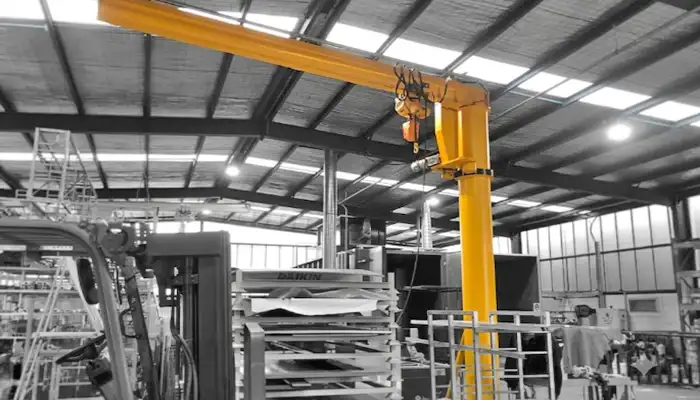
Buyer Questions This Guide Solves for Cantilever Jib Crane Camber and Deflection
In cantilever jib crane procurement, buyers usually don't start with formulas. They start with practical questions like "will it drift?" or "can I place the load exactly where I need it?"
For 0.5–5 ton jib crane systems, camber and deflection behavior directly affect daily operation in assembly, machining support, and general material handling. This section summarizes the questions buyers ask before purchase.
+How does jib arm camber affect lifting accuracy in operation?
+What is acceptable deflection for a floor-mounted or wall-mounted jib crane?
+How do I know if a manufacturer's camber design is reliable or overestimated?
+What is the relationship between camber, outreach, and rated load?
+Should camber be fixed or adjustable for different industrial applications?
+How does camber influence long-term fatigue and structural lifespan?
+What technical data should I request before purchasing a jib crane?
Camber Design in Industrial Jib Arms (Cantilever Jib Crane Systems 0.5–5 Ton)
In a cantilever jib crane system, camber design is a simple but practical idea. The jib arm is built with a slight upward curve before any load is applied. Then when the crane lifts a load, the beam bends down and becomes closer to level in working condition. People in workshops often just say, "it's pre-set to handle the sag." That is basically camber.
In0.5–5 ton jib crane applications, this matters because the cantilever works like a fixed beam carrying load at the far end. Without compensation, the arm will naturally deflect under weight, especially at full outreach.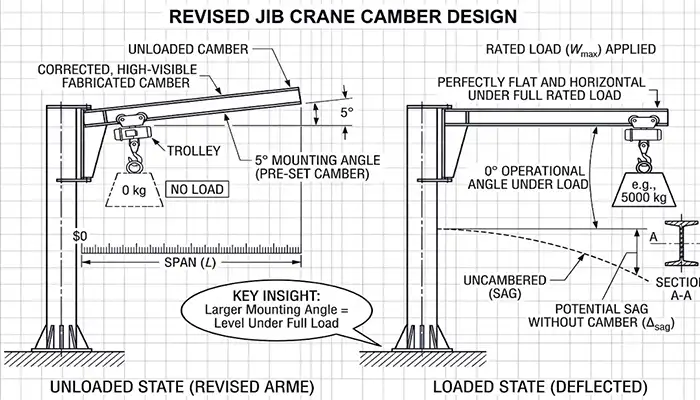
+Camber meaning in jib crane cantilever design
+Why jib crane arms behave like cantilever beams
+Real-world behavior vs theoretical calculation
+Why camber matters in industrial jib crane selection
Camber Design in Industrial Jib Arms (Cantilever Jib Crane Systems 0.5–5 Ton)
In a cantilever jib crane system, camber design is a simple but very practical engineering idea. The jib arm is built with a slight upward curve before any load is applied. Then when the crane lifts a load, the beam bends down and becomes closer to level in working condition. In workshops people often say, "it's set a bit higher to take the sag," or "yeah, it levels out once you load it." That is basically camber in use.
In 0.5–5 ton jib crane applications, this matters because the cantilever works like a fixed beam carrying load at the far end. Without this compensation, the arm will naturally deflect under weight, especially at full outreach during daily lifting work.
+What camber means in jib crane cantilever design
+Why jib crane arms behave like cantilever beams
+-world behavior vs theoretical calculation
+Why this matters in application
Camber Design Objectives in Industrial Applications
In cantilever jib crane systems, camber design is not just a drawing detail. It has clear working goals in workshop operation. In 0.5–5 ton jib crane applications, the focus is always simple: keep the load stable, reduce drift, and make positioning easier during daily lifting work.
Operators often say, "as long as it lands in the same spot, it's good." That is exactly what camber is trying to support in industrial use.
+Compensating for elastic deformation under full load
+Maintaining hook positioning tolerance in assembly operations
+Improving repeatability in repetitive lifting cycles
+Reducing operator correction time in precision workflows
Camber Calculation and Engineering Factors in Cantilever Jib Crane Design
In cantilever jib crane systems, camber is not decided by guessing. It is based on basic structural calculation and workshop experience. For 0.5–5 ton jib crane applications, engineers look at steel behavior, load condition, and how the jib arm will actually be used in daily lifting work.
In workshop terms, people may say, "just give it a bit more curve so it won't sag too much." But in engineering, there are several key factors behind that decision.
+Material modulus (Q235 / Q345 steel influence)
+Section modulus of jib arm (I-beam, box girder, truss structure)
+Load case scenarios (point load vs moving trolley load)
+Safety factor integration in camber estimation
+Influence of welding sequence and residual stress
Types of Camber Approaches in Jib Crane Design
In cantilever jib crane systems, camber is not always done in the same way. Different factories and engineering teams choose different approaches based on load condition, outreach length, and required positioning accuracy. For 0.5–5 ton jib crane applications, the goal is always the same: reduce visible deflection and keep load placement stable in daily workshop use.
In simple workshop talk, people may say, "some cranes are bent a bit straight, some are shaped more carefully." That is basically different camber methods in practice.
+Linear camber design for uniform load compensation
+Parabolic camber for variable load distribution along span
+Pre-set camber during fabrication vs site-adjusted camber
+Reinforced stiffness design vs geometric camber compensation
Camber vs Deflection Control: What Buyers Must Compare
In cantilever jib crane systems, camber is only one part of the picture. The other part is actual deflection control under working load. For 0.5–5 ton jib crane applications, buyers often focus on capacity, but in daily workshop use, what ly matters is how much the jib arm moves when it is fully loaded and extended.
In simple terms, people in workshops often say, "it lifts fine, but does it stay steady when I go to the far end?" That question is exactly what camber vs deflection comparison is about.
+Rated deflection limits (L/150 to L/300 range)
+Manufacturer load–deflection curve interpretation
+Theoretical camber vs tested camber performance
+Importance of full-load tip displacement testing data
Application-Based Camber Requirements in Cantilever Jib Crane Systems
In cantilever jib crane systems, camber requirements are not the same for every job. It depends on how the crane is used day to day. For 0.5–5 ton jib crane applications, some workshops care about millimeter-level positioning, while others care more about speed and handling efficiency.
In practical terms, people often say, "for us, accuracy matters," or "we just need it to move fast." That difference decides how camber and deflection control should be designed.
+Precision assembly workshops (tight tolerance positioning)
+Steel fabrication yards (moderate deflection tolerance)
+Logistics and warehousing (speed over precision balance)
+Heavy-duty outdoor lifting (wind load and dynamic sway impact)
Common Camber Design Mistakes in Procurement of Cantilever Jib Crane Systems
In cantilever jib crane procurement, many issues do not come from the crane itself, but from missing technical checks during purchase. For 0.5–5 ton jib crane systems, buyers often focus on tonnage and price, but ignore how the crane behaves under working load and full outreach conditions.
In workshop ity, people sometimes say, "it lifts the weight, so it should be fine." But in practice, load positioning and deflection behavior are what decide daily performance.
+Over-reliance on rated capacity without deflection analysis
+Ignoring trolley travel position effect on bending moment
+Accepting missing load test documentation
+Selecting incorrect duty class for cyclic operations
What Buyers Should Request from Cantilever Jib Crane Manufacturers
In cantilever jib crane procurement, especially for 0.5–5 ton systems, what you ask from the manufacturer is often more important than the brochure itself. Many cranes look similar on paper, but behave differently in workshop operation.
In practice, buyers often say, "just send me the spec sheet." But for positioning accuracy and load stability, that is not enough. You need technical proof related to deflection, camber, and actual installation behavior.
+Full load deflection report at maximum outreach
+Structural calculation sheet for jib arm beam
+Camber geometry diagram (before/after load condition)
+Material certification and welding procedure specification
+installation case references with similar working radius
Conclusion
Industrial jib arm camber design is a critical but often underestimated factor in crane performance. For buyers, the value is not the presence of camber itself, but whether the camber is engineered to match the actual load case, outreach length, and operational duty cycle. A well-designed camber system ensures predictable deflection behavior, stable hook positioning, and long-term structural reliability-while poor camber design leads to positioning errors, higher maintenance, and reduced operational efficiency.


