


Key Takeaways
Heavy machinery requires precise load planning to ensure safety, efficiency, and equipment longevity.
Different equipment types demand varying crane capacities, lifting aids, and precision handling.
Duty cycles and intermittent lifting directly impact crane selection and maintenance strategy.
Identify typical load ranges for engines, gearboxes, turbines, presses, and mining equipment.
Factor precision and weight considerations for safe lifting.
Match lifting aids (spreader beams, anti-sway devices) to the application.
Consider duty cycle, intermittent operation, and ergonomic control options.
Introduction
Planning lifts in a maintenance workshop might sound straightforward at first, but anyone who has spent time moving heavy machinery knows it's more than just hooking up a crane. Every lift carries risks-not only to personnel but also to the equipment itself. That's why understanding load handling requirements is critical for workshop managers, engineers, and crane operators.
When dealing with engines, gearboxes, turbines, presses, or mining equipment, the first step is to match the maintenance crane load capacity to the actual weight of the machinery. A mismatch can cause anything from minor alignment issues to serious accidents. Even small mistakes in load planning can halt maintenance schedules, damage expensive components, and create safety hazards in the workshop.
This article is a practical guide for anyone responsible for lifting heavy machinery in a workshop setting. We'll break down the essentials:
Typical load ranges for different industrial equipment, including engines, gearboxes, turbines, presses, and mining machinery.
Precision versus weight considerations, and when a standard hoist won't cut it.
Duty cycle and intermittent lifting requirements, so you know how often your crane can safely lift heavy loads without extra wear.
Examples of lifting aids, such as spreader beams, anti-sway devices, and remote control systems that improve safety and control.
By the end of this guide, you'll have a clear understanding of how to plan lifts that are safe, efficient, and reliable. You'll also see practical ways to combine precision hoist systems for workshops with standard lifting equipment to handle both heavy and delicate loads.
In short, whether you're moving a 500 kg gearbox or a 50-ton turbine, this guide provides the information you need to make informed, safe lifting decisions in your workshop.
single girder overhead crane for heavy machinery maintenance
Typical Loads in Heavy Machinery Maintenance
Lifting heavy machinery safely starts with knowing exactly what you're moving. Workshop cranes aren't one-size-fits-all, and the load ranges for different types of equipment vary widely. Understanding these ranges is the foundation for proper maintenance crane load capacity planning and ensures both safety and efficiency in your workshop.
Common Industrial Equipment & Approximate Load Ranges
Different machines present different challenges. Some are heavy but compact, others are large and awkward. Here's a practical breakdown:
| Equipment Type | Typical Weight Range | Notes / Handling Considerations |
|---|---|---|
| Engines (diesel, gas) | 500 kg – 10 tons | Often requires lifting brackets, cradles, or custom engine mounts for stable handling. Alignment matters during installation. |
| Gearboxes / Transmissions | 1 – 8 tons | Sensitive components; using anti-sway devices or dual-hook setups prevents damage and misalignment. |
| Turbines (steam, gas) | 5 – 50 tons | Large footprint; spreader beams or multiple lift points are essential to distribute weight evenly and avoid bending the crane hook. |
| Presses & Punching Machines | 3 – 30 tons | Heavy base units; floor loading must be verified before lifting. Consider short travel lifts for safety. |
| Mining Equipment Components | 2 – 40 tons | Irregular shapes; may require slings, lifting clamps, or adjustable lifting frames for stable control. |
Pro Tip: Visualizing the weight range against equipment type helps quickly determine the right crane class. A simple diagram plotting equipment vs. load can guide operators and engineers at a glance.
Precision vs. Weight Considerations
Not every lift is about raw weight. Sometimes the challenge is positioning a component accurately without sway or misalignment. For example, aligning a gearbox shaft or turbine rotor may require millimeter-level accuracy. In such cases, a standard hoist can move the load, but a precision hoist for workshops gives smoother control and reduces risk of equipment damage.
Key factors to consider:
Speed control: Precision hoists allow fine-tuned, low-speed operation, which is critical for alignment-heavy lifts.
Sway mitigation: Anti-sway systems prevent dangerous pendulum effects when moving heavy components over long spans.
Operator interface: Remote controls or joystick systems improve accuracy and keep the operator safe.
Here's a practical comparison of standard hoists versus precision hoists for workshop applications:
| Feature | Standard Hoist | Precision Hoist |
|---|---|---|
| Load Accuracy | ±5 cm | ±1 cm |
| Speed Control | Fixed | Variable / fine-tuned |
| Operator Interface | Basic | Remote / joystick |
| Sway Mitigation | Minimal | High |
Practical Note: If your workshop handles both heavy and delicate loads, it's often worth investing in a crane system that can switch between standard and precision hoisting modes. This approach maximizes flexibility without compromising safety.
Duty Cycle and Lifting Frequency
Understanding how often a crane will lift is just as important as knowing what it will lift. In crane and workshop planning, this concept is called the duty cycle. Simply put, the duty cycle refers to the ratio of active lifting time to total operating time. A crane used for heavy lifts once or twice a day is very different from one running dozens of precise lifts every hour.
+Duty Cycle Explained
+How Load Planning Changes with Activity Levels
+Practical Tip: Maintenance & Planning
Lifting Aids and Load Control Devices
Even the strongest crane can struggle if the load isn't properly controlled. In real workshops, lifting aids and load control devices are essential for both safety and precision. Using the right combination of accessories ensures that heavy machinery moves smoothly, without damage, and that operators remain safe.
+Spreader Beams
+Anti-Sway Devices
+Remote Controls
+Other Lifting Accessories
Practical Load Handling Examples
The theory behind load handling is one thing-but seeing real-world examples makes it practical. Below are three common scenarios in heavy machinery maintenance, showing how crane type, hoist, and lifting aids combine for safe and efficient lifts.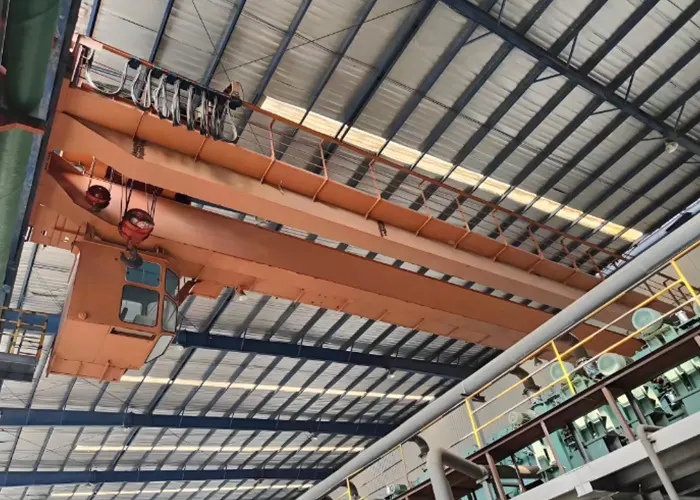
double girder overhead cranefor heavier material handling in large span workshops
+Example 1: 5-Ton Diesel Engine Lift
+Example 2: 20-Ton Turbine Rotor
+Example 3: Gearbox Alignment Lift in Tight Maintenance Bay
Summary Table: Practical Lift Examples
| Example | Load | Crane Type | Lifting Aids | Key Considerations |
|---|---|---|---|---|
| 5-ton Diesel Engine | 5 tons | Single-girder overhead | Spreader beam, tag lines | Safety margin, load stability, alignment |
| 20-ton Turbine Rotor | 20 tons | Double-girder overhead Crane | Spreader beam, anti-sway device, remote control | Minimize bending, precise alignment, operator safety |
| Gearbox Alignment in Tight Bay | 3–5 tons | Single-girder overhead | Adjustable slings, load balancing bar | Precision positioning, duty cycle, clear lift path |
Planning for Maintenance Bay Lifting
Before any lifting work starts in a maintenance workshop, planning is not optional. It directly affects safety, equipment life, and how smoothly the job will run. In heavy machinery maintenance lifting, most issues come not from the crane itself, but from missing details in planning-clearance, load shape, or lifting method.
This checklist is designed for workshop engineers, crane operators, and procurement teams to quickly confirm whether a lift is properly prepared. It also aligns with maintenance crane load capacity planning and practical workshop execution.
+Workshop Space and Clearance Verification
+Equipment Weight and Dimensions Confirmation
+Precision and Alignment Requirements
+Hoist Type and Lifting Accessories Selection
+Duty Cycle and Lift Frequency Assessment
+Operator Safety and Control Options
+Crane Load Rating and Safety Margin
A proper lift in heavy machinery maintenance lifting operations is not just about lifting power. It is a combination of space, load behavior, precision requirements, duty cycle, and equipment selection. When all checklist points are confirmed, the result is predictable operation, reduced downtime, and safer workshop performance.
Checklist for Maintenance Bay Lifting (Buyer Fillable Form)
This checklist is designed for quick use during quotation, planning, or site preparation. Fill in the blanks and tick items where applicable. It helps ensure heavy machinery maintenance lifting is correctly planned and matches maintenance crane load capacity requirements before installation or operation.
Workshop Space and Clearance Verification
Workshop bay width: ___________ m
Crane span (rail to rail): ___________ m
Travel length: ___________ m
Overhead clearance (hook to highest point): ___________ m
Obstructions present (beams / pipes / cable trays / platforms): ☐ Yes ☐ No
. If yes, specify: ___________________________
Crane runway condition checked: ☐ Yes ☐ No
Note: Low-headroom workshops must confirm clearance with real measurements, not visual estimation.
Equipment Weight and Dimensions
Equipment type: ___________________________
Actual weight (confirmed): ___________ tons / kg
Length: ___________ m
Width: ___________ m
Height: ___________ m
Center of gravity identified: ☐ Yes ☐ No / Unknown
Lifting points available: ☐ Factory-rated ☐ Custom ☐ Not confirmed
Note: For irregular loads, correct COG is critical for stable lifting and safe positioning.
Precision and Alignment Requirements
Operation type: ☐ Installation ☐ Removal ☐ Alignment ☐ Maintenance repositioning
Positioning accuracy required: ☐ Coarse ☐ Medium ☐ Precision (fine alignment)
Anti-sway required: ☐ Yes ☐ No
Variable speed control required: ☐ Yes ☐ No
Sensitive mating surfaces involved (shaft, gearbox, turbine): ☐ Yes ☐ No
Hoist Type and Lifting Accessories
Hoist type selected: ☐ Standard hoist ☐ Precision hoist for workshops
Spreader beam required: ☐ Yes ☐ No
Lifting slings type: ☐ Wire rope ☐ Synthetic ☐ Chain ☐ Not confirmed
Shackles / hooks checked and rated: ☐ Yes ☐ No
Load balancing bar required: ☐ Yes ☐ No
Remote control system required: ☐ Yes ☐ No
Duty Cycle and Lift Frequency
Expected lifting frequency: ☐ Occasional ☐ Daily ☐ Frequent (multi-shift)
Duty level requirement: ☐ Low ☐ Medium ☐ High duty cycle crane
Continuous operation expected: ☐ Yes ☐ No
Planned maintenance interval awareness: ☐ Yes ☐ No
Note: In real industrial workshop crane systems, duty cycle affects lifespan as much as load capacity.
Operator Safety and Control
Operator visibility is clear: ☐ Yes ☐ No
Remote control used: ☐ Yes ☐ No
Safety exclusion zone defined: ☐ Yes ☐ No
Emergency stop system verified: ☐ Yes ☐ No
Overload protection active: ☐ Yes ☐ No
Operator training completed: ☐ Yes ☐ No
Crane Capacity and Safety Margin
Maximum lifting load required: ___________ tons
Recommended crane capacity (with margin): ___________ tons
Safety margin applied (recommended 20–30%): ☐ Yes ☐ No
Hoist rated capacity verified: ☐ Yes ☐ No
Runway beam load capacity checked: ☐ Yes ☐ No
Structural support confirmed: ☐ Yes ☐ No
Inspection / certification valid: ☐ Yes ☐ No
A properly completed checklist ensures the crane system is correctly matched to real workshop conditions. In maintenance crane load capacity planning, most operational issues come from missing or incorrect site data-not from the crane itself.
This form helps align equipment selection with actual heavy machinery maintenance lifting requirements, reducing installation risks, downtime, and operational uncertainty.
Conclusion: Structured Load Handling in Maintenance Workshops
Load handling in a maintenance workshop is never just a lifting task. It is a coordination of planning, equipment selection, and controlled execution. When done properly, heavy machinery maintenance lifting becomes predictable, safe, and efficient-even for large engines, turbines, presses, or mining components.
+Proper Load Planning as the Core of Safe Maintenance Work
+Matching Crane System Components to Real Workshop Demands
+The Value of Proactive Planning in Industrial Environments


