


What Are Factory Cranes?
Factory cranes are specialized industrial lifting systems designed to transport heavy materials, components, and equipment within manufacturing facilities. By enabling safe and efficient material handling, factory cranes play a key role in improving productivity, reducing manual handling risks, and supporting smooth production workflows.
Typical factory lifting equipment includes Overhead Crane, Gantry Crane, and Jib Crane. These cranes are widely used in factories for tasks such as moving materials along production lines, installing heavy machinery, and positioning workpieces during assembly and manufacturing processes.
This guide is intended for manufacturers, factory managers, production engineers, and equipment buyers who want to understand the role of factory cranes and how to select the right lifting solution. Continue reading to explore the different types of factory cranes and their applications in modern manufacturing environments.
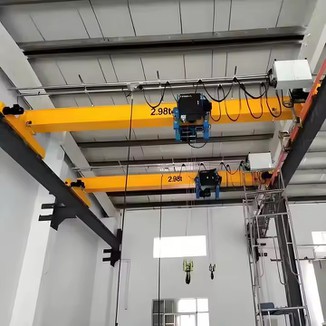


Overhead crane Gantry Crane Jib Crane
Components
Main Girder: The core load-bearing structure of the crane, spanning between the workshop rails, supporting the entire lifting system.
Hoisting Mechanism: Responsible for lifting and lowering loads. It consists of components such as the electric motor, reducer, drum, wire rope, and hook.
Trolley System: Installed on the main girder, moving left and right along it.
Traveling Mechanism: Used to control the entire crane's forward and backward movement along the workshop rails.
Control System: Used to operate various crane functions. Control methods include pushbutton control, remote control, or automated control systems, improving operational convenience and precision.
Electrical System: Provides power to the crane and controls the operation of various electrical components.
Main Types of Factory Cranes
Minecranes factory cranes are available in several configurations to accommodate different workshop layouts, lifting capacities, and production requirements. Selecting the right crane type depends on factors such as available space, load weight, lifting frequency, and workflow efficiency. In manufacturing plants, several crane systems are commonly used to support material handling, equipment installation, and assembly operations.
Below are the main types of factory cranes widely used in industrial facilities.
Overhead Crane
An Overhead Crane, also known as a bridge crane, is one of the most widely used lifting systems in manufacturing plants. It runs on rails installed on building structures and moves loads across the workshop using a bridge beam and hoist mechanism. This design allows the crane to cover a large working area and efficiently transport heavy components within the factory.
Applications: Production line material handling, heavy equipment installation, large component assembly in manufacturing plants.
Lifting capacity: 1 – 50 tons
Span: 7.5 – 30 m
Lifting height: 6 – 30 m
Travel speed: 20 – 120 m/min

Gantry Crane
A Gantry Crane is a freestanding crane supported by two legs that move on ground-mounted rails or wheels. Unlike overhead cranes, it does not rely on the factory building structure, making it suitable for workshops, warehouses, and outdoor factory yards where flexible lifting solutions are required.
Applications: Handling heavy machinery and equipment, material transport in fabrication workshops, outdoor yard handling and loading operations.
Lifting capacity: 2 – 100 tons
Span: 10 – 35 m
Lifting height: 6 – 18 m
Traveling speed: 20 – 60 m/min

Jib Crane
A Jib Crane is a compact lifting device designed for localized material handling at individual workstations. It features a horizontal arm mounted on a column or wall that can rotate within a specific angle, allowing operators to easily lift and position loads within a limited working radius.
Applications: Machine loading and unloading, workpiece positioning in assembly stations, handling small to medium components in production lines
Lifting capacity: 0.25 – 5 tons
Arm length: 2 – 10 m
Rotation angle: 180° – 360°
Lifting height: 3 – 12 m

Magnetic Crane
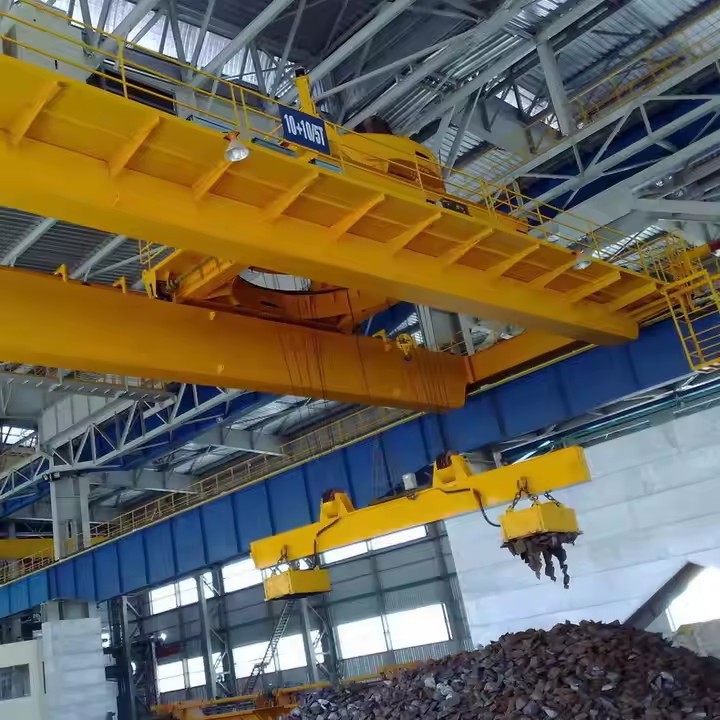
A Magnetic Crane is designed for handling ferromagnetic materials such as steel plates, billets, and scrap metal. It is equipped with an electromagnetic lifting device that allows steel materials to be lifted quickly without hooks or slings, improving efficiency in steel handling operations.
Applications: Steel plate and billet handling, scrap metal transportation, steel warehouses and metal processing plants.
Lifting capacity: 1 – 20 tons
Magnetic lifting force: customized based on load weight
Power supply: electromagnetic lifting system
Control mode: remote control or cabin operation
Grab Crane
A Grab Crane is equipped with a mechanical or hydraulic grab bucket for handling bulk materials such as sand, coal, grain, or aggregates. It is widely used in industries that require efficient loading, unloading, and transportation of loose materials.
Applications: Bulk material handling in factories, sand, coal, and aggregate transport, raw material storage yard operations
Lifting capacity: 5 – 25 tons
Grab bucket capacity: 0.5 – 10 m³
Span: 10 – 30 m
Lifting height: 8 – 25 m

Common Applications of Factory Cranes
Factory cranes are widely used across many manufacturing and industrial sectors to improve efficiency, safety, and workflow in material handling operations. By enabling the lifting, positioning, and transportation of heavy components, these cranes play an essential role in supporting production lines, equipment installation, and internal logistics. From precision assembly to heavy-duty material movement, factory cranes help manufacturers handle large loads quickly and safely while reducing manual labor.
Metal Fabrication
In metal fabrication workshops, factory cranes are used to lift and transport steel plates, metal sheets, and fabricated components between cutting, bending, welding, and finishing stations. Cranes help ensure safe handling of heavy metal parts and improve workflow efficiency in fabrication lines. Common equipment used includes Overhead Crane, Jib Crane, and Magnetic Crane for steel plate handling.
Automotive Manufacturing
Automotive factories rely heavily on cranes for moving vehicle frames, engine components, molds, and assembly fixtures throughout the production process. Factory cranes support tasks such as equipment installation, production line material supply, and heavy component positioning during vehicle assembly. Typical lifting solutions include Overhead Crane for assembly lines and Jib Crane for workstation-level operations.
Steel Processing
Steel plants and processing workshops use cranes to handle steel billets, plates, coils, and scrap materials. Due to the heavy weight and magnetic properties of steel products, specialized cranes equipped with electromagnetic lifting devices are commonly used. Systems such as Magnetic Crane and heavy-duty Overhead Crane enable efficient material movement within steel warehouses and processing lines.
Heavy Machinery Production
Manufacturers of construction equipment, industrial machinery, and large mechanical components require cranes to lift and assemble oversized parts. Factory cranes are used to transport castings, large frames, and mechanical assemblies across production areas. High-capacity systems such as Overhead Crane and Gantry Crane are typically used to support heavy machinery manufacturing processes.
Warehouse and Logistics Handling
In warehouses and industrial logistics centers, cranes help move heavy goods, equipment, and bulk materials between storage areas and loading zones. They are commonly used for loading large components, organizing storage yards, and improving material flow within logistics operations. Systems such as Gantry Crane and Grab Crane are often used for efficient cargo handling and bulk material movement.
Differences Between Factory Cranes and General Cranes
Although both are used for lifting and handling heavy objects, there are significant differences in usage environment, structural design, work intensity, and application scenarios. Let's understand them through a table.
| Comparison Item | Factory Crane | General Crane |
|---|---|---|
| Usage Environment | Primarily used in fixed industrial environments like factory workshops, production lines, warehousing and logistics centers. | Commonly used in construction sites, engineering projects, or temporary lifting scenarios. |
| Structure Type | Common types include overhead cranes, single girder cranes, double girder cranes, jib cranes, etc. | Common types include mobile equipment like truck-mounted cranes, crawler cranes, etc. |
| Operating Frequency | Typically requires long-term, high-frequency operation to meet continuous production line demands. | Usage frequency is relatively low, mostly for phased or temporary operations. |
| Load Capacity | Wide range of load capacities, can be designed for different tonnages based on production needs. | Generally used for engineering lifting; load capacity varies according to equipment model. |
| Installation Method | Mostly fixed installation on workshop rails or fixed structures. | Mostly mobile equipment, can be used at different job sites. |
| Automation Level | Relatively high automation level, can be equipped with remote control, PLC control, or intelligent systems. | Automation level is relatively low, usually relies on manual operation. |
Factory cranes are more suitable for stable industrial production environments and high-frequency material handling, while general cranes emphasize mobility and temporary lifting capabilities. When selecting lifting equipment, enterprises should choose the appropriate crane type based on the actual working environment, load weight, and usage frequency.
How to Choose the Right Factory Crane
Selecting the right factory crane is critical to ensuring safe, efficient, and cost-effective material handling within a facility. Choosing the wrong lifting system can lead to production delays, safety hazards, and increased operating costs. Key factors to consider include: lifting capacity, lifting height, span and coverage of the work area, suitability of the crane type, shop layout, and frequency of use.
By carefully evaluating these aspects, you can match a crane system to your specific operational needs, whether moving heavy machinery, handling steel, or processing bulk cargo. Below is a selection guide table:
| Crane Type | Typical Lifting Capacity | Lifting Height | Span / Coverage | Best Application | Advantages |
|---|---|---|---|---|---|
| Overhead Crane | 1 – 50 tons | 6 – 30 m | 7.5 – 30 m | Production line material handling, heavy machinery installation, large component assembly | Large coverage, precise positioning, high load capacity |
| Gantry Crane | 2 – 100 tons | 6 – 18 m | 10 – 35 m | Heavy machinery handling, fabrication workshops, outdoor yards | Flexible installation, indoor & outdoor use, high load capacity |
| Jib Crane | 0.25 – 5 tons | 3 – 12 m | Arm length 2 – 10 m | Workstation lifting, machine loading/unloading, assembly tasks | Compact, easy rotation, ideal for small work areas |
| Magnetic Crane | 1 – 20 tons | Custom | Custom | Steel plate handling, scrap metal transport, steel processing plants | Efficient handling of steel, fast operation, reduces manual labor |
| Grab Crane | 5 – 25 tons | 8 – 25 m | 10 – 30 m | Bulk material handling: sand, coal, aggregates | Ideal for loose materials, automated loading/unloading, high-volume handling |
This selection guide allows you to quickly identify which factory crane type fits your production environment, load requirements, and workflow needs. For tailored solutions, contact the Mine Crane team to help design the optimal crane system for your facility.
Factory Crane Safety Considerations
Ensuring the safe operation of factory cranes is critical for protecting personnel, equipment, and production efficiency. Improper use or lack of safety measures can lead to accidents, equipment damage, and costly downtime. By following essential safety practices, manufacturers can minimize risks and maintain a reliable material handling workflow.
Key safety considerations include:
Load Limits: Always operate cranes within their specified lifting capacities to prevent structural damage and accidents.
Operator Training: Ensure that crane operators are properly trained and certified to handle equipment safely and efficiently.
Maintenance Inspection: Conduct regular inspections and maintenance of cranes, hoists, and supporting structures to identify wear, fatigue, or malfunction.
Emergency Protection Systems: Install safety devices such as limit switches, emergency stop buttons, and overload protection to reduce the risk of accidents during operation.
Following these safety practices helps factories maintain a secure working environment while optimizing crane performance and longevity.
Conclusion
Factory cranes play a crucial role in modern manufacturing by providing safe, reliable, and efficient solutions for material handling, equipment installation, and production support. From overhead and gantry cranes to jib, magnetic, and grab cranes, each system is designed to meet specific lifting needs across a wide range of industries, including metal fabrication, automotive manufacturing, steel processing, heavy machinery production, and warehouse operations.
For businesses looking to optimize workflow, improve safety, and handle heavy loads with precision, contact the Mine Crane team for customized factory crane solutions. Our experts can help you select and design the right crane system to meet your facility's unique requirements.
FAQ
1. What is the maximum lifting capacity of a factory crane?
The lifting capacity of a factory crane varies depending on the equipment design and application scenario. Generally, the lifting capacity of small factory cranes ranges from 1 to 5 tons, while large industrial cranes can reach 50 tons or even higher.
2. Do factory cranes require regular maintenance?
Yes. Regular maintenance ensures safe equipment operation and extends its service life. Common maintenance tasks include checking wire ropes, braking systems, electrical systems, and lubricating key mechanical components.
3. What is the typical service life of a factory crane?
Under normal use and regular maintenance, factory cranes typically last 15 to 20 years or even longer. The actual service life depends on usage frequency, working environment, and maintenance conditions.
4. Is professional training required to operate a factory crane?
Yes. Personnel operating factory cranes must undergo professional training and obtain relevant operating qualifications to ensure safe equipment operation and reduce accident risks.
5. What is the difference between a factory crane and a warehouse crane?
Factory cranes are primarily used for handling raw materials and equipment within production workshops, while warehouse cranes focus more on goods handling in warehousing logistics. There may be differences in their design structure and work intensity.
6. Why do factories need to install cranes?
Installing factory cranes can significantly improve production efficiency, reduce manual handling costs, and enhance the safety of heavy material handling. In modern manufacturing, cranes have become essential production equipment.
7. How much installation space is required for a factory crane?
The installation space required for a factory crane mainly depends on the crane's span, lifting height, and workshop structure. Before installation, professional design is usually required based on workshop dimensions, rail positions, and equipment operating range to ensure the crane can operate safely and smoothly.
8. Can factory cranes achieve automated control?
Yes. Modern factory cranes can achieve intelligent operation through PLC control systems, remote operating systems, and automation control technologies. Some advanced cranes also support automatic positioning, remote monitoring, and intelligent safety protection functions.
9. What is the difference between single girder and double girder cranes?
Single girder cranes typically have a simple structure and lower cost, suitable for small to medium lifting capacities and general production environments. Double girder cranes have higher load capacity and greater lifting height, suitable for heavy material handling and high-intensity operating environments.
10. How long does it take to install a factory crane?
Installation time usually depends on the equipment type and size. Generally, installation of small cranes may take only a few days, while the installation of large overhead or double girder cranes may take one to two weeks or even longer.


