


15 ton indoor crane options, design types, applications & practical considerations to select the safest, most efficient crane.Get15 ton overhead crane!
Choosing the Right 15 Ton Indoor Crane: A Buyer's Guide to Design Options and Applications
Why 15 Ton Indoor Cranes?
When it comes to indoor lifting, 15 tons hits a very practical middle ground. It's heavy enough to handle industrial loads like molds, large steel plates, and machine assemblies, but it doesn't push the building design into the extreme ranges that heavier cranes often demand. In other words, you get the strength you need without oversizing the whole system.
A Practical Capacity for Many Industries
A 15-ton overhead craneis widely used across different plants and workshops. It works in environments where loads are regular but not excessive, making it suitable for both production tasks and maintenance lifting.
Workshops and factories: Perfect for lifting motors, pumps, steel structures, or heavy tools during installation or repair.
Steel and fabrication shops: Handles plates, beams, billets, or semi-finished products with enough margin for safe operation.
Plastic and mold industries: Ideal for lifting molds during changeovers, which can easily weigh 10–12 tons each.
General maintenance bays: Provides the capacity to move machinery or spare parts without relying on external lifting contractors.
Flexibility in Building Design
Since you mentioned this will be installed in a new concrete room, you have the advantage of designing the civil structure alongside the crane. That means the crane doesn't need to "fit into" old constraints-it can be built into the plan from day one.
Rails in floor slots: A good choice if you prefer gantry or semi-gantry cranes, keeping the crane independent of wall or roof loads.
Wall/column brackets: A solid option for bridge cranes, where the crane runs overhead, leaving the floor free for other operations.
Embedded steel plates or anchor systems: Useful for future-proofing-if you decide to upgrade or adjust the crane in later years, the support system is already there.
Balanced Power and Usability
Many buyers choose 15 tons because it's versatile without being excessive. It avoids the problems of undersized cranes that constantly run near their limits, and it saves the expense and heavier structure needed for cranes above 20 tons.
Provides enough margin for safe lifting even when using spreader beams, C-hooks, or lifting magnets.
Fits well into medium-sized workshops with spans around 10–15 meters and lifting heights of 7–10 meters.
Runs comfortably on a 415V, 3-phase, 50 Hz supply, which is standard in the UK and many other regions.
Main Types of 15 Ton Indoor Crane Design Options
Not every 15-ton indoor crane is built the same. The right design depends on how often you'll be using it, the type of loads, and how the building itself is structured. Below are the most common options you'll see for indoor applications.
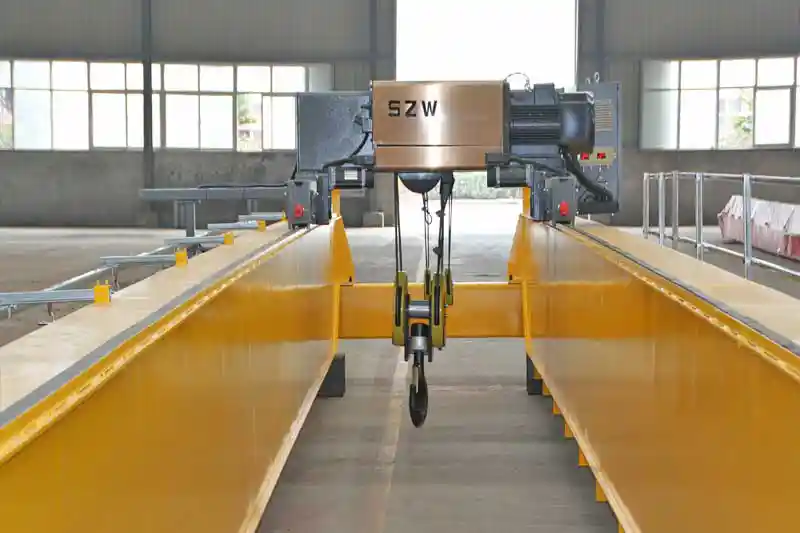
Top-Running Double-Girder 15 Ton Indoor Crane (EOT)
The double-girder bridge crane is the go-to option when your operation requires frequent, heavy lifting across the entire workspace. With two girders spanning the runway, the hoist sits on top, giving the best hook height and approach, which is ideal for handling bulky or specialized lifting devices.
When it works best:
This crane is suited for workshops and factories where lifting is regular and intensive, and the floor space needs to remain clear for other operations. If you use spreader beams, magnets, or C-hooks, this design gives the room and stability to do so safely.
Key features:
Dual girders providing extra strength and rigidity
Wire rope hoist mounted on top, allowing maximum lifting height
Easy to add walkways, service platforms, or future upgrades
Typically equipped with VFD drives for smooth, precise travel and control
Typical applications:
Production workshops: Efficiently moving raw materials or finished products between stations
Mold handling: Lifting and positioning molds in plastics, foundries, or similar industries
Steel fabrication shops: Transporting plates, beams, and welded assemblies safely
Warehouses with heavy goods: Keeping floors free for forklifts and pallet traffic
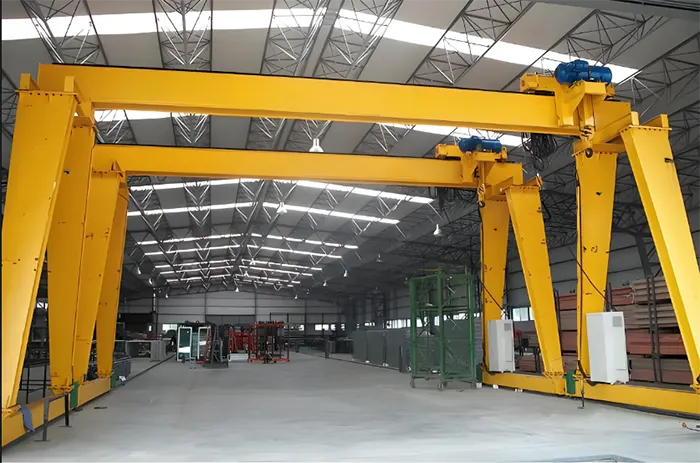
Full Gantry Crane 15 Ton on Recessed Floor Rails
A full gantry crane is the go-to choice when your building cannot carry the weight of a bridge crane. Instead of depending on walls or roof beams, the crane has its own independent structure, with wheels running along rails embedded in the floor. This makes it perfect for situations where structural support is limited or uneven.
When it works best:
You'll find full gantry cranes most useful in workshops or indoor bays where walls or ceilings are too weak to handle overhead loads. They're also ideal when floor space allows for recessed rails without getting in the way of daily operations. Basically, if you need heavy lifting but don't want the crane stressing the building, this is the solution.
Key features:
Standalone crane structure with end carriages moving along floor rails
Rails set in concrete slots to keep the floor flush and reduce trip hazards
Handles the full 15-ton capacity safely without transferring load to walls or columns
Flexible layout-rails can be extended or modified as operational needs change
Typical applications:
Indoor bays lifting steel plates, machinery, or molds where walls or roof cannot support cranes
Production lines moving heavy loads along fixed paths without affecting the building
Temporary or modular setups that may need relocation or adjustment in the future
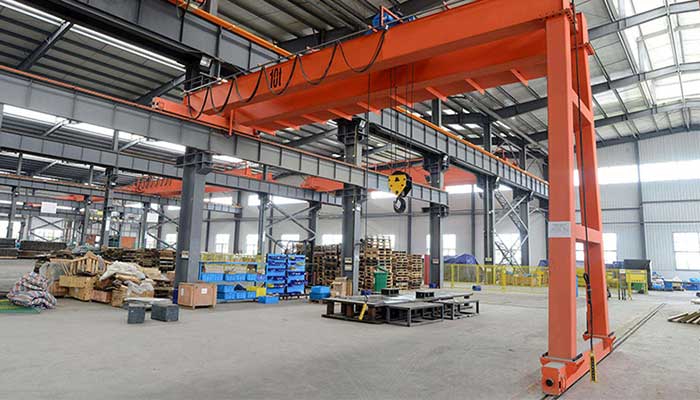
Semi-Gantry Crane 15 ton for Indoor Use
The semi-gantry crane is a hybrid solution, perfect when your workshop conditions are partially restrictive. One side rides on a floor rail, while the other is supported by a wall or column bracket. This design blends the advantages of a full gantry and a bridge crane, offering a compromise between building constraints and operational flexibility.
When it works best:
Semi-gantry cranes shine in spaces with uneven structural strength-maybe one strong wall can take the load, but the opposite side cannot. They're also suitable when machinery lines or partial obstructions prevent a full bridge installation, and you still need some floor clearance for movement.
Key features:
One side on the floor, the other anchored to a wall bracket or embedded plate
Can safely lift the full 15-ton load when engineered correctly
Balances structural constraints with usable floor space
Easier and faster to install than a full gantry in rooms with limited space
Typical applications:
Workshops where floors or walls have uneven strength and a bridge crane is not an option
Production bays with machinery along one wall, needing clear space on the other side
Facilities requiring flexibility without major building reinforcement
Selection Considerations
Choosing the right 15-ton indoor crane isn't just about the load-it's about the space, the building, and how you plan to use it day in and day out. Getting these factors right upfront can save time, money, and headaches later.
Duty Cycle
Before anything else, think about how often the crane will be used. Duty cycle refers to the frequency and intensity of lifting operations, which directly affects the type of crane and hoist you need.
Light duty: Occasional lifts, maintenance tasks, or small-scale workshops; single-girder cranes often suffice.
Moderate duty: Daily lifting with a mix of heavy and medium loads; single-girder or semi-gantry cranes are suitable.
Heavy duty: Continuous lifting in production environments or steel fabrication; double-girder or full gantry cranes are recommended.
Properly matching duty cycle ensures your crane lasts longer and reduces maintenance costs.
Headroom
Headroom is the vertical space between the floor and the lowest obstruction above. It's a critical factor, especially in workshops with low ceilings.
Double-girder cranes: Offer the best hook height and approach, which is great for tight spaces or tall loads.
Single-girder cranes: Slightly lower efficiency in confined rooms but still effective if you choose a low-headroom wire rope hoist.
Always measure the room height carefully and allow extra clearance for the hoist, trolley, and end stops.
Floor Space
The layout of your floor will affect your crane choice.
Gantry cranes: Require rails on the floor, which may reduce usable floor space but provide independent structural support.
Bridge cranes: Keep the floor clear since they are supported from above, allowing forklifts, pallets, and other operations to continue uninterrupted.
Consider access points, pathways, and material handling flows when planning rail locations or bridge clearance.
Structural Capacity
Your building's walls, columns, and roof may or may not handle the loads from a crane. Knowing this early is essential.
Bracketed bridge cranes: Require walls or columns capable of carrying the full crane load plus dynamic forces.
Suspension cranes: Depend entirely on roof beams or trusses.
Gantry or semi-gantry cranes: Carry the load on floor rails, reducing stress on walls/roof.
Check the building structure or consult a structural engineer before finalizing the crane type.
Future Expansion
Think beyond today. Your crane may need to adapt to new processes or heavier loads in the future.
Double-girder and gantry cranes: Offer the most flexibility for adding auxiliary hoists, automation, or larger lifting devices.
Single-girder cranes: Can handle upgrades but are less adaptable for specialized or oversized equipment.
Consider leaving extra runway length or headroom for future modifications.
Practical Recommendations
Once you've considered duty cycle, headroom, floor space, and structural capacity, the next step is choosing the crane that fits your needs most efficiently. Here are some practical options based on typical indoor conditions:
Most Versatile Choice
For most industrial workshops and production bays, a top-running double-girder bridge crane is the safest bet.
Equipped with a wire-rope hoist, it handles the full 15-ton load smoothly and safely.
VFD drives allow precise movement of both the trolley and the crane, which reduces load sway and increases safety.
Radio remote control provides flexible operation without being tied to a fixed control pendant.
Works well in high-frequency lifting environments, giving you flexibility for future upgrades, auxiliary lifting devices, or automation.
Alternative for Lower Duty
If your lifting needs are less frequent or budget is a key concern, a single-girder bridge crane is a practical alternative.
Lighter and simpler, it's easier to install and maintain.
Handles occasional 15-ton lifts without overengineering the building structure.
Works best in workshops with adequate headroom and moderate workflow.
Ideal for maintenance bays, assembly areas, or general material handling with fewer daily lifts.
Alternative for Structural Limits
When the building cannot safely carry crane loads, a full gantry or semi-gantry crane is the way to go.
These cranes are independent of walls or roof, so they don't impose extra stress on the structure.
Floor rails can be recessed to maintain a flat, unobstructed floor.
Semi-gantry cranes provide a compromise when one wall is strong enough to carry part of the load, saving space and materials.
Suitable for indoor bays with weak walls or low ceilings, where bridge cranes would be unsafe.
By matching your crane type to duty, structure, and budget, you can ensure safe, efficient, and long-lasting lifting operations. Taking these practical steps upfront also reduces installation delays and maintenance issues down the line.


