


Chinese vs. European Cranes in Brazil – Cost, Performance, and Reliability
For many Brazilian factories, ports, and steel plants, the real decision is not simply Chinese vs. European cranes. The key question is which crane solution provides the best balance of price, durability, maintenance availability, and local service support over the crane's lifecycle.
European crane brands are often associated with high-end engineering and advanced automation, while Chinese crane manufacturers increasingly offer competitive performance with significantly lower upfront costs and flexible customization. The best option depends on budget, operating intensity, spare parts access, and long-term maintenance strategy in Brazil. We, Yuantai BetterCrane offers customized overhead crane project solution for clients from Brazil.
Key Takeaways for Crane Buyers
Brazilian buyers often compare Chinese overhead cranes with European crane brands when planning new factories or equipment upgrades.
European cranes typically offer premium engineering, advanced control systems, and established global brands.
Chinese cranes usually provide lower initial investment and customizable configurations.
For many industrial projects, lifecycle cost and spare parts availability in Brazil matter more than the purchase price alone.
The choice often depends on operation intensity, environment, and long-term maintenance capability.
Questions Answered in This Guide
Are Chinese cranes reliable enough for Brazilian industrial operations?
Why do European cranes usually cost more?
How do maintenance and spare parts availability compare in Brazil?
Which crane option offers better value over time?
How should buyers evaluate crane suppliers when importing equipment?
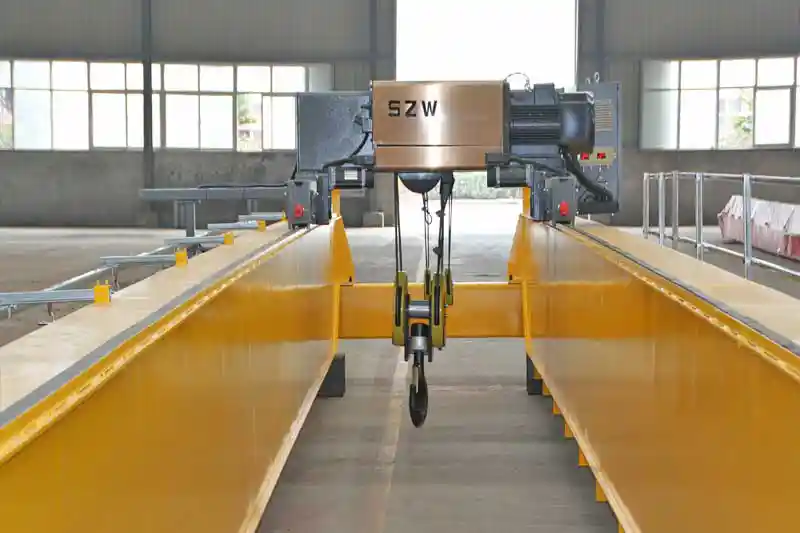
European style double girder overhead crane for sale and single girder overhead cranes for sale
The Brazilian Crane Market: Why the Comparison Matters
Brazil has one of the largest industrial bases in Latin America. From steel production to mining and port logistics, material handling equipment plays a central role in daily operations. When heavy materials need to move safely and efficiently inside a workshop or across a yard, cranes become essential infrastructure rather than optional equipment.
Across the country, cranes are widely used in several key sectors:
Steel mills handling slabs, billets, coils, and plates
Mining operations moving ore, equipment, and maintenance components
Ports and logistics terminals loading containers, bulk cargo, and heavy machinery
Manufacturing plants supporting assembly lines and warehouse handling
Energy and infrastructure projects lifting turbines, generators, and structural components
Each of these industries requires dependable lifting equipment because production often runs continuously. A crane failure in a steel mill or port can slow down an entire operation.
Because of this, many Brazilian companies take crane procurement very seriously. They usually compare multiple suppliers before making a decision.
Why Buyers Compare Chinese and European Cranes
In practice, most procurement teams reviewing overhead cranes or gantry cranes in Brazil end up comparing two major supply sources: manufacturers from Europe and manufacturers from China.
Both groups are active in the Brazilian market, but they approach crane design and supply a bit differently.
European crane brands are traditionally associated with:
Long-established engineering standards
Advanced drive systems and control technologies
Strong global brand reputation
Higher purchase prices
Chinese crane manufacturers, on the other hand, are often known for:
Competitive equipment pricing
Flexible customization for different industries
Large manufacturing capacity
Increasing global export experience
So when Brazilian buyers start reviewing crane proposals, the discussion usually goes beyond brand preference. It becomes a practical comparison between price, performance, and long-term service conditions.
Key Factors That Drive the Comparison
For most industrial projects, the decision is rarely based on a single factor. Purchasing teams typically evaluate several practical issues at the same time.
Some of the most common considerations include:
Equipment investment budgets
Large cranes can represent a major capital expense, especially for new factories, port expansions, or steel plant upgrades.
Project timelines
Delivery time matters. Many industrial projects in Brazil operate under tight construction or expansion schedules.
Technical performance requirements
Lifting capacity, duty classification, span length, and lifting height must match the actual working conditions.
Long-term maintenance planning
Buyers often ask how easy it will be to obtain spare parts, perform repairs, and train maintenance teams.
These factors tend to shape the entire discussion when comparing crane suppliers.
Why Procurement Teams Look at Lifecycle Value
Inside many Brazilian companies, crane purchases are reviewed by both engineering teams and financial departments. Engineers focus on technical reliability. Finance teams focus on cost control.
That means the purchasing decision usually needs to answer two practical questions:
Can the crane perform reliably in our working environment?
Does the total cost make sense over the long term?
This is why buyers rarely look only at the purchase price. They also consider:
Expected service life of the crane
Maintenance complexity
Spare parts logistics
Downtime risk in critical operations
In other words, the comparison between Chinese and European cranes in Brazil is really about overall operating value, not just where the crane is manufactured.
Price Comparison: Why Chinese Cranes Are Often More Affordable
When Brazilian buyers start comparing crane proposals, the first difference that usually stands out is the initial purchase price. In many cases, quotations from Chinese crane manufacturers are noticeably lower than those from European suppliers offering similar lifting capacity and basic configuration.
That price gap often raises a practical question: Why does the cost differ so much if the cranes appear similar on paper?
The answer usually comes down to manufacturing scale, component sourcing, and system design.
Typical Price Factors Behind Chinese Crane Costs
Chinese crane manufacturers operate within one of the largest industrial supply chains in the world. Many core components used in overhead cranes and gantry cranes are produced locally and in high volumes, which helps reduce overall manufacturing costs.
Several factors contribute to the lower price structure:
Large-scale manufacturing capacity
Many Chinese factories produce hundreds or thousands of cranes each year. High production volume spreads engineering and tooling costs across more units.
Integrated supply chains for key components
Motors, reducers, wire rope hoists, electrical panels, and steel structures are often sourced from domestic suppliers within the same industrial regions.
Efficient steel structure fabrication
Girder fabrication, machining, and assembly are often done in facilities designed specifically for crane production.
Flexible customization for industrial projects
Chinese manufacturers often adapt crane specifications to the project rather than requiring standardized packages.
Because of these factors, the manufacturing cost of a 10 ton overhead crane or a 20 ton double girder crane can be significantly lower when produced in China.
Cost Structure of European Crane Systems
European crane manufacturers often follow a different product philosophy. Their equipment is typically built around proprietary technologies and integrated systems.
This approach brings certain advantages, but it also affects price.
Common cost drivers include:
Proprietary drive systems and control platforms
Some manufacturers design their own hoists, gearboxes, and electronic control units.
Advanced automation and monitoring systems
Features such as load monitoring, smart diagnostics, and automated motion control may be integrated into the crane package.
Higher labor and manufacturing costs
Production costs in Europe are generally higher due to labor rates and regulatory requirements.
Brand-driven engineering packages
Many European cranes are sold as complete engineered systems rather than modular equipment.
For projects that require sophisticated automation or specialized handling precision, this approach can make sense. But for many standard industrial lifting applications, it also increases the purchase price.
What Brazilian Buyers Often Find in Real Comparisons
When Brazilian companies compare quotations for similar crane specifications, they often see differences such as:
Comparable lifting capacity and span
Similar hoisting speeds and duty classifications
Different levels of automation and integrated electronics
Yet the initial price of a Chinese crane can sometimes be 30–50% lower than an equivalent European package, depending on configuration.
For factories that need several cranes - for example, multiple workshop cranes or warehouse lifting systems - this difference can represent a substantial investment saving.
Why the Purchase Price Should Not Be the Only Factor
Even though the purchase price is important, experienced buyers rarely evaluate cranes based on price alone. A crane is long-term industrial equipment that may operate for 15 to 25 years.
Before making a decision, procurement teams usually look at the full cost picture, including:
Ocean transportation and inland logistics
Import duties and customs clearance in Brazil
Installation and commissioning costs
Operator and maintenance training
Spare parts packages
Long-term service and technical support
In many projects, the most reliable approach is to compare the total lifecycle cost of the crane system, not just the purchase price on the quotation sheet.
Performance Comparison: Engineering and Technology
When crane buyers in Brazil compare Chinese and European cranes, the discussion often moves beyond price and into engineering performance and control technology. On paper, two cranes may show similar lifting capacity and span. But their internal design, control systems, and integration level can be quite different.
In most cases, the difference comes down to design philosophy. European manufacturers tend to focus heavily on integrated systems and precision control, while Chinese manufacturers often emphasize robust mechanical performance and adaptable configurations for a wide range of industries.
Both approaches can work well depending on the application.
European Crane Characteristics
European crane manufacturers are widely known for their emphasis on system integration and control precision. Their cranes are often designed as complete engineered systems, where mechanical components, drives, and electronics are tightly integrated.
Typical technical characteristics include:
Precision motion control
Smooth acceleration and deceleration help reduce load swing and improve positioning accuracy.
Advanced frequency converter systems
Variable frequency drives are commonly used for hoisting, trolley travel, and bridge travel to achieve stable speed control.
Integrated automation and smart diagnostics
Some crane systems include monitoring functions that track operating hours, motor temperature, and load cycles.
High-efficiency hoisting mechanisms
Optimized gearboxes, compact motor designs, and lightweight hoists are often used to improve lifting efficiency.
These features are particularly useful in environments where crane movements must be precise and repeatable.
Common examples include:
Automated warehouses and logistics centers
High-frequency production lines in manufacturing plants
Precision lifting tasks in assembly workshops
Facilities where cranes are integrated with automated production systems
In these environments, smooth motion control and integrated monitoring can help maintain production efficiency.
Chinese Crane Characteristics
Chinese crane manufacturers have made major progress in engineering and manufacturing over the past two decades. Many modern cranes exported from China now incorporate reliable mechanical systems and internationally compatible electrical components.
In practical terms, Chinese crane designs usually focus on durability and adaptability across many industries.
Common characteristics include:
Reliable hoisting mechanisms
Electric wire rope hoists and hoisting motors are designed for stable lifting performance and straightforward maintenance.
Standardized industrial components
Many cranes use motors, electrical parts, and control systems that are widely available in global industrial markets.
Flexible configuration options
Manufacturers often customize cranes based on span, lifting height, duty classification, and environmental conditions.
Compatibility with international control systems
Variable frequency drives and PLC-based control systems can be integrated when required by the project.
This approach works well for many industrial lifting applications where durability and practical operation matter more than highly specialized automation.
Typical use cases include:
Steel handling in fabrication workshops
Warehouse lifting and logistics operations
General manufacturing plants
Construction material handling
Real-World Performance in Industrial Operations
In day-to-day operations, many Brazilian companies find that the performance gap between modern Chinese cranes and European cranes has become much smaller than it was years ago.
For common industrial lifting tasks such as:
moving steel plates and coils
lifting machinery components
handling pallets or containers in warehouses
modern Chinese cranes can provide stable lifting performance, adequate speed control, and reliable operation when properly designed and installed.
The key point for buyers is that crane performance depends not only on brand origin, but also on correct specification, duty classification, and installation quality.
For many industrial projects, the final decision comes down to whether the project requires high-end integrated automation or simply a strong, reliable crane system that performs consistently at a reasonable investment level.
Reliability and Durability in Brazilian Conditions
Brazil is a large country with very different industrial environments. A crane operating inside a coastal port facility faces very different conditions compared with one installed in a mining workshop or steel plant inland. Because of this, reliability is not only about the brand of the crane. It also depends on how well the crane design matches the working environment.
In many Brazilian industries, cranes must operate under conditions that can gradually affect mechanical parts, electrical systems, and structural components.
Typical operating challenges include:
High humidity
In many regions, humidity remains high throughout the year, which can affect electrical cabinets, motors, and wiring insulation.
Coastal corrosion
Ports and shipyards near the Atlantic coast are exposed to salt air. Without proper protection, steel structures and mechanical components can corrode over time.
Dust from mining and bulk materials
Mining sites and bulk material handling facilities often produce large amounts of dust that can enter motors, brakes, and gearboxes.
Heavy-duty lifting cycles
Steel mills and manufacturing plants may run cranes continuously during production shifts, which places constant stress on hoisting mechanisms and travel drives.
These environmental factors mean that crane reliability often depends on practical engineering decisions during design and installation.
Conclusion
When it comes to choosing between Chinese and European cranes in Brazil, the decision is less about where the crane comes from and more about overall value for your operation.
European cranes are often associated with premium engineering, precise motion control, and advanced automation. They can be ideal for facilities that require high-frequency operation, precise positioning, or integration with automated production systems.
Chinese cranes, on the other hand, have made significant progress in performance, reliability, and customization. With lower initial investment and widely available components, they can be a practical choice for many steel mills, warehouses, ports, and general manufacturing operations.
For Brazilian buyers, the key is to evaluate the total lifecycle value of the crane system, not just the purchase price. This includes:
Reliability in local environmental conditions
Maintenance accessibility and spare parts availability
Quality of local technical support and service
Selecting the right crane supplier and solution ensures that your equipment will operate safely, efficiently, and consistently for many years. In other words, a well-planned procurement focuses on long-term operational success, not just upfront cost.


