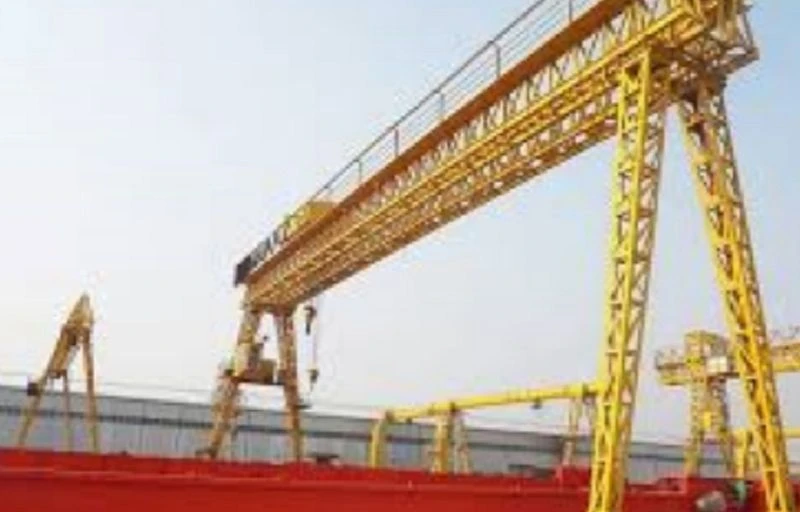
Gantry cranes are excellent work platforms for many industries and applications. This article focuses on gantry cranes in the one-ton to five-ton category. Customers considering purchasing a gantry crane need to know the answers to certain questions at the time of purchase in order to properly size the crane. This article provides answers to these questions.


Height and span are two important aspects to be considered.
Height considerations:
Lowest obstruction above the work area - What is the lowest object in the work area that will be used and/or moved by the gantry crane? You must ensure that the crane can be positioned and moved (if necessary), that it can enter and exit the work area, and that it can be installed below the lowest object directly above the work station. The lowest overhead obstruction can be a ceiling, support beams, sprinklers, part of the HVAC system, pipes, railings, etc.
Overall height:The overall height of a gantry crane usually includes the distance from the ground (including casters) to the top of the I-beam. If the crane is a height adjustable model with a height range of 7' 6' to 14'0' below the I-beam, the total height including casters is the range of measurements (low to high) plus the height of the I-beam.
Height under the beam: The height under the beam is measured from the ground to the bottom of the I-beam. Again, subtracting the height of the I-beam from the total height equals the height under the I-beam.
Hook Height Requirement: This is perhaps the most important height requirement. It is the measurement from the ground to the highest point on the inside underside of the hook when the load is secured to the hook. Be sure to consider the slackness of the chain, slings, etc. used to lift the load.
Lifting height: Carts and lifts vary in size and height. If overall height restrictions are strict, you may need to look for a trolley and lift combination that meets your 'lift height' requirements. The total height of the cart and lift to the inside of the bottom hook of the lift is called the 'clear height'. The clear height is measured from the underside of the trolley rollers to the inside of the bottom hook of the lift (when attached to the trolley). If you want to be precise, you can add the thickness of the flange thickness of the I-beam that the trolley rollers sit on. If you want to minimise the height, look for a cart/lift with 'eye mount'. This type of trolley and lift are mounted on top of each other, reducing the space they take up in a gantry configuration.
Chain drop: Hoists are available with different chain lengths. Chain drop is the amount of chain that is available for lifting. If the chain drop is 15 feet, then at full extension there is 15 feet of usable chain from the hoist to the hook. Keep in mind ceiling height measurements and the possible need to go below grade when determining chain drop requirements. For example, say you have a hook height requirement of 10' and a 2 '6" clearance for the trolley and hoist. First, the gantry crane must meet or exceed 12 '6" below the I-beam height (10' hook height + 2 '6" clearance). If we choose a standard crane with a height of 14' below the I-beam, what is the required chain drop to reach a hook point 2' above the floor? Answer: 14' minus 2' 6" height equals a hook height of 11' 6" (which exceeds the 10' hook height requirement). Therefore, the maximum hook height is 11' 6" minus 2", which equates to a 9.6" chain drop required to reach a load 2" above the floor. Given the popular options, a chain drop of 3' may be selected. So even if the height under the I-beam is 14', you would only need a standard 10' chain drop to reach a hook point 2' above the floor.
Height adjustment: For height-adjustable models, you may want to consider a height adjustment kit so that you can easily adjust the height of the beam. For steel models, the beam can be very heavy, accounting for about a third of the total weight of the crane. For easier height adjustment, consider an aluminium crane, which is more expensive but less than ? of the total weight of a steel crane.
Safety clearance considerations:
There are two measurements to note for the span, or width, of a gantry crane. The first is the overall width, which is simply the length from outer edge to outer edge of the beams and legs. Gantry cranes have end stops to prevent the trolley from rolling off the beam and/or base plate (used when the legs and beam are fitted together and when they are welded), which means that the trolley will not roll the full length of the beam, and this needs to be taken into account when determining the required beam width. Usable width' measures the distance between the end points where the trolley stops on either side. The usable width is approximately 2.6 inches less than the full beam width.
Capacity: Make sure that the capacity of the hoist does not exceed the capacity of the crane or trolley. Ideally the crane, trolley and pallet should have the same capacity. From top to bottom, the capacity of the gantry should be equal to or greater than the capacity of the trolley, and the capacity of the trolley should be equal to or greater than the capacity of the hoist. All components of the gantry system should equal or exceed the maximum load weight - however, this should not be exceeded by too much. Choose the capacity that is closest to the load that will accomplish the task. Overhead cranes are usually tested at 125% of their rated capacity, so there is no need to overdo it.
Armed with this knowledge, you are now ready to purchase a gantry crane.