


Choosing the wrong jib crane supplier costs more than money. It costs downtime, safety risks, and expensive replacements. If you are sourcing a 2 ton jib crane, the supplier you pick matters just as much as the crane itself. This guide helps you identify what separates a reliable manufacturer from a risky one - so you can buy with confidence.
Whether you are upgrading a workshop, outfitting a new production line, or replacing aging equipment, the criteria in this article will give you a clear framework. We cover certifications, key technical specs, red flags to watch for, and questions to ask before signing any purchase order.
What Makes a 2 Ton Jib Crane Manufacturer "Reliable"?
Reliability is not a marketing claim. It is a combination of verifiable standards, production capability, and post-sale support. A trustworthy supplier will always be able to back up their claims with documentation.
Certifications and Compliance Standards
Any reputable 2 ton jib crane manufacturer should meet internationally recognized standards. The most important ones to look for include:
CE Marking - Required for equipment sold in European markets. It confirms compliance with EU Machinery Directive 2006/42/EC.
ISO 9001 - Demonstrates a certified quality management system in the manufacturing process.
FEM 1.001 / ISO 4301 - Standards that govern crane classification and duty cycles.
If a supplier cannot provide these certifications upon request, that is a serious warning sign. Legitimate manufacturers keep documentation readily available for buyers.
Manufacturing Capacity and Quality Control
A factory's production capability directly impacts consistency. When evaluating suppliers, ask about:
In-house steel fabrication vs. outsourced components
Welding certifications held by their workforce (e.g., ISO 3834)
Load testing procedures before shipment
A reliable manufacturer will conduct a rated load test at 125% of the working load limit - meaning a 2 ton crane is tested at 2.5 tons before delivery. This is standard practice per ISO 9927-1 and EN 14502.
Key Technical Specifications to Compare Across Suppliers
Not all 2 ton jib cranes are built the same. Understanding the specs helps you compare apples to apples when requesting quotes.
Structural Design and Rotation Range
2 ton jib cranes are available in Wall Mounted Cantilever Crane , Floor Mounted Jib Crane, and Articulating Jib Crane. Each suits different workspace layouts.
Wall Mounted Cantilever Crane
Bolts directly to a structural wall or column. Rotates 180°–270°, making it ideal for narrow bays and workstations along walls. No floor space consumed - keeps the work area clear and accessible.
Lifting capacity: 0.25 ~ 2 ton
Span: 4 ~ 5 m
Lifting height: 5 ~ 6 m
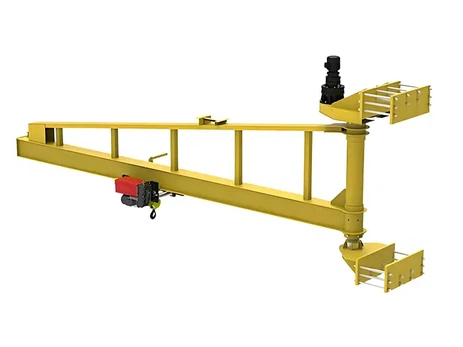
Floor Mounted Jib Crane
A freestanding pillar anchored to a concrete foundation. Delivers full 360° rotation, making it the most flexible option for open floor areas and central workstations. Easy to relocate if your layout changes.
Lifting capacity: 0.125 ~ 10 ton
Span: 2 ~ 6 m
Lifting height: 2 ~ 6 m

Articulating Jib Crane
Features a two-segment folding arm that bends at a middle joint. Reaches around obstacles and into tight spaces that a standard boom cannot access. A practical choice for complex workstation layouts where flexibility matters most.
Lifting capacity: 0.125 ~ 2 ton
Span: 3 ~ 6 m
Lifting height: 1.75 ~ 3.5 m
Get Quote

The rotation range affects how much of your floor area the crane can actually serve. Always confirm the effective working radius - not just the boom length.
Hoist Compatibility and Lift Height
The crane structure is only part of the equation. The hoist must also be matched to the application. A 2 ton jib crane should be compatible with:
Electric chain hoists (most common for 2T loads)
Wire rope hoists (for longer lift heights or heavy-duty cycles)
Confirm the minimum hook approach (MHA) - the closest distance the hook can travel to the end of the boom. A smaller MHA means better reach and less dead zone at the tip.
Steel Grade and Surface Treatment
The structural steel grade directly affects durability and weld quality. Look for suppliers using S355 or equivalent high-strength structural steel. Surface treatment should include:
Shot blasting to Sa 2.5 standard
Primer + topcoat system rated for the operating environment (indoor, outdoor, corrosive)
How to Evaluate a Supplier Before Purchasing
Beyond specs and certifications, there are practical steps to vet a manufacturer before committing.
Request Factory Audits or Third-Party Inspection
For significant orders, a factory audit is worthwhile. This can be done in person or through a third-party inspection agency such as SGS, Bureau Veritas, or TÜV. An audit gives you visibility into actual production quality - not just what a brochure claims.
If an on-site visit is not possible, request:
Recent factory inspection reports
Video walkthrough of the production floor
Sample welding inspection records
Review After-Sales Support and Spare Parts Availability
A crane is a long-term asset. After-sales service matters as much as the initial build quality. Ask potential suppliers:
What is the standard warranty period? (Industry standard is typically 12–24 months)
Are spare parts stocked locally or shipped from the factory?
Is technical support available in your language and time zone?
Suppliers who hesitate on these questions often struggle with post-sale service. This is a common complaint among buyers who prioritized price over supplier reliability.
Check References and Project History
Ask for a list of completed projects in your industry or region. A supplier with relevant experience in your sector - automotive, logistics, fabrication - is better positioned to understand your requirements. Legitimate manufacturers will provide references without hesitation.
Common Mistakes Buyers Make When Sourcing a 2 Ton Jib Crane
Many purchasing errors are avoidable. Here are the most frequent ones seen in the field.
Focusing Only on Unit Price
The lowest quote rarely reflects the lowest total cost of ownership. Factors like shipping damage, poor documentation (which delays customs clearance), and missing spare parts can add significant hidden costs. A slightly higher price from a more established supplier often pays for itself quickly.
Ignoring Duty Cycle Classification
Cranes are classified by duty cycle - how intensively they are used. A 2 ton jib crane classified for light-duty use (FEM 1Am / ISO M3) should not be deployed in a high-frequency production environment. Using the wrong duty class accelerates wear and can void warranties. Always specify your actual usage pattern when requesting quotes.
Skipping Local Compliance Review
Even if a crane carries CE marking, local installation codes may impose additional requirements. In the United States, ASME B30.11 governs monorail systems and underhung cranes. In other markets, local authorities may require additional load testing or third-party inspection upon installation. Confirm these requirements before the equipment ships.
A Practical Checklist Before You Buy
Selecting a reliable 2 ton jib crane supplier comes down to a few non-negotiable criteria:
Verified certifications (CE, ISO 9001 at minimum)
Clear technical documentation including load test reports
Appropriate duty cycle classification for your actual usage
Responsive after-sales support with accessible spare parts
References from comparable projects
The global overhead crane market is growing steadily, with demand driven by manufacturing automation and logistics expansion. As more suppliers enter the market, the quality gap between manufacturers is widening - making due diligence more important than ever. Invest time in supplier evaluation upfront, and you will avoid costly mistakes down the line.


