









Double Girder Truss Type Gantry Crane
Product Introduction
Products Description
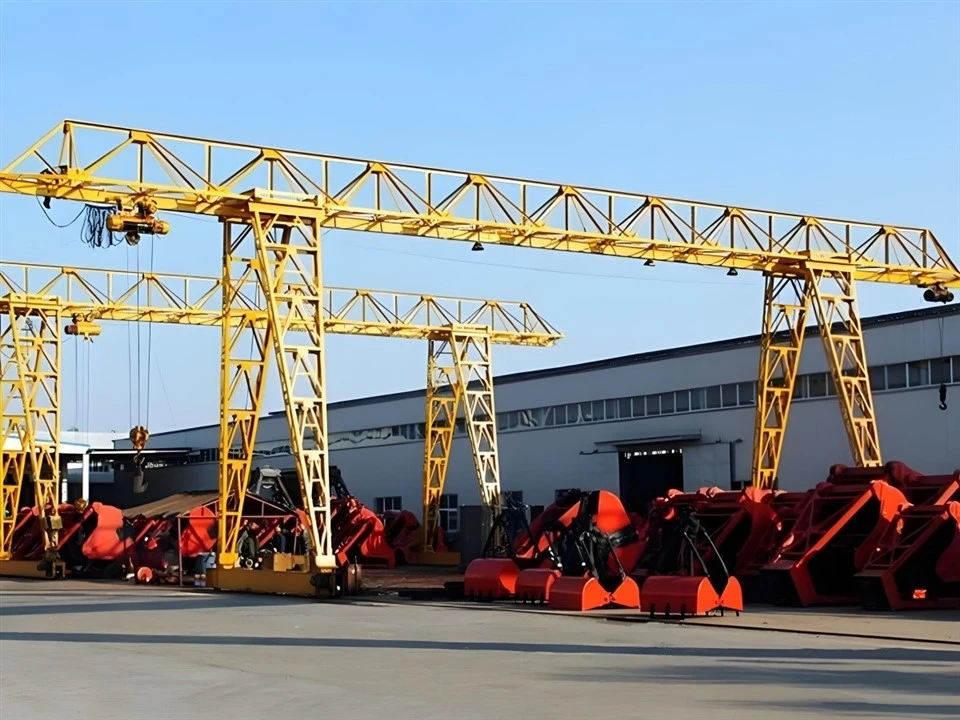
- The Double Girder Truss Type Gantry Crane is a highly efficient and versatile lifting solution designed for heavy-duty applications in outdoor environments. This type of crane is ideal for handling large loads, such as steel, precast concrete, containers, and other industrial materials. Its robust construction, stability, and adaptability make it suitable for industries like construction, shipbuilding, mining, and logistics.
- The crane features a truss structure that provides excellent wind resistance, making it ideal for outdoor use, even in windy regions.
- Lightweight yet durable, reducing the overall load on the supporting foundation.
- Two girders ensure greater load capacity and stability compared to single girder designs.
- Supports heavier lifting applications, with capacities ranging from 5 to 200 tons or more.The wide-span design offers maximum coverage for large working areas.Can be customized with spans ranging from 10 meters to 50 meters.Equipped with an electric hoist or trolley for smooth, precise lifting and traveling.Options for single-speed, double-speed, or variable frequency drive (VFD) for greater control.
- Operated via cabin control, remote control, or pendant control, providing flexibility and safety.Optional automation and smart features for improved efficiency.Constructed with high-quality steel and anti-corrosion coatings for long-lasting performance.Suitable for extreme weather conditions, including rain, heat, and snow.
Core Components:Engine, Gear, Gearbox
Place of Origin:Henan, China
Warranty :1 Year
Weight (KG):20000 kg
Video outgoing-inspection:Provided
Machinery Test Report:Provided
Application:widely
Color:Can be customized
Span:12~30m
Working duty:A3 /A4
Lifting speed:Variable Speed (standard)
Control Method:Ground Control+ Remote Control (customized)
Main electrical parts:Schneider
Lifting mechanism:Wire Rope Electric Hoist

Pictures & Components
1.Main beam
The main beam of a double girder truss type gantry crane is a key structural component designed to support and transfer the load being lifted. The main beam is constructed as a truss structure, typically made of steel. It uses a combination of triangular units for strength and rigidity while minimizing weight.The gantry crane has two parallel main beams, providing higher lifting capacity and stability compared to single-girder cranes.
These are the horizontal members of the truss. The upper chord handles compressive forces, while the lower chord handles tensile forces.These members connect the upper and lower chords, forming the triangular truss design. They provide the beam with its structural integrity.Often included on the main beam for easy inspection and maintenance of the crane components.A rail is typically mounted on the top of the beam for the trolley and hoist to move along the length of the crane.
The main beam spans the width of the working area and carries the load lifted by the crane's hoist and trolley.It transmits the load to the gantry legs, which are supported by rails or wheels on the ground.
High-strength steel is commonly used to balance durability and weight.The truss design further reduces material usage while maintaining strength.

2.Lifting System
The lifting system of a double girder truss type gantry crane is a crucial component designed to handle heavy loads in outdoor environments like construction sites, shipyards, or warehouses. This system works in conjunction with the crane structure to ensure safe and efficient lifting operations.
Electric Hoist: The most common, powered by an electric motor and controlled by a pendant, remote, or cabin control.
Wire Rope Hoist: Suitable for heavy loads, using durable wire ropes.
Chain Hoist: For lighter loads, typically used in smaller gantry cranes.
Electric Trolley: Driven by motors for high precision and speed.
Lifting Motor: High-power motor that drives the hoist.
Reducer (Gearbox): Reduces motor speed and increases torque for smooth lifting.
Brake System: Electromagnetic or hydraulic brakes ensure safety by halting movement during emergencies or rest.
Rope Drum: Guides and winds the wire rope or chain during lifting and lowering.
Pulley System: Reduces the effort required and distributes the load evenly.

3.End carriage
The end carriage of a double girder truss type gantry crane refers to the structural components located at both ends of the crane's girders. These end carriages are responsible for supporting the entire crane structure and allowing it to move along its designated runway or track.
The truss structure of the crane extends to the end carriages, ensuring lightweight yet strong components. The truss design minimizes the overall weight while maintaining high load-carrying capacity.The end carriages are directly connected to the double girders, ensuring stability and alignment for smooth crane operation.

4.Crane travelling mechanism
1) Working principle
When the operator gives a command, the motor drives the gearbox, which rotates the wheels.The wheels roll along the rails, allowing the gantry crane to move forward or backward.The truss design ensures the crane is lightweight while maintaining high strength, making it suitable for outdoor applications, even in areas with high wind loads.
2) Components of the crane operating mechanism
Crane Wheels:Four or more wheels are typically used, with two or more driven wheels and the rest serving as idlers.The wheels are designed to run on rails mounted on the ground.Materials used for wheels are high-strength alloy steel to resist wear and tear.
End Beams:The wheels are mounted on the end beams, which are connected to the truss-type gantry structure.The end beams house bearings and axles for smooth wheel rotation.
Motors:Motors power the wheels for crane movement.Typically, AC motors with variable frequency drives (VFD) are used for smooth acceleration and deceleration.
Gearbox:A reduction gearbox is installed between the motor and the driving wheel.It reduces the motor speed while increasing torque for efficient crane movement.
Coupling:Elastic or rigid couplings connect the motor to the gearbox, ensuring power transfer with minimal vibration.
5.Trolley travelling mechanism
The trolley travelling mechanism of a double girder truss type gantry crane is a critical component responsible for the horizontal movement of the trolley (which carries the hoist) along the girders.
Components
Trolley Frame: The rigid structure supporting the hoist and driving mechanisms. For a truss-type gantry crane, the trolley frame is designed to match the lightweight and high-strength nature of the truss structure.
Travelling Wheels: Mounted on rails laid along the top of the double girders. These wheels guide and support the trolley's movement.
Drive Mechanism:
Motor: Provides the driving force for trolley movement.
Gearbox: Adjusts speed and torque to match operational requirements.
Couplings: Connect the motor to the driving shaft for smooth power transmission.
Brakes: Electromagnetic or hydraulic brakes to ensure accurate positioning and safety.
Rail System: Rails are laid on the upper surface of the girders to facilitate smooth trolley movement.
Control System:Operated by a cabin, pendant, or remote control.Includes limit switches to prevent over-travel and ensure safety.
2) Working Mechanism
The motor drives the travelling wheels through the gearbox and coupling, allowing the trolley to move along the length of the gantry crane's girders.
Speed control can be achieved via a Variable Frequency Drive (VFD), enabling smooth acceleration, deceleration, and precise positioning.
Brakes engage automatically to hold the trolley in place when not in motion.
6.Crane wheel
1) Function of wheels
Mobile support: The main function of the wheels is to support the movement of the crane on the track and ensure the smooth operation of the crane.
Load distribution: The wheels help to evenly distribute the load of the crane, reduce the pressure on the track, and increase the service life of the equipment.
2) Design requirements
Strength and rigidity: The wheels must have sufficient strength and rigidity to withstand the dead weight of the crane and various dynamic loads.
Wear resistance: Due to the continuous friction between the wheels and the track, the wheel material must have good wear resistance to extend the service life.
Anti-skid design: The wheel surface should be designed to be anti-skid to avoid sliding or slipping under heavy load.

7.Crane Hook
The crane hook of a double girder truss type gantry crane is a key lifting component designed to handle heavy loads efficiently and safely.
The hook is used to attach and lift loads securely, transferring the weight to the crane structure for transport.Typically made from high-strength alloy steel or carbon steel to ensure durability and resistance to deformation under heavy loads. Most hooks have a curved, open throat shape, making them easy to attach to slings, ropes, or chains.
The hook is suspended from the hoist mechanism, which travels along the two girders of the crane. Double girder truss cranes are designed for heavy-duty applications, and the hook's capacity matches the crane's load limits.

8.Motor
The motor of a double girder truss type gantry crane plays a crucial role in ensuring smooth and efficient crane operation.
Hoisting Motor: Powers the hoist mechanism for lifting and lowering loads.
Trolley Motor: Drives the trolley along the bridge girder.
Travel Motor: Enables crane movement along the rails.
Duty Cycle: Motors are designed for intermittent or continuous duty, depending on the application. Gantry crane motors typically follow standards like FEM or ISO.
Insulation Class: Typically F or H class for heat resistance.
Protection Class: IP54 or higher for protection against dust and water.


9.Sound and light alarm system & limit switch
1) Sound and light alarm system
A sound and light alarm system for a double girder truss type gantry crane is a critical safety component designed to alert workers and operators in the vicinity of the crane about its operation or any hazardous conditions.
Audible Alarm (Sound Warning):Typically a loud siren or buzzer that emits sound to warn personnel of the crane's movement or any unsafe conditions.
Visual Alarm (Light Warning):Flashing lights (strobe lights or rotating beacons) mounted on the crane structure to provide a visual warning.
Common colors:
Red: Emergency stop or dangerous conditions.
Yellow/Amber: Crane in operation.
Green: Normal operation or start-up signals.
2) Limit switch
The limit switch is a safety protection device for the crane, which is used to control the operating range of the crane to prevent it from exceeding the preset safety position.
Upper and lower limits: The limit switch is used to set the upper and lower movement limits of the crane. When the lifting mechanism or trolley reaches the set limit position, the limit switch will cut off the power supply or sound an alarm to prevent it from exceeding the safety range.
Prevent collision: The limit switch can effectively prevent the crane from colliding with other equipment or obstacles, ensuring the safety of equipment and personnel.
Automatic stop: In the event of a malfunction or accident, the limit switch can realize the automatic stop function to prevent accidents.

10.Safety Devices
1. Overload Protection Device
Prevents the crane from lifting loads that exceed its maximum rated capacity.
Usually includes load sensors that alert the operator or stop the operation when the load exceeds the limit.
2. Limit Switches
Hoisting Limit Switch: Stops the hoist if it travels too far up or down, preventing collisions or damage to the hook or wire rope.
Travel Limit Switch: Limits the movement of the crane along the rails to prevent it from exceeding its operating range.
Slewing Limit Switch (if applicable): Prevents excessive rotation.
3. Emergency Stop System
An emergency stop button is provided on the control panel or pendant, allowing operators to immediately halt all crane movements during hazardous situations.
4. Anti-Collision Devices
Sensors detect obstructions in the path of the crane or trolley and stop movement to prevent collisions.
5. Over-Speed Protection
Monitors the speed of hoisting, lowering, or trolley movement. If the speed exceeds the preset safety limit, the crane automatically slows down or stops.
6. Rail Clamps and Storm Brakes
Rail Clamps: Mechanically lock the crane to the rails to prevent movement when idle.
Storm Brakes: Secure the crane during strong winds, especially for outdoor gantry cranes.
11.Control Mode
1. Cabin Control
Description: An operator sits in a cabin attached to the crane, usually on the side of the bridge or trolley.
Features:
Provides a clear view of the load and surrounding area.
Suitable for heavy-duty operations or hazardous environments.
Equipped with joysticks, levers, or other controls for precise operation.
Applications: Large-scale construction sites, ports, and heavy industries.
2. Wireless Remote Control
Description: The operator uses a handheld remote controller to operate the crane from a safe distance.
Features:
Enhances operator safety by allowing operation from a safe location.
Lightweight and portable.
Typically operates via radio frequencies.
Applications: Warehouse operations, outdoor material handling, and areas with safety risks.
3. Pendant Control
Description: A control panel is suspended from the crane, allowing the operator to walk alongside the load while controlling its movement.
Features:
Provides a direct line of sight to the load.
Simple and cost-effective.
Applications: Light to medium-duty operations, such as factories and workshops.
4. Automatic Control (PLC-Controlled or CNC Integration)
Description: The crane operates autonomously based on pre-programmed instructions, often managed by a PLC (Programmable Logic Controller).
Features:
High precision and efficiency.
Reduces human error and increases productivity.
Can integrate with other automated systems like conveyor belts.
Applications: Large-scale manufacturing, shipyards, and automated warehouses.
5. Hybrid Control
Description: Combines two or more control modes (e.g., cabin control and wireless remote control) for flexibility.
Features:
Allows operators to switch between modes depending on the task.
Increases operational versatility.
Applications: Multi-purpose crane operations.

12.Sketch

Main technical

Advantages
Increased Load Capacity: The double girder design allows for higher load capacity compared to single girder cranes. The truss structure further enhances the crane's ability to bear heavy loads, making it suitable for heavy lifting operations.
Stability and Strength: The truss design provides greater stability and strength, especially in challenging environments. This structure can withstand higher wind loads and other external forces, making it ideal for outdoor applications, such as in shipyards or ports.
Longer Span: Double girder truss cranes can span wider distances without compromising structural integrity. This is particularly beneficial for large warehouses or construction sites where heavy machinery or materials need to be transported over long distances.
Improved Headroom: The double girder setup allows for a higher hook height, which provides better clearance for taller loads. This is crucial when handling items that require extra space, such as containers or oversized equipment.
Enhanced Durability: The truss structure is often made of steel, which gives the crane excellent durability. These cranes can withstand harsh weather conditions, chemicals, or heavy impacts, making them ideal for demanding industrial environments.
Reduced Deflection: The design of a double girder truss crane helps to minimize deflection (the bending or sagging of the crane's structure), ensuring more accurate and safe lifting operations, especially under heavy load conditions.
Maintenance Accessibility: The design of a truss crane allows easier access to parts and components for maintenance, reducing downtime and improving overall efficiency in operations.
Customization: Double girder truss cranes can be customized to meet specific application needs, such as varying load capacities, spans, or lifting heights, making them versatile for different industries like construction, shipbuilding, and logistics.
Application:
1. Heavy Duty Lifting in Construction
Application: Double girder truss-type gantry cranes are used for lifting large beams, heavy construction materials, or prefabricated building components.
Benefit: Their high load capacity and ability to operate in open spaces make them ideal for construction sites with heavy equipment and structures.
2. Shipbuilding
Application: In shipyards, these cranes are used to move heavy ship parts, such as hull sections, engines, and large equipment.
Benefit: They are capable of handling massive weights and precise movements required for ship assembly and repair.
3. Steel Mills and Foundries
Application: In steel plants, these cranes are employed to handle molten metal, steel beams, and large equipment.
Benefit: The crane's ability to endure high temperatures and heavy lifting makes it ideal for steel handling, especially in high-temperature environments.
4. Container Handling at Ports
Application: Ports and container terminals use double girder truss-type gantry cranes to load and unload shipping containers from vessels to trucks or trains.
Benefit: These cranes offer high precision, speed, and safety for handling cargo, improving efficiency in logistics.
5. Heavy Equipment Manufacturing
Application: Manufacturing plants that produce large machinery and heavy equipment utilize these cranes for moving large parts and sub-assemblies.
Benefit: These cranes' structural design supports significant weight, making them well-suited for moving large, heavy machine components.
6. Energy Sector
Application: In the energy sector, particularly in the construction of power plants or wind turbines, double girder truss-type gantry cranes are used for moving large turbines, generators, and heavy components.
Benefit: The crane's flexibility and capacity help handle oversized components in often tight or specialized spaces.
7. Railway Yard Operations
Application: These cranes are used in railway yards for loading and unloading trains, especially for heavy or oversized cargo.
Benefit: They can move large, heavy items across railway tracks and can work in various weather conditions.
Crane production procedure
1. Design and Engineering
Structural Design: The crane's design is planned based on the specific lifting requirements, load capacity, span, and operational conditions.
Calculations: Structural engineers calculate stresses, load distributions, and safety factors to ensure the crane will operate safely under its intended conditions.
CAD Modeling: Detailed 3D models are created to visualize the crane, and parts are designed with dimensions for fabrication.
2. Material Selection and Procurement
Materials like high-strength steel are selected for the trusses, girders, and other structural components. Plates, beams, and rails are commonly used.
All materials must be ordered and inspected for quality before the production process begins.
3. Fabrication of Main Components
Girders: The main girders are fabricated by cutting, welding, and assembling structural steel plates. These are the primary load-bearing components of the crane.
Trusses: The trusses, which make up the frame of the crane, are welded together from steel bars, forming a lightweight yet strong structure.
End Beams and Legs: The end beams, which connect the girders and support the crane's movement along the rails, are also fabricated. The crane's legs are often made of large steel profiles and are designed to bear the load of the crane and any lifted loads.
4. Welding and Assembly
Welding: The fabricated steel components are welded together with high precision. Special attention is given to alignment and strength, ensuring the welded joints can withstand the loads during crane operation.
Assembly of Girders and Trusses: The fabricated trusses and girders are assembled into the main crane frame. Additional components like the hoist frame, trolley, and electrical systems are also assembled.
5. Component Installation
Hoist and Trolley: The hoist system, which includes the lifting mechanism, rope, or chain, is installed. The trolley system, which moves along the gantry's girder, is fitted next.
Electrical Systems: The electrical wiring and control systems are installed, including motors, transformers, sensors, and control panels.
6. Testing
Load Testing: The crane is tested under load conditions to ensure it can handle the specified weight. This involves gradually increasing the load and checking for stability and functionality.
Operational Testing: The crane is tested for its operation, including smooth movement along the tracks, lifting and lowering of loads, and response to control commands.
Safety Checks: Safety systems, such as limit switches, emergency stops, and overload protection, are tested to ensure they function correctly.
7. Painting and Finishing
After testing, the crane is cleaned and painted to protect it from corrosion. The finishing process includes applying a protective coating, such as an anti-corrosive paint.
8. Final Inspection and Delivery
A final inspection is conducted to verify all components are functioning as per design specifications. This includes a visual check and final safety checks.
Once cleared, the crane is prepared for delivery. It may be disassembled into sections for shipping, with the assembly done at the installation site.
9. Installation and Commissioning
The crane is delivered to the customer's site, where it is reassembled and installed. The final commissioning process includes setting up the crane on its track, ensuring it's aligned properly, and performing operational tests at the site.

Workshop view:
The company has installed an intelligent equipment management platform, and has installed 310 sets (sets) of handling and welding robots. After the completion of the plan, there will be more than 500 sets (sets), and the equipment networking rate will reach 95%. 32 welding lines have been put into use, 50 are planned to be installed, and the automation rate of the entire product line has reached 85%.
Hot Tags: double girder truss type gantry crane, China double girder truss type gantry crane manufacturers, suppliers, factory
Previous
Trussed Type Gantry CraneYou Might Also Like


Send Inquiry