










With Hook Gantry Crane
Products Description
What is a "With Hook" Gantry Crane?
A "With Hook" Gantry Crane is the most common and versatile type of gantry crane, characterized by its use of a simple, robust hook as the primary lifting attachment. This distinguishes it from cranes with specialized end-effectors like magnets, grabs, or vacuum lifters.
It is a self-supporting, portable, or fixed crane that operates on ground-level rails or wheels, with a hoist and trolley system that moves a hook to handle a wide variety of loads using standard slings, chains, or other rigging.
Key Advantages
Exceptional Versatility: The hook can be combined with slings, shackles, and other rigging to lift an almost infinite variety of objects-from machinery and crates to steel beams and concrete blocks.
Cost-Effectiveness: It is generally the most economical type of gantry crane, both in initial investment and maintenance, due to its simple design and standardized components.
Ease of Use and Maintenance: Simple operation and readily available replacement parts (hooks, wire ropes) make it easy to maintain.
Mobility and Flexibility: Portable gantry cranes can be easily moved and set up wherever needed, providing lifting capability without a fixed installation.
High Reliability: With fewer complex components than specialized cranes, a hook gantry crane offers robust and dependable performance.
Common Configurations
Portable Gantry Cranes: Lightweight, often aluminum or steel, with adjustable height and span. Used in workshops, warehouses, and for maintenance. Typically manual or electric chain hoist.
Semi-Gantry Cranes: One leg runs on a ground rail, while the other end runs on an elevated runway attached to a building column. Saves space and cost.
Full Gantry Cranes: Both legs run on ground-level rails. Ideal for outdoor yards, storage areas, and production lines where a wide area needs to be covered.
Rubber-Tired Gantry (RTG) Cranes: Large, self-propelled cranes used primarily in shipping ports for container handling, but the fundamental lifting unit is a spreader beam attached via hooks and cables.
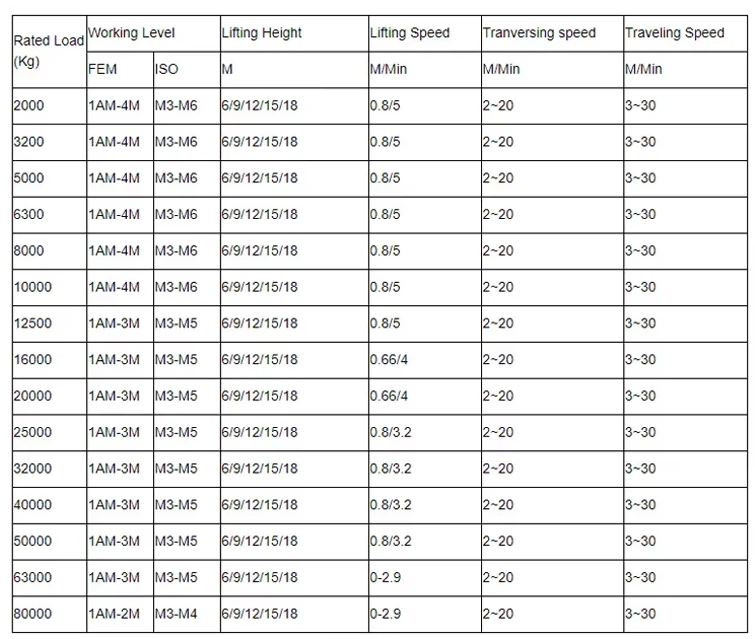
Lifting Capacity 320 tons
Span (Width) 3 - 12 meters (adjustable)
Lifting Height 3 - 10 meters
Working Class A3-A5 (light to medium duty)
Hoisting Speed 0.5 - 8 m/min (variable)
Main Beam Type Single/double girder (box-type)
Power Supply 220V/380V 3-phase or manual
Control Mode Pendant control/wireless remote
Hoist Type Electric chain hoist/wire rope hoist
Travel Drive Manual push or motorized
Corrosion Protection Hot-dip galvanized or marine-grade paint
Wind Resistance Up to Beaufort scale 6 (for outdoor use)
Operating Temp -20°C to +50°C

Pictures & Components
Here is a detailed breakdown of the components of a "With Hook" Gantry Crane.
1. Primary Structural System (The Framework)
Main Girder(s): The primary horizontal beam(s) that span the working area.
Single Girder: A single beam (I-beam or box girder) where the hoist trolley runs on the bottom flange. More economical for lighter loads.
Double Girder: Two parallel girders where the trolley runs on top of the girders. Provides higher capacity, better hook height, and greater rigidity for heavy-duty applications.
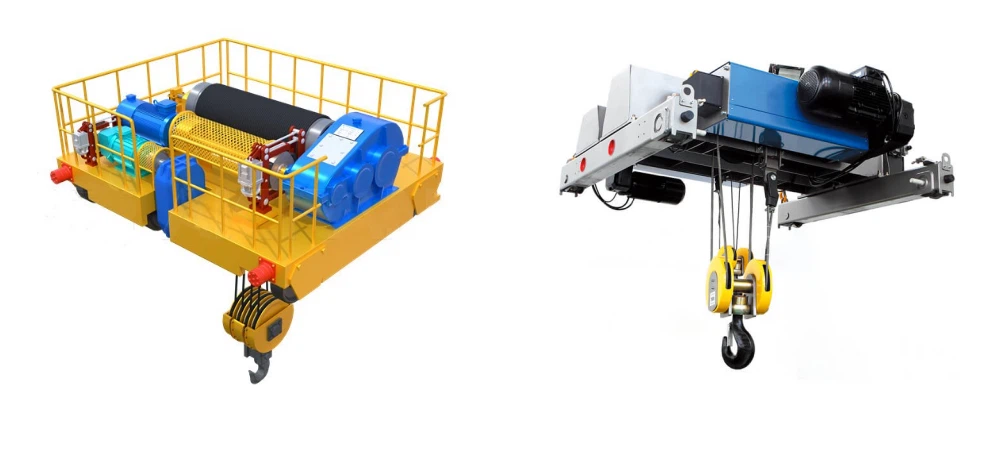
Legs (End Trucks): The vertical supports at each end of the girder.
Can be fixed height or adjustable (telescopic or with pin settings).
House the wheels, axles, and often the drive motors for long travel.
Runway System: The path the crane follows.
For Rail-Mounted Cranes: Consists of steel rails mounted on a solid foundation.
For Rubber-Tired Cranes: A smooth, hard surface is sufficient.
Bracing & Supports: Cross-braces between the legs to provide lateral stability and prevent swaying, especially important for taller cranes.

2. Lifting & Travel System (The Workhorse)
Hoist Unit: The core component that performs the lifting.
Motor: Electric, hydraulic, or manually operated.
Gearbox: Reduces motor speed to increase lifting torque.
Drum or Sprocket: Spools the wire rope or lifts the load chain.
Brake: Automatically holds the load when the hoist is not actively lifting or lowering.
Trolley Assembly: The unit that carries the hoist along the bridge girder.
Trolley Frame: Supports the hoist.
Trolley Wheels: Run along the girder flange(s).
Trolley Drive: Motor and gears that propel the trolley (can be manual push, electric, or hydraulic).

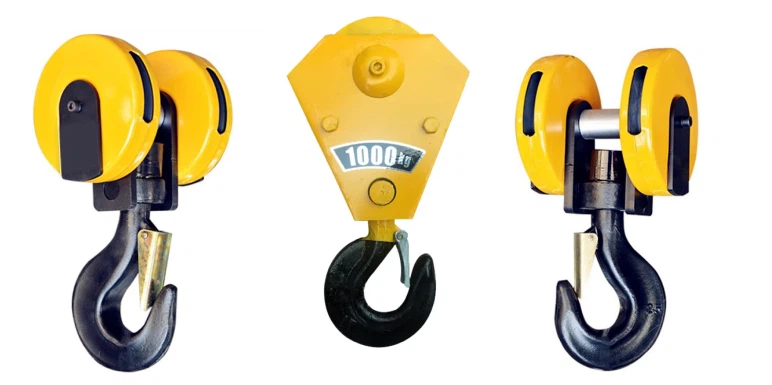
Lifting Hook: The forged steel hook that connects to the load.
Safety Latch: A spring-loaded gate that prevents slings or chains from accidentally slipping off the hook.
Travel Drives (Long Travel): The system that moves the entire crane.
Drive Motors: Mounted on the end trucks.
Wheels: Can be flanged for rails or solid rubber for floor use.
3. Power & Control System (The Nerves)
Power Source:
Electric: Most common for powered cranes. Can be via a cable reel, festoon system, or conductor bar for rail-mounted cranes, or a built-in battery for portable ones.
Hydraulic: Powered by an electric or diesel-driven hydraulic power unit.
Manual: Human-powered for chain hoists and push-style travel.
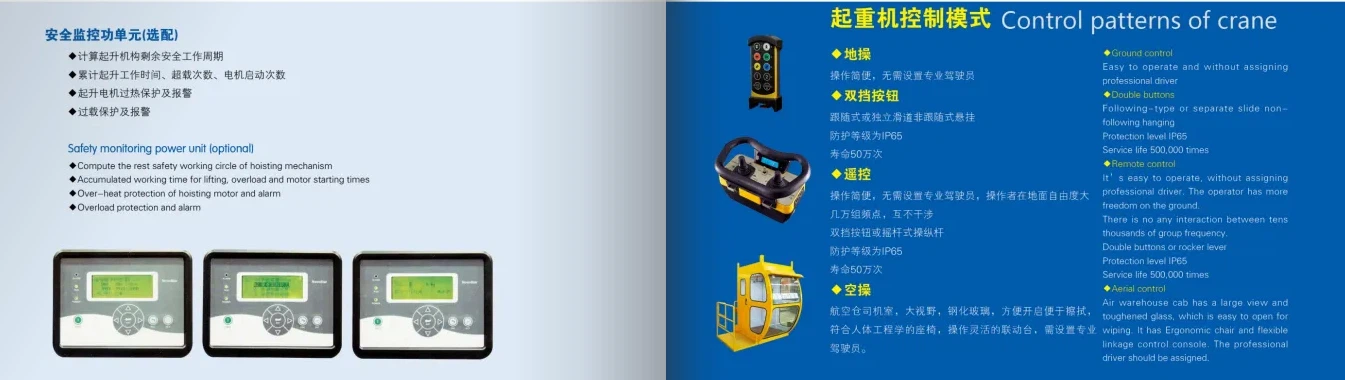
Control Interface:
Pendant Station: A hanging control box with buttons for all crane functions (up/down, left/right, forward/back).
Radio Remote Control: Allows the operator to control the crane wirelessly from a safe and optimal viewing position.
Cab: For very large gantry cranes, an operator's cab may be mounted on the crane.


4. Safety Systems (The Lifeline)
Load Limiting Device: A critical feature, especially in electric hoists, that prevents the hoist from lifting a load beyond its rated capacity.
Limit Switches:
Upper/Lower Limit Switches: Automatically cut power to the hoist motor to prevent the hook from over-traveling and damaging the mechanism.
Travel Limit Switches: Stop the crane or trolley at the ends of its permitted travel.

Braking Systems:
Hoist Brake: Automatically engages when the hoist motor is off.
Travel Brakes: On the drive motors to ensure smooth stopping.
Bumpers & End Stops: Physical buffers (often made of rubber or polymer) at the end of the crane and trolley travel to absorb impact energy.
Warning Devices: Horns or buzzers to alert personnel when the crane is in motion.
SKETCH
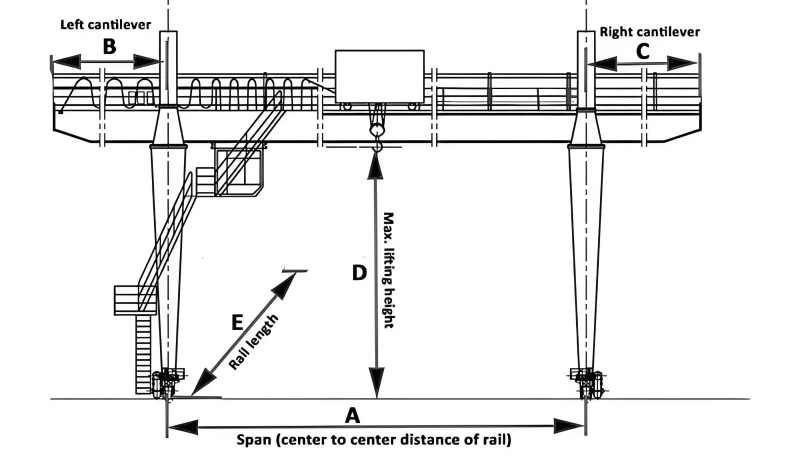
Main technical
Advantages
Advantages of a "With Hook" Gantry Crane
This crane's design offers a powerful combination of versatility, economy, and reliability, making it a fundamental tool across industries.
1. Unmatched Versatility
Universal Load Handling: The standard hook can be used with a vast array of rigging equipment-slings, chains, shackles, and spreader beams-to lift virtually any object, regardless of its shape, size, or material. This makes it a true "one-crane-fits-most" solution.
Adaptable to Various Environments: It can be used indoors and outdoors, in workshops, warehouses, construction sites, and storage yards.
2. Cost-Effectiveness
Low Initial Investment: It is generally the most economical type of gantry crane to purchase and install, especially compared to cranes with specialized end-effectors like magnets or vacuums.
Reduced Operating Costs: Maintenance is straightforward, and replacement parts (hooks, wire ropes) are standardized and readily available, keeping lifetime costs low.
3. Simplicity and Reliability
Ease of Use: Operation is intuitive, requiring minimal specialized training for basic lifts.
Robust Design: With fewer complex components than specialized cranes, there is less that can go wrong. This simplicity translates into high reliability and less downtime.
Easy Maintenance: The mechanical systems are easy to inspect, service, and repair.
4. Mobility and Flexibility
No Fixed Infrastructure Required: Portable and rubber-tired models can be quickly moved and set up anywhere there is a solid surface, providing lifting capability exactly where and when it's needed.
Ideal for Temporary Work: Perfect for construction projects, maintenance tasks, and workshops where a permanent overhead crane is not justified.
5. High Efficiency
Quick Rigging: While slightly slower than a magnet, rigging a load with a hook and slings is still a very fast process that can be easily mastered.
Precise Control: Powered models offer smooth and precise load placement, speeding up production and assembly tasks.
Application
Applications of a "With Hook" Gantry Crane
The universality of the hook makes this crane applicable in nearly every sector that involves moving heavy objects.
1. Manufacturing and Assembly
Moving Raw Materials: Transporting steel, aluminum, and other materials to production lines.
Handling Components: Lifting engine blocks, machine frames, and other heavy sub-assemblies.
Loading Finished Goods: Placing completed products like machinery or large equipment onto trucks for shipment.
2. Warehousing and Logistics
Loading/Unloading Trucks: Efficiently moving heavy palletized goods that exceed forklift capacity.
Stacking and Storage: Rearranging heavy items in a warehouse or storage yard.
3. Construction and Infrastructure
Handling Construction Materials: Lifting steel rebar, pipes, concrete forms, and scaffolding.
Placing Equipment: Positioning generators, pumps, and HVAC units on-site.
Precast Concrete: Lifting and moving concrete elements using embedded lifting loops.
4. Shipping, Ports, and Storage Yards
General Cargo Handling: Loading and unloading non-containerized cargo from ships and barges.
Yard Management: Moving heavy goods, machinery, and steel profiles in outdoor storage yards.
5. Maintenance, Repair, and Workshops
Equipment Servicing: Lifting engines, transmissions, and turbines out of vehicles, ships, or industrial machinery for overhaul.
Factory Maintenance: Replacing heavy machine tools, molds, and press tools.
Crane production process
The production process for a "With Hook" Gantry Crane is a systematic sequence of engineering, fabrication, and assembly. While simpler than a massive double-girder crane, it still requires precision and quality control to ensure safety and reliability.
Here is a detailed breakdown of the production process.
Stage 1: Design & Engineering
This stage defines the crane's specifications and creates the blueprint for production.
Customer Requirements Analysis: Reviewing key parameters: capacity, span, lifting height, power source (electric/hydraulic/manual), and mobility (fixed/portable/rail-mounted).
Structural & Mechanical Design:
Girder Selection: Calculating the required beam size (I-beam, box girder) and determining if a single or double girder design is needed based on capacity and span.
Stability Analysis: Ensuring the leg design and bracing provide sufficient stability against tipping and sway.
Component Selection: Specifying the hoist, trolley, wheels, and other mechanical parts from trusted suppliers.
Bill of Materials (BOM) Creation: Listing all raw materials (steel beams, plates) and purchased components (hoist, wheels, motors, electrical gear).
Stage 2: Material Procurement & Preparation
Procurement: Sourcing certified steel beams and plates, and purchasing the pre-specified components (hoists, motors, etc.).
Material Preparation: Steel components are cut to length using saws or CNC plasma cutters. Holes for bolts and connections are drilled or punched.
Stage 3: Structural Fabrication & Assembly
This is where the crane's frame is built.
Leg Fabrication: For fixed-height cranes, legs are often made from sturdy steel sections (I-beams, tube steel). For adjustable cranes, telescopic sections are fabricated and holes are drilled for height pins.
Girder Preparation: The main beam is prepared. For larger cranes, stiffeners may be welded to the girder to prevent web buckling.
Sub-Assembly: Components like end trucks (which house the wheels) are assembled.
Welding: All structural connections are welded. Critical welds are performed by certified welders to ensure strength and integrity.
Machining (if needed): For high-precision cranes, mating surfaces may be machined to ensure a perfect fit.
Stage 4: Mechanical Assembly
The structural frame is combined with the mechanical systems.
Frame Assembly: The main girder is connected to the legs, forming the basic gantry structure. Bracing is installed for stability.
Wheel & Axle Installation: Wheels are mounted to the end trucks. For powered travel, axles and drive components are installed.
Trolley Assembly: The trolley frame is built, and wheels are attached. The hoist unit is then mounted onto the trolley frame.
Hook Attachment: The hook block is attached to the hoist's wire rope or chain.
Stage 5: Electrical & Control System Installation (For Powered Cranes)
Wiring: Electrical cables are run along the crane structure to the travel motors, hoist motor, and control points.
Control System Installation: The pendant control station (or radio receiver) is installed and wired. Control panels with contactors and overload protection are mounted.
Power Supply Setup: For electric cranes, a festoon system or cable reel is installed to manage the power cable.
Stage 6: Works Testing & Inspection (FAT - Factory Acceptance Test)
The fully assembled crane is tested to ensure it meets all specifications and safety standards.
Visual Inspection: Checking for workmanship, proper welding, and correct assembly.
No-Load Test: Operating all functions (hoisting, trolley travel, gantry travel) without a load to check for smooth operation and abnormal noise.
Load Testing:
Static Load Test: Lifting a test load of 125% of the rated capacity and holding it to verify structural integrity and brake holding capacity.
Dynamic Load Test: Lifting a test load of 110% of the rated capacity and running it through all motions to ensure performance under working conditions.
Safety Device Test: Verifying the operation of all limit switches, emergency stops, and overload protection devices.
Stage 7: Dismantling, Painting & Packaging
Dismantling: The crane is partially disassembled into logical sections (girder, legs, trolley) for shipping.
Painting: All components are painted with a primer and topcoat for corrosion protection. Customer-specific colors are applied at this stage.
Packaging: Components are securely packaged, with special attention to protecting machined surfaces, threads, and electrical components.
Stage 8: Site Installation & Commissioning (SAT - Site Acceptance Test)
Site Erection: The crane is reassembled on the customer's site.
Final Connections: Electrical power is connected, and final checks are made.
Site Commissioning & SAT: The crane undergoes a final operational test in its actual working environment. The customer's operators are often trained on safe and efficient use.

Workshop view:
The company has installed an intelligent equipment management platform, and has installed 310 sets (sets) of handling and welding robots. After the completion of the plan, there will be more than 500 sets (sets), and the equipment networking rate will reach 95%. 32 welding lines have been put into use, 50 are planned to be installed, and the automation rate of the entire product line has reached 85%.




Hot Tags: with hook gantry crane, China with hook gantry crane manufacturers, suppliers, factory
You Might Also Like


Send Inquiry