










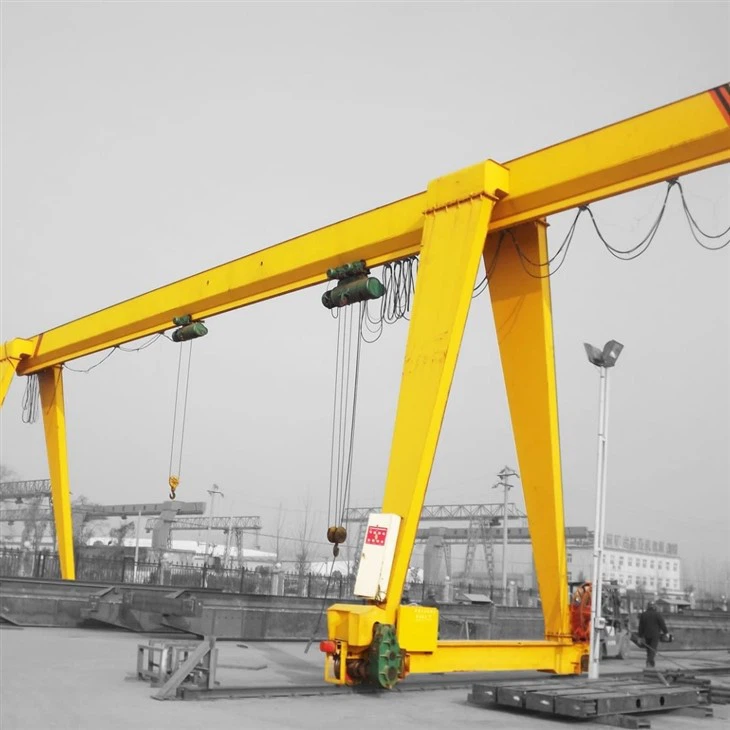
Electric Mobile Gantry Crane 5t
Product Introduction
Key Features of a 5-Ton Electric Mobile Gantry Crane:
Capacity:
Designed to lift loads up to 5 tons, making it suitable for medium-scale lifting operations in a wide range of industries.
Electric-Powered System:
Electric Hoist: The hoist, powered by electricity, enables efficient lifting and lowering of loads. It can be controlled via a wired or wireless remote control system.
Electric Motors: Drive motors power the movement of the crane, allowing it to be positioned easily without manual effort.
Adjustable Speeds: Some cranes come with adjustable hoist and travel speeds for more precise control and safer handling.
Mobility:
Wheeled Design: Fitted with wheels, often made of rubber or polyurethane, the crane can move freely on flat surfaces. The wheels may have brakes for locking the crane in place during operations.
Manual or Motorized Travel: Depending on the model, the crane can either be pushed manually or have motorized travel for automated movement across the workspace.
Adjustable Height and Span (Optional):
Some models offer adjustable height and span to accommodate different workspace requirements, making the crane versatile for various lifting applications.
Modular Design:
Many electric mobile gantry cranes feature a modular design, allowing for easy assembly and disassembly. This makes the crane portable, enabling transportation between different sites or sections of a workspace.
Applications:
Workshops and Factories: Ideal for moving machinery, equipment, and materials within industrial facilities.
Maintenance and Repair Shops: Commonly used in maintenance facilities for lifting heavy parts and tools.
Warehousing and Logistics: Assists in loading and unloading trucks, moving goods, and organizing materials.
Construction Sites: Useful for lifting and positioning smaller construction materials or equipment.
Advantages:
Flexibility: The crane can be moved easily to different locations within a workspace, offering greater flexibility in material handling.
Efficient Operation: Electric-powered hoisting and movement reduce manual labor, improving productivity and efficiency.
Space-Saving: Since it doesn't require fixed infrastructure, it's suitable for facilities with limited space or where overhead cranes cannot be installed.
Safe and Easy to Operate: Electric controls offer smooth and safe operation, with precision handling for heavy loads.
Safety Features:
Overload Protection: Prevents the crane from lifting loads beyond its capacity, ensuring safety during operations.
Emergency Stop Function: Allows the operator to quickly stop the crane in case of an emergency.
Braking Systems: Both the wheels and the hoist are equipped with brakes to secure the load and prevent unwanted movement.
Limit Switches: Automatically stop the hoist when it reaches the upper or lower travel limit, preventing damage or accidents.
This Electric Mobile Gantry Crane (5T) provides an efficient and reliable solution for material handling, combining mobility with the power of electric hoisting to meet the demands of various industrial applications.
Rated Loading Capacity:5 ton
Max. Lifting Height:40m, customized
Span:35m or clients' demands
Warranty:1 Year
Weight (KG):20000 kg
Core Components:PLC, Engine, Bearing, Gearbox, Motor, Pressure vessel, Gear, Pump
Control way:Cab, wireless remote control or customized

Pictures & Components
1. Main Girder (Beam)
Function: The primary horizontal beam that supports the load and allows the trolley (which holds the hoist) to move along its length.
Material: Typically made of high-strength steel to withstand heavy loads. It may be either a single or double girder depending on the design.
2. Legs (Support Structure)
Function: These vertical columns or legs support the main girder and connect the entire crane structure to the ground. They are crucial for the stability of the crane.
Material: High-strength steel to ensure durability and load-bearing capacity.
Portability: Usually equipped with wheels for mobility.
 .
.
3. Hoist (Electric)
Function: The hoist is the device that lifts and lowers the load. It includes an electric motor, a drum or chain, and a hook or lifting mechanism.
Types: It could be a wire rope hoist or chain hoist, depending on the specific model and application.
Capacity: Designed specifically for lifting up to 5 tons of weight.

4. Trolley
Function: A component that moves horizontally along the main girder, carrying the hoist. The trolley allows the load to be positioned accurately along the span of the crane.
Material: Usually made of steel with wheels that allow smooth movement along the girder.
Drive System: Can be manual or electric, with motorized trolleys offering greater precision and ease of use.


5. Electric Motors
Function: Motors power the hoist, trolley, and sometimes the crane's movement along the ground. They are responsible for lifting, lowering, and moving loads with precision.
Key Components:
Hoist Motor: Drives the lifting and lowering operation.
Trolley Motor: Moves the hoist along the girder.
Travel Motor (Optional): Powers the movement of the entire crane along the ground.
6. Control System
Function: Enables the operator to control the crane's operations, such as lifting, lowering, and moving the load. Control systems can be wired or wireless.
Types:
Pendant Control: A handheld wired device with push buttons to control the crane's movement.
Remote Control: Wireless control for ease of operation from a distance.
Control Panel: Houses the electrical components, including the circuitry for controlling the motors and safety systems.
7.Trolley travelling mechanism
1.The trolley traveling mechanism of an industrial gantry crane is responsible for moving the hoist or lifting mechanism horizontally along the crane's main beam or gantry. This allows the crane to position the load precisely in the transverse direction.
2.The trolley traveling mechanism consists of several key components:
Components of the Trolley Traveling Mechanism
Drive Unit: Typically an electric motor, the drive unit provides the power to move the trolley. The size and capacity of the motor depend on the crane's lifting capacity and the required speed of the trolley.
Gearbox: The gearbox reduces the high speed of the motor output to a lower speed suitable for the trolley's travel. It also increases the torque, which is necessary to move the hoist mechanism and any attached load.
Wheels or Rollers: The trolley rides on wheels or rollers that are mounted on axles. These wheels or rollers travel along the flanges or tracks on the main beam, allowing the trolley to move back and forth.
Brake System: A braking system is integrated into the trolley to control its movement and to hold it in position when needed. This can be a mechanical brake, an electromechanical brake, or a dynamic braking system.
3.The trolley traveling mechanism is crucial for precise positioning of the load in the transverse direction. It allows the crane to place loads accurately at different points along the length of the gantry. Proper maintenance and regular inspections are essential to ensure that the trolley mechanism operates smoothly and safely. Any issues with this mechanism can significantly impact the crane's operational efficiency and safety, making it vital to address any problems promptly.
8.Crane wheel
1.The crane wheel of an industrial gantry crane is a critical component that allows the crane to move along its runway beams or rails. These wheels are designed to support the weight of the crane, its load, and any additional dynamic forces generated during operation.
2.Here are the key features and functions of crane wheels:
Features of Crane Wheels
Material: Crane wheels are typically made from high-strength materials such as steel or cast iron to ensure they can withstand the heavy loads and stresses involved in lifting operations.
Size and Configuration: The size of the wheels varies depending on the capacity and design of the crane. They can be larger for heavier cranes to distribute the load more evenly. The number of wheels per axle and the number of axles per crane can also vary based on design requirements.
3.Crane wheels play a vital role in the mobility and stability of industrial gantry cranes. They are responsible for transferring the weight of the crane and its load to the runway beams or rails while allowing for smooth travel. The durability and efficiency of the crane's movement largely depend on the quality and condition of these wheels.
4.Proper maintenance of crane wheels, including regular inspections and timely replacement of worn components, is crucial for the safe and reliable operation of the crane. Neglecting wheel maintenance can lead to increased downtime, reduced efficiency, and potential safety hazards.
 |
 |
 |
9.Crane Hook
1.The crane hook of an industrial gantry crane is a critical component that allows the crane to lift and move various loads. The hook is the point of contact between the crane's hoisting mechanism and the load, making it a crucial interface for safe and efficient operations.
2.Here are the key features and functions of crane hooks:
Features of Crane Hooks
Material: Crane hooks are typically made from high-strength steel or alloy steel to ensure they can withstand the heavy loads involved in lifting operations. The material is chosen for its durability and resistance to wear and tear
Design: The design of the hook includes an opening at the top where it attaches to the hoist rope, chain, or other lifting device. The bottom part of the hook has a curved shape that allows it to securely engage with lifting points on the load.
Safety Latch: Many hooks are equipped with a safety latch or locking mechanism to prevent the load from accidentally slipping off. This latch must be manually opened to release the load at the desired location.
Load Ratings: Each hook is rated for specific maximum loads, and it is essential to use hooks that are rated for the intended loads to ensure safety and compliance with regulations.
 |
 |
 |
10.Motor
The motor of an industrial gantry crane is a critical component that provides the power necessary for lifting and moving loads. Motors in gantry cranes are typically electric and can be categorized into two main types based on their function: the hoisting motor and the travelling (or traversing) motor.
The hoisting motor is responsible for lifting and lowering the hook or grab that engages with the load. This motor's primary function is to control the vertical movement of the crane's loading mechanism.
Crane motors are the powerhouse of industrial gantry cranes, providing the energy required for both lifting and moving operations. The performance, reliability, and safety of the crane are heavily dependent on the motors' efficiency and durability. Proper selection, maintenance, and regular inspections of these motors are crucial for ensuring the crane operates smoothly and safely. Any issues with the motors can lead to operational inefficiencies, increased downtime, and potential safety risks, making prompt attention to motor problems essential.

.
11.Sound and light alarm system & limit switch
1.Industrial gantry cranes are equipped with a sound and light alarm system and limit switches to enhance safety and operational efficiency. These components play crucial roles in preventing accidents and ensuring that the crane operates within its designated parameters.
2.Sound and Light Alarm System
The sound and light alarm system is designed to alert personnel in the vicinity of the crane about its operational status. This system is particularly important in environments where the crane operates in close proximity to workers or where visibility is limited.
3.Limit Switches
Limit switches are electronic devices that serve as critical safety features on industrial gantry cranes. They detect the position of the crane or its components and cut off power when the crane reaches its operational limits, preventing potential accidents and damage.
4.Both the sound and light alarm system and limit switches are integral to the safe operation of industrial gantry cranes. The alarm system ensures that personnel are aware of the crane's movements and operational status, reducing the risk of collisions or other hazards. Limit switches, on the other hand, automate safety by physically preventing the crane from operating beyond its design limits. Together, these systems contribute to a safer workplace and protect both the crane equipment and the personnel working around it. Proper maintenance and regular testing of these systems are essential to ensure they function reliably and effectively.

12.Safety Devices
Overload Protection Devices
Overload protection devices are designed to prevent the crane from operating beyond its safe working load limits. These devices monitor the load being lifted and will either send an alert or shut down the crane if the load exceeds the specified limit. This is crucial for preventing structural damage to the crane and avoiding accidents that can occur due to overloading.
Limit Switches
As mentioned earlier, limit switches automatically stop the crane when it approaches the end of its travel range or when any of its components reach their operational limits. These switches are essential for preventing the crane from exceeding its physical boundaries, which could result in damage to the structure or collision with obstacles.
Anti-Collison Devices
Anti-collison devices are particularly important in environments where multiple cranes operate in close proximity or where there is significant ground traffic. These devices use sensors, cameras, or other technologies to detect the presence of other objects in the crane's path and either alert the operator or automatically halt the crane's movement to prevent a collision.
Emergency Stop Buttons
Emergency stop buttons are manually operated controls that allow the crane operator or any authorized personnel to immediately stop all crane operations in case of an emergency. These buttons are strategically placed within easy reach of the operator and are often red and highly visible.
Brake Systems
Brake systems on industrial gantry cranes are designed to hold the load securely in place when not in motion and to provide controlled stopping during operations. These brakes can be mechanical, electrical, or a combination of both, and they are critical for preventing unexpected load movements that could lead to accidents.
Levelness Indicators
Levelness indicators are used to ensure that the crane is level during operation, especially when lifting precise or delicate loads. Uneven lifting can cause loads to shift, potentially leading to loss of control and accidents. These indicators help operators maintain the crane's balance and stability.
Safe Working Load Indicators
Safe working load indicators clearly mark the maximum safe load capacity for the crane. This information is vital for operators to ensure that the crane is not overloaded and operates within its design specifications.
13.Control Mode
1.Manual Control
Direct Intervention: The crane operator directly controls the hoisting and traveling movements of the crane using handwheels, levers, or push buttons. This mode requires skilled operators who can manually synchronize the movements to achieve the desired positioning of the load.
Simple Mechanisms: Manual control systems are generally simpler in design and may be less prone to complex failures.
Limited Precision: The precision of the crane's movements is limited to the operator's skill and experience.
2.Semi-Automatic Control
Assisted Operation: The crane operator uses control devices such as joysticks or paddle switches to command the crane, but the system includes automated features that assist in controlling speed and synchronization.
Enhanced Safety: Semi-automatic systems often include safety features like automatic stops at load limits or travel limits.
Improved Efficiency: These systems can improve operational efficiency by reducing the need for highly skilled operators.
3.Fully Automatic Control
Programmable Logic Controller (PLC): The crane's operations are governed by a PLC, which can be programmed to perform specific sequences of operations automatically.
Precise Control: Fully automatic systems offer precise control over the crane's movements, allowing for complex maneuvers to be executed consistently.
Reduced Human Error: Automated systems reduce the potential for human error, enhancing safety and reliability.
Remote Operation: In some cases, fully automatic cranes can be operated remotely, removing the operator from potentially hazardous environments.
4.Radio Control
Wireless Operation: The crane operator uses radio transmitters to control the crane from a distance, which can be particularly useful in environments where visual contact with the crane is limited.
Increased Flexibility: Radio control allows operators to move freely around the work area while maintaining control of the crane.
Safety Considerations: Proper frequency management and security measures must be in place to prevent interference or unauthorized operation of the crane.
5.Computer Control
Advanced Systems: Some gantry cranes may employ computer systems that integrate advanced features such as machine vision, artificial intelligence, and data analysis to optimize operations.
Data Collection: Computer-controlled cranes can collect operational data, which can be used for maintenance planning and operational optimization.
Interface Options: Operators may interact with the crane through touch screens or other advanced interfaces, providing detailed feedback and control options.

14.Sketch

Main technical

Advantages
Advantages of an Electric Mobile Gantry Crane (5 Ton)
Implementing an Electric Mobile Gantry Crane (5T) in your operations provides several key benefits, particularly in terms of mobility, efficiency, and cost-effectiveness. Here are the main advantages:
1. Mobility and Flexibility
Portable Design: The crane's wheels allow it to be moved easily across different areas within a facility, offering versatility for operations that require the crane to handle loads in multiple locations.
No Fixed Infrastructure: Unlike traditional overhead cranes that require fixed rails or support structures, a mobile gantry crane can operate without needing permanent installations, making it ideal for temporary or changing work environments.
2. Cost-Effective Solution
Lower Installation Costs: Since it doesn't require extensive infrastructure like overhead cranes, it minimizes the costs associated with installation and setup.
No Permanent Modifications: The lack of need for fixed supports means no structural modifications to the facility, saving on long-term expenses and allowing the crane to be used in different projects or locations.
3. High Load Capacity
5-Ton Capacity: This crane is designed to lift loads up to 5 tons, making it suitable for a variety of medium-scale industrial applications such as handling machinery, equipment, and materials.
4. Efficient Operation
Electric-Powered Hoisting and Movement: Powered by electricity, the crane provides efficient lifting and moving, reducing manual labor and increasing productivity.
Precise Control: Electric controls allow for smooth, precise lifting and positioning of loads, making it easier to handle delicate or complex tasks.
5. Improved Safety
Enhanced Load Control: Electric systems enable smooth operation, reducing the risk of accidents that can occur from abrupt or manual movements.
Safety Features: Built-in safety features such as overload protection, limit switches, and emergency stop functions ensure that the crane operates safely during lifting and movement.
6. Versatile Applications
Adaptable to Different Workspaces: This crane is suitable for use in various industries, including warehouses, workshops, factories, and construction sites. Its mobility makes it ideal for both indoor and outdoor applications.
Adjustable Height and Span (Optional): Some models offer adjustable height and span features, allowing the crane to accommodate different load sizes and workspace configurations.
7. Time and Labor Savings
Reduced Manual Effort: Electric operation reduces the need for manual lifting or pushing, making it easier to move heavy loads across the workspace. This decreases physical strain on workers and enhances productivity.
Faster Material Handling: With electric-powered hoists and trolleys, operations can be completed much faster compared to manual lifting, improving workflow efficiency.
8. Customizable Options
Custom Heights and Spans: Many electric mobile gantry cranes come with customizable options, including adjustable heights, spans, and load capacity, to match specific project needs.
Remote Control Operation: Wireless remote control options allow operators to manage the crane from a safe distance, increasing safety and ease of use.
9. Space-Efficient
Compact Footprint: The crane's mobile nature and space-efficient design allow it to operate in confined or narrow spaces where traditional cranes may not fit. This is particularly useful for smaller workshops or work areas with space constraints.
10. Easy to Assemble and Disassemble
Modular Design: Many models feature a modular construction, making them easy to assemble and disassemble, allowing for portability and transportation to different job sites.
In summary, an Electric Mobile Gantry Crane (5T) provides significant advantages in terms of mobility, efficiency, cost-effectiveness, and safety, making it an excellent solution for material handling in various industries. It delivers high-performance lifting while being flexible enough to adapt to changing operational requirements.
Application:
1.Manufacturing and Production
Heavy Machinery Assembly: In industries that require the assembly of large machines, a 30t gantry crane can move components into place with precision, ensuring accuracy during the assembly process.
Product Transport: Within factories, these cranes transport heavy materials or assembled products from one stage of production to another, streamlining the 2.manufacturing process.
Construction and Civil Engineering
Precast Elements Handling: For construction projects using precast concrete elements, a 30t gantry crane can install these heavy pieces efficiently, reducing installation time and labor costs.
Bridge Construction: In bridge building projects, these cranes are used to lift and place beams or other structural components accurately into their designated positions.
3.Shipping and Port Operations
Cargo Loading and Unloading: At ports, a 30t gantry crane is instrumental in loading and unloading containers and heavy cargo onto ships or trucks, facilitating faster turnaround times for vessels.
Warehouse Logistics: In large warehouses, especially those storing heavy items like steel coils or large machinery, these cranes manage storage more accessibly and safely.
4.Railroad and Airport Infrastructure
Rail Maintenance: For maintenance and repair of rail tracks, a 30t gantry crane can lift and move heavy rails or replace sleepers, minimizing disruption to services.
Aircraft Maintenance: In aircraft maintenance hangars, these cranes are used for lifting engines or other heavy components for inspection or repair.
5.Energy and Utilities
Nuclear Power Plants: In the nuclear industry, gantry cranes are used for handling and positioning heavy radioactive components, ensuring safety and precision.
Wind Turbine Installation: For assembling wind turbines, a 30t gantry crane can lift the heavy nacelle or rotor blades into place, simplifying the installation process.
6.Mining and Quarrying
Rock Transport: In mining operations, gantry cranes transport rocks from the extraction site to processing areas or conveyance systems.
Equipment Maintenance: Heavy mining equipment often requires maintenance or replacement of parts; a 30t gantry crane can lift these components with ease.
Crane production procedure
1. Design and Engineering
Detailed Engineering: Develop detailed engineering drawings and specifications, including the main beam, hoist, trolley, end carriages, and other components.
Simulation and Modeling: Use computer-aided design (CAD) and simulation tools to model the crane's performance and optimize its design.
2. Material Selection
Material Specifications: Select high-quality materials that meet the requirements for strength, durability, and heat resistance. Common materials include high-strength steel, alloys, and specialized coatings.
Procurement: Source materials from approved suppliers, ensuring they meet the necessary quality and certification standards.
3. Component Fabrication
Cutting and Shaping: Cut and shape raw materials into the required components, such as beams, columns, and brackets. This may involve processes like plasma cutting, laser cutting, and machining.Welding and Assembly: Weld components together to form the crane's structural elements. This includes welding the main beam, end carriages, and other load-bearing parts.
4. Assembly
Sub-Assembly: Assemble individual components, such as the hoisting system, trolley, and end carriages, into sub-assemblies. This involves fitting parts together and ensuring proper alignment.Main Assembly: Combine sub-assemblies to construct the complete crane structure. This includes mounting the hoist and trolley on the main beam, attaching the end carriages, and installing the control systems.
5. Integration of Systems
Electrical Systems: Install electrical components, including motors, control panels, wiring, and sensors. Ensure that the crane's electrical systems are properly integrated and tested.
Control Systems: Implement and configure control systems, such as programmable logic controllers (PLCs), remote controls, and safety devices. Verify that the control systems function correctly and are calibrated.
6. Testing and Quality Assurance
Pre-Operational Testing: Conduct pre-operational tests to check the crane's functionality, including load testing, operational testing of the lifting and traveling mechanisms, and control system checks.
Safety Testing: Verify that safety features, such as limit switches, alarms, and emergency stops, are working correctly and meet safety standards.
Inspection: Perform a detailed inspection of the crane's structure and components to ensure compliance with design specifications and quality standards.
7. Final Adjustments and Calibration
Fine-Tuning: Make any necessary adjustments to optimize the crane's performance and ensure smooth operation. This may include calibrating sensors, adjusting controls, and fine-tuning the lifting system.
Documentation: Prepare and review documentation, including operation manuals, maintenance guides, and safety instructions.
8. Delivery and Installation
Transport: Arrange for the transport of the crane to the installation site, ensuring that it is handled and shipped safely to prevent damage.
Installation: Oversee the installation of the crane at the customer's facility, including assembly, alignment, and connection to power sources and control systems.
Training: Provide training for operators and maintenance personnel to ensure they are familiar with the crane's operation and safety procedures.
9. Commissioning and Handover
Commissioning: Conduct final commissioning tests to verify that the crane operates correctly under real-world conditions and meets performance specifications.
Handover: Officially hand over the crane to the customer, providing all necessary documentation, including certificates of compliance, warranty information, and maintenance schedules.

Workshop view
Material Inspection
Quality Inspection: Strict quality inspection is carried out on the purchased raw materials to ensure that they meet the design requirements and national standards.
Material Storage: Qualified materials are stored according to classification to prevent corrosion or damage.
Cutting and Forming
Steel Cutting: Use plasma cutting, laser cutting or flame cutting and other technologies to cut the steel according to the size of the design drawing.
Forming Processing: Form the steel plate through bending, rolling, welding and other processes to manufacture the main beam, end beam and other structural parts.
Welding
Component Welding: The cut and formed steel parts are welded into the main structures such as the main beam, end beam and trolley. The welding process needs to be strictly controlled to ensure the structural strength and welding quality.
Weld Inspection: Use non-destructive testing technology (such as ultrasonic testing, radiographic testing) to inspect the welds to ensure that there are no cracks or other defects.
Machining
Precision Machining: Precision machining is performed on the key components of the crane, such as wheel sets, bearing seats, pulleys, etc., to ensure their dimensional accuracy and surface quality.
Assembly of the whole machine
General assembly: On the basis of pre-assembly, the overall assembly of the crane is carried out, including the final installation of the main beam, end beam, lifting mechanism, walking mechanism, etc.
Commissioning and testing
Under dynamic conditions, the operating performance of the crane is tested, including the testing of lifting, walking, steering and other functions. The overall size of the assembled bridge crane is checked to ensure that all dimensions meet the design requirements.
Spraying and anti-corrosion treatment
Surface treatment Rust removal: Rust removal on the surface of the crane, common methods include sandblasting, pickling, etc. Primer spraying: Spray anti-corrosion primer on the treated surface to prevent metal oxidation and corrosion. Topcoat spraying Color spraying: Spray topcoat according to customer requirements or industry standards to give the crane a protective and decorative effect. Marking: After spraying, mark the crane's identification information in accordance with the specifications, such as model, rated load, etc.
Factory and installation
Packaging and transportation
Packaging protection: Protectively package the key components of the crane to prevent damage during transportation. Transportation arrangement: According to the equipment size and transportation conditions, select a suitable transportation method to transport the crane to the customer's site.
Acceptance and delivery
Customer acceptance
On-site acceptance: The customer conducts on-site acceptance of the crane according to the contract requirements and technical specifications to check the performance and quality of the equipment.
Problem rectification: If any problems are found, the manufacturer needs to rectify them in time to ensure that the equipment fully meets the customer's requirements. Delivery and use Operation training: The manufacturer usually trains the customer's operators to ensure that they can operate the crane correctly and safely.


Hot Tags: electric mobile gantry crane 5t, China electric mobile gantry crane 5t manufacturers, suppliers, factory, Grab Bucket Overhead Crane, Single Beam Explosion Proof Overhead Crane, Forged Wheel, Double Beam Explosion Proof Overhead Crane, Metallurgical Crane, Train Wheels
You Might Also Like




Send Inquiry