










Ship Shore Harbour Container Lifting Crane
Products Description
Key Features of STS Cranes
1. Structural Components
Boom (Fixed or Telescopic) – Extends over the ship's deck.
Luffing Boom (adjustable angle for clearance).
Fixed Boom (more common in modern cranes).
Gantry Legs – Supports the crane on rails along the quay.
Trolley & Hoist System – Moves horizontally along the boom with a spreader (for 20', 40', 45', or twin-lift containers).
Cabin (Operator Control Room) – High-tech controls for precise movements.
2. Mobility & Operation
Rails along the Quay – STS cranes move on tracks parallel to the dock.
Outreach & Backreach:
Outreach (over the ship, up to 24+ rows of containers).
Backreach (over the dock, to place containers on trucks/AGVs).
Lifting Capacity: Typically 40–100+ tons (some handle ultra-large ships with 120+ tons).
3. Power & Automation
Electric-powered (most modern STS cranes).
Automated STS Cranes (some ports use semi/full automation for efficiency).
Regenerative Braking (recovers energy when lowering containers).
Comparison with Other Cranes
| Feature | STS Crane | RTG Crane | RMG Crane |
|---|---|---|---|
| Location | Ship-to-shore | Yard stacking | Rail yard |
| Mobility | Rail-mounted | Rubber tires | Rail-mounted |
| Lifting Cap. | 40–100+ tons | 30–50 tons | 30–50 tons |
| Automation | High (in modern ports) | Medium | High |
Lifting Capacity: 30 metric tons (30,000 kg)
Span: 10m–35m (customizable)
Lifting Height: 6m–20m (adjustable)
Hoist Type: Double-girder with electric wire rope hoist (QD-type)
Travel System: Motorized (rail-guided or rubber-tired)
Wheel Type: Steel wheels (for rails) / Pneumatic tires (floor use)
Control System: Cabin-operated or remote control
Power Supply: 380V/50Hz (3-phase)
Structural Steel: Q345B (high-strength) with corrosion-resistant coating

Pictures & Components
1. Structural Components
A. Boom (Fixed or Luffing)
Fixed Boom: Horizontal structure extending over the vessel (most common in modern cranes).
Luffing Boom: Adjustable-angle boom (for ports with airspace restrictions).
Telescopic Boom: Extendable for greater reach (less common).
B. Gantry Frame & Legs
Portal Legs: Steel supports on rails, spanning the quay width.
Cross Beams: Connect legs for stability.
Apex Frame: Top structure supporting the boom and trolley.

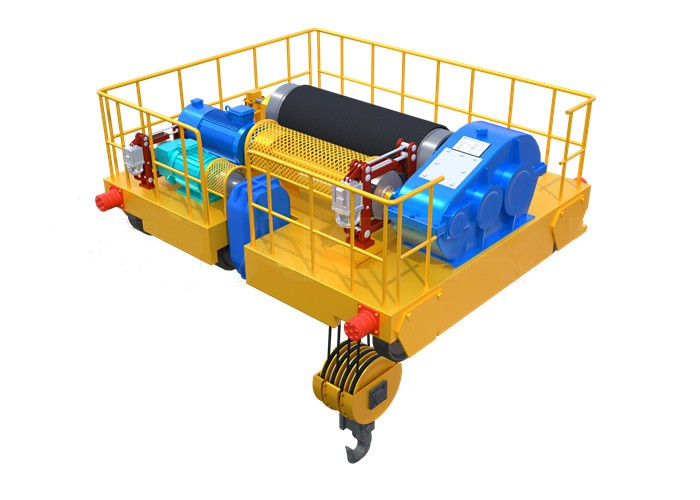
C. Trolley & Hoist System
Trolley: Moves along the boom on rails, carrying the spreader.
Hoist Mechanism: Wire ropes/drums for lifting containers (dual-hoist for heavy loads).
Spreader: Twist-lock device (20', 40', 45', or twin-lift capable).
D. Cabin (Operator Station)
Glass-enclosed control room with joysticks, screens, and safety systems.
Some cranes feature remote-control or autonomous operation.
 |
 |
2. Mobility & Drive Systems
A. Rail System
Quay Rails: Heavy-duty tracks parallel to the dock for crane movement.
Drive Wheels: Electric motors with anti-slip mechanisms.
Buffers & Brakes: Prevent collisions at rail ends.
 |
 |
B. Outreach & Backreach
Outreach: Distance over the ship (up to 70m+ for mega-ships).
Backreach: Distance over the land (for trucks/AGVs).
C. Anchoring & Anti-Tip Systems
Storm Brakes: Lock the crane during high winds.
Rail Clamps: Secure the crane when idle.

3. Power & Electrical Systems
A. Power Supply
High-Voltage Cable Reel: Delivers electricity from the dock.
Backup Diesel Generator: For emergencies (rare in modern cranes).

B. Motors & Drives
Hoist Motors: High-torque AC/DC motors.
Trolley/Traverse Motors: For horizontal movement.
Gantry Motors: Drive wheels for rail movement.
C. Energy Recovery
Regenerative Braking: Converts lowering energy into electricity.

4. Control & Automation
A. PLC & Sensors
Programmable Logic Controller (PLC): Manages crane operations.
Load Cells: Monitor container weight.
Anti-Sway System: Reduces pendulum motion.
.
B. Automation Features
Auto Landing: Precisely places containers on AGVs/trucks.
OCR (Optical Character Recognition): Scans container IDs.
AI Path Planning: Optimizes trolley/hoist movements.
C. Safety Systems
Collision Avoidance: Laser scanners/cameras detect obstacles.
Wind Speed Sensors: Trigger shutdowns at unsafe speeds.
Emergency Stop (E-Stop): Instantly halts operations.

5. Auxiliary Components
A. Lighting & Alarms
LED Work Lights: Illuminate the ship's deck.
Audible Alarms: Warn personnel during movement.
B. Lubrication Systems
Automatic Greasing: For wires, rails, and gears.
C. Maintenance Platforms
Access Walkways: For servicing hoist/trolley systems.

SKETCH

Main technical

Advantages
High Productivity
Capable of handling 25-50+ container moves per hour
Modern cranes achieve up to 60 moves/hour in optimal conditions
Dual-hoist systems enable simultaneous loading/unloading
Massive Lifting Capacity
Standard capacity: 40-65 tons
Mega cranes handle up to 120 tons (for ultra-large vessels)
Can lift two 20' containers simultaneously (twin-lift capability)
Exceptional Reach
Outreach up to 72 meters (24+ container rows)
Backreach 25-30 meters for landside operations
Accommodates world's largest container ships (24,000+ TEU vessels)
Precision Handling
Advanced anti-sway systems for smooth operation
Auto-landing systems (±5mm accuracy)
Load monitoring with real-time feedback
Operational Flexibility
Adjustable luffing booms for height restrictions
Telescopic spreaders for mixed container sizes
Quick-change attachments for special cargo
Energy Efficiency
Regenerative braking recovers 30-40% of energy
Electric-powered models produce zero emissions
Smart power management reduces peak loads
Advanced Automation
OCR (Optical Character Recognition) for container tracking
AI-powered motion planning optimizes cycles
Remote operation capabilities for 24/7 work
Safety Features
Collision avoidance systems (laser/LiDAR)
Wind speed monitoring (auto shutdown at 55+ km/h)
Emergency stop systems with redundancy
Application:
Commercial Port Operations
Loading/unloading container ships of all sizes
Transshipment hubs (e.g., Singapore, Rotterdam)
Feeder vessel operations in regional ports
Mega-Terminal Operations
Handling Ultra Large Container Vessels (ULCVs)
Serving alliance hub ports with high-volume traffic
Inter-terminal transfers in port complexes
Specialized Cargo Handling
Heavy-lift projects (project cargo)
Reefer container operations
Dangerous goods handling
Automated Terminal Integration
Working with Automated Guided Vehicles (AGVs)
Coordinating with automated yard cranes (ASC)
Interface with Terminal Operating Systems (TOS)
Military/Strategic Ports
Rapid deployment of military containerized cargo
Disaster relief operations
Strategic reserve handling
Intermodal Connections
Direct transfer to rail-mounted gantry cranes
Loading barge operations for river transport
Feeding truck loading zones
Crane production procedure
1. Design and Planning
Demand Analysis: According to customer needs and usage scenarios, a detailed demand analysis is carried out to determine the specifications, load, span, lifting height, etc. of the crane.
Engineering Design: Engineers use CAD and other design software to carry out detailed design, including structural, mechanical, electrical and other aspects to ensure that the design meets relevant standards and specifications.
2. Material Procurement
Material Selection: Select appropriate steel, motors, control systems and other components according to design requirements.
Supplier Screening: Screen suppliers of materials and components to ensure the quality and reliability of materials.
3. Processing and Manufacturing
Cutting and Forming: Cut, weld, bend and other processes on steel to form main beams, end beams and other structural components.
Machining: Precision machining of key components, such as turning, milling, drilling, etc., to ensure that the size and accuracy meet the design requirements.
Surface Treatment: Spray, galvanize or rust-proof metal parts to enhance corrosion resistance and aesthetics.
4. Assembly
Component Assembly: Assemble the main beam, end beam, trolley, lifting mechanism and other components to form a complete crane structure.
Installation of electrical system: Install electrical equipment such as motors, control cabinets, sensors, limit switches, etc. to ensure the normal operation of the electrical system.
5. Debugging and testing
Preliminary debugging: Carry out preliminary debugging of the crane to check the coordination and operation of each component.
Load test: Carry out load test to ensure the safety and stability of the crane under rated load, and test the functions of safety devices such as overload protection and limit switches.
Performance test: Test the performance indicators of the crane such as lifting speed, running speed, braking effect, etc. to ensure that they meet the design requirements.
6. Quality inspection
Quality inspection: Carry out a comprehensive quality inspection of the crane, including appearance, size, performance, etc., to ensure compliance with relevant standards.
Safety assessment: Carry out safety assessment to ensure the normal operation of all safety devices and systems.
7. Delivery and installation
Packaging and transportation: Pack qualified cranes and prepare them for transportation to the customer site.
On-site installation: Carry out on-site installation according to customer requirements, including basic production and equipment debugging.
Training and handover: Train operators to ensure that they master the operation methods and safety precautions of the equipment and complete the handover work.


Workshop view
Material Inspection
Quality Inspection: Strict quality inspection is carried out on the purchased raw materials to ensure that they meet the design requirements and national standards.
Material Storage: Qualified materials are stored according to classification to prevent corrosion or damage.
Cutting and Forming
Steel Cutting: Use plasma cutting, laser cutting or flame cutting and other technologies to cut the steel according to the size of the design drawing.
Forming Processing: Form the steel plate through bending, rolling, welding and other processes to manufacture the main beam, end beam and other structural parts.
Welding
Component Welding: The cut and formed steel parts are welded into the main structures such as the main beam, end beam and trolley. The welding process needs to be strictly controlled to ensure the structural strength and welding quality.
Weld Inspection: Use non-destructive testing technology (such as ultrasonic testing, radiographic testing) to inspect the welds to ensure that there are no cracks or other defects.
Machining
Precision Machining: Precision machining is performed on the key components of the crane, such as wheel sets, bearing seats, pulleys, etc., to ensure their dimensional accuracy and surface quality.
Assembly of the whole machine
General assembly: On the basis of pre-assembly, the overall assembly of the crane is carried out, including the final installation of the main beam, end beam, lifting mechanism, walking mechanism, etc.
Commissioning and testing
Under dynamic conditions, the operating performance of the crane is tested, including the testing of lifting, walking, steering and other functions. The overall size of the assembled bridge crane is checked to ensure that all dimensions meet the design requirements.
Spraying and anti-corrosion treatment
Surface treatment Rust removal: Rust removal on the surface of the crane, common methods include sandblasting, pickling, etc. Primer spraying: Spray anti-corrosion primer on the treated surface to prevent metal oxidation and corrosion. Topcoat spraying Color spraying: Spray topcoat according to customer requirements or industry standards to give the crane a protective and decorative effect. Marking: After spraying, mark the crane's identification information in accordance with the specifications, such as model, rated load, etc.
Factory and installation
Packaging and transportation
Packaging protection: Protectively package the key components of the crane to prevent damage during transportation. Transportation arrangement: According to the equipment size and transportation conditions, select a suitable transportation method to transport the crane to the customer's site.
Acceptance and delivery
Customer acceptance
On-site acceptance: The customer conducts on-site acceptance of the crane according to the contract requirements and technical specifications to check the performance and quality of the equipment.
Problem rectification: If any problems are found, the manufacturer needs to rectify them in time to ensure that the equipment fully meets the customer's requirements. Delivery and use Operation training: The manufacturer usually trains the customer's operators to ensure that they can operate the crane correctly and safely.


Hot Tags: ship shore harbour container lifting crane, China ship shore harbour container lifting crane manufacturers, suppliers, factory
You Might Also Like




Send Inquiry