








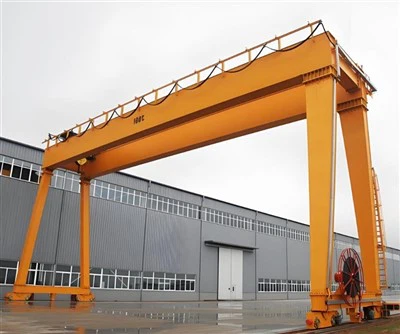
MG Box Type Double Beam Gantry Crane

MG Box Type Double Beam Gantry Crane suppliers

MG Box Type Double Beam Gantry Crane factory

MG Box Type Double Beam Gantry Crane best

MG Box Type Double Beam Gantry Crane high quality

MG Box Type Double Beam Gantry Crane price

MG Box Type Double Beam Gantry Crane price
MG Box Type Double Beam Gantry Crane
Products Description
What is an MG Box Type Double Beam Gantry Crane?
An MG Box Type Double Beam Gantry Crane is a heavy-duty, rail-mounted gantry crane characterized by its two main girders, which are fabricated from steel plate into a hollow, rectangular "box" design. The "MG" designation typically follows industry standards (like Chinese JB/T) and stands for a Very Severe Duty or Heavy Duty classification, indicating it is built for the most intensive and demanding applications.
Think of it as the ultimate heavy-lift workhorse for outdoor yards and heavy industries, combining immense strength with precision movement.
Advantages of MG Box Type Double Beam Gantry Cranes
Extreme Load Capacity & Long Span: Capable of handling loads from 20 tons up to 500+ tons and spanning over 35 meters, making it suitable for the widest work areas.
Exceptional Durability & Uptime: Built with premium components to withstand the most abusive environments and intensive use, ensuring high productivity and low lifetime cost.
Superior Hook Height: The top-running trolley design offers the best possible use of vertical space for stacking or handling tall loads.
Precision & Stability: The rigid box girder structure and rail-mounted system ensure smooth, stable, and precise load control, which is critical for safety and operational efficiency.
Versatility for Severe Applications: Can be equipped with various heavy-duty attachments like magnets, grabs, or C-hooks to handle diverse materials (coils, containers, scrap, machinery).
Comparison: MG Type vs. Other Gantry Cranes
| Feature | MG Type (Box Girder, Severe) | MZ Type (Single Girder, Light) | MH Type (Double Girder, Heavy) |
|---|---|---|---|
| Girder Design | Double Box Girder | Single Girder | Double Girder (I-beam or light box) |
| Duty Cycle | Very Severe (M6/M7) | Light/Moderate (M3/M4) | Heavy (M5/M6) |
| Typical Capacity | 20 - 500+ Tons | 1 - 20 Tons | 10 - 100 Tons |
| Hook Height | Very High (Top-Running) | Lower (Under-Running) | High (Top-Running) |
| Cost | Very High | Economical | High |
| Ideal For | Steel mills, ports, severe duty | Workshops, warehouses | Fabrication, heavy industry |
Conclusion: The MG Box Type Double Beam Gantry Crane is the pinnacle of gantry crane design for severe-duty applications. Its robust box girder construction and MG-class components make it a high-capacity, high-reliability solution where failure is not an option. It represents a significant capital investment that is justified by unparalleled performance, safety, and longevity in the world's toughest industrial environments.
Lifting Capacity 320 tons
Span (Width) 3 - 12 meters (adjustable)
Lifting Height 3 - 10 meters
Working Class A3-A5 (light to medium duty)
Hoisting Speed 0.5 - 8 m/min (variable)
Main Beam Type Single/double girder (box-type)
Power Supply 220V/380V 3-phase or manual
Control Mode Pendant control/wireless remote
Hoist Type Electric chain hoist/wire rope hoist
Travel Drive Manual push or motorized
Corrosion Protection Hot-dip galvanized or marine-grade paint
Wind Resistance Up to Beaufort scale 6 (for outdoor use)
Operating Temp -20°C to +50°C

Pictures & Components
Here is a detailed breakdown of the components of an MG Box Type Double Beam Gantry Crane.
1. Primary Structural System (The Backbone)
Double Box Girders: The primary horizontal beams. These are fabricated by welding steel plates into hollow, rectangular sections. This design provides superior strength, torsional rigidity, and resistance to bending and buckling under extreme loads and long spans.

Reinforced End Trucks & Legs: The massive vertical support structures.
Legs: Often designed with A-frame or cross-bracing to provide exceptional stability and prevent leaning or racking when lifting off-center loads.
End Trucks: House the wheels, axles, and long travel drive assemblies. Built to withstand immense vertical and horizontal forces.
Crane Rail and Runway System: A critical, fixed infrastructure.
Running Rails: Extra-heavy-duty steel rails (often large crane rails).
Reinforced Foundation: A deep, engineered concrete foundation that ensures the rails remain perfectly level and aligned under dynamic loads and over time.
2. Lifting & Travel System (The Workhorse)
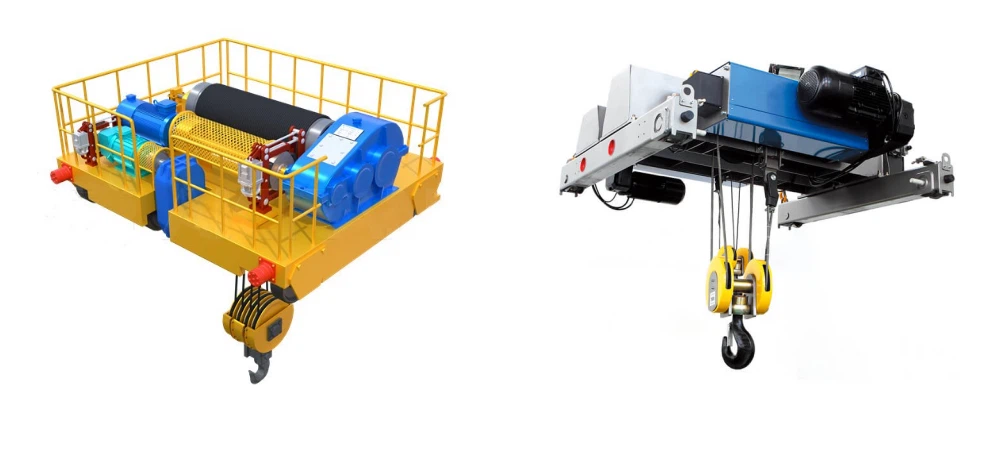
Severe-Duty Main Hoist Unit:
Hoist Motor: High-torque, high-duty cycle motor designed for continuous operation under full load.
Wire Rope Drum: Machined drum with precise grooving to spool multiple layers of high-strength wire rope.
Gearboxes: Heavy-duty, precision-cut gears designed to handle shock loads and transmit immense torque.
Multiple Disc Brakes: Primary, secondary, and emergency braking systems, all fail-safe.

Auxiliary Hoist: A second, smaller-capacity, faster hoist on the same trolley for handling lighter duties, providing operational flexibility without using the main hoist.
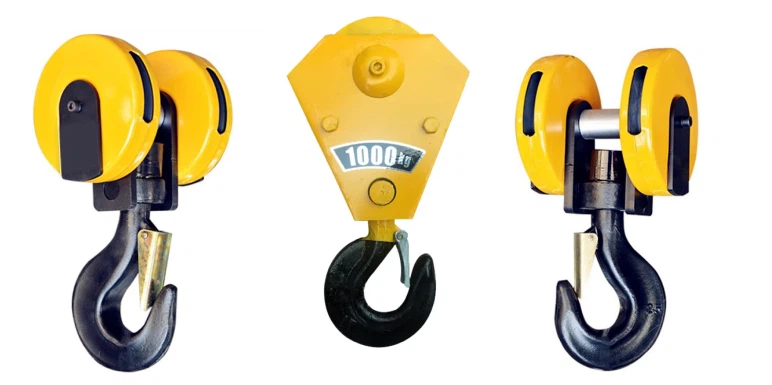
Top-Running Trolley & Drive:
Trolley Frame: A robust steel structure that carries the hoist(s).
Trolley Wheels & Rails: Flanged wheels running on rails mounted on top of the main girders. This provides maximum hook height.
Trolley Travel Drive: Powerful motor and gearbox for smooth transverse movement.
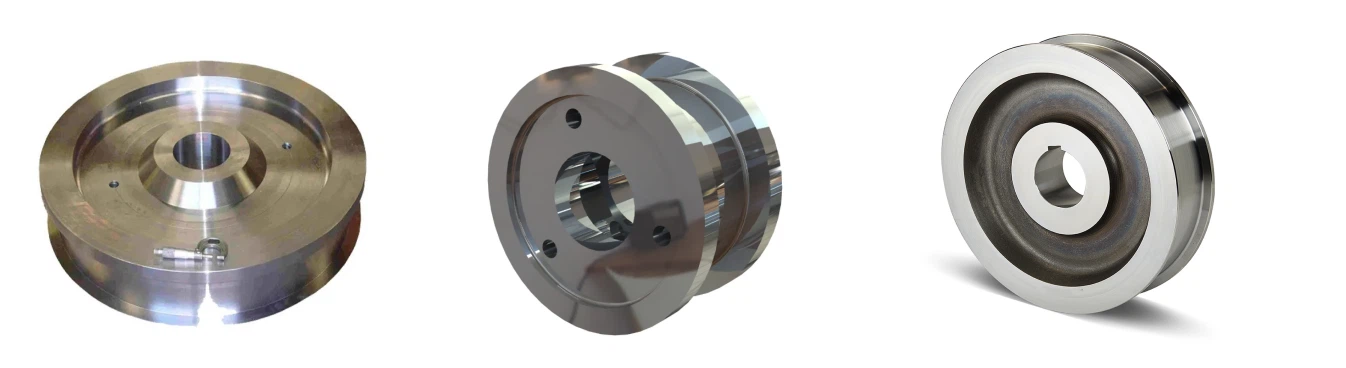
Gantry Long Travel Drives:
Travel Motors: Multiple high-horsepower motors (one or more per leg) for synchronized movement along the runway.
Gearboxes & Wheels: Large-diameter, forged or hardened steel wheels driven through heavy-duty gear reducers.
3. Power, Control & Motion Systems (The Nerves)
Power Supply System:
Conductor Bar System (Enclosed Track): The standard for heavy-duty cranes. Provides a reliable, high-amperage power supply without the maintenance issues of festoon systems.
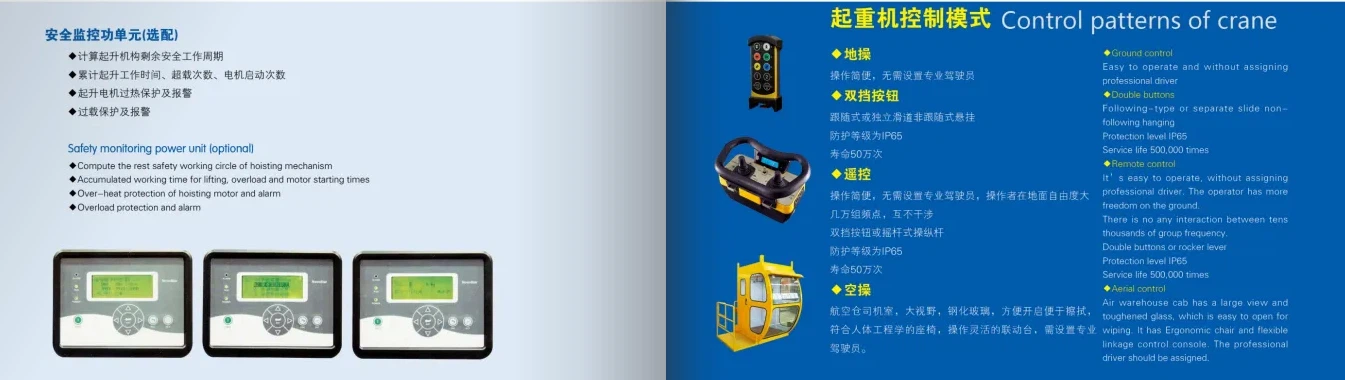
Operator Control:
Operator's Cab: A fully-equipped, often air-conditioned and sound-insulated cabin suspended from the crane bridge, giving the operator a clear view.
Radio Remote Control: Allows the operator to control the crane from the safest and most optimal vantage point on the ground.
Control Panels & Drives:
Main Control Panel: Houses the programmable logic controller (PLC), contactors, overload relays, and Variable Frequency Drives (VFDs). VFDs are essential for providing smooth, controlled acceleration and deceleration, protecting the structure and the load.

4. Critical Safety Systems (The Lifeline)
Load Moment Indicator (LMI): A non-negotiable safety device that constantly monitors the load weight, calculates the crane's stability, and can automatically prevent dangerous operations if an overload is detected.
Redundant Braking Systems:
Primary Hoist Brake: A high-capacity disc or caliper brake.
Secondary (Emergency) Brake: A fully independent backup brake that engages automatically.
Limit Switches & Anti-Collision Systems:
Limit Switches: Heavy-duty switches for hoist upper/lower limits and trolley/gantry travel limits.
Anti-Collision System: Uses laser or radar to detect and prevent collisions with other cranes or obstacles on the same runway.

Anemometer: Wind speed indicator that alarms or automatically shuts down crane operations if wind speeds exceed safe limits (critical for outdoor cranes).
Rail Clamps / Anchors: Large mechanical clamps that lock the crane to the rails to prevent movement during storms or when parked.
Monitoring & Diagnostics: Advanced systems that provide real-time data on crane health and performance, enabling predictive maintenance.

Summary: Key Differentiators of an MG Box Type
| Component | MG Box Type Characteristic |
|---|---|
| Girders | Fabricated Double Box Girders for maximum strength & rigidity |
| Hoist | Severe-Duty (M6/M7 Class) for continuous, heavy use |
| Legs | Reinforced with A-Frame or Cross-Bracing for ultimate stability |
| Power Supply | Robust Conductor Bar System for reliable, high-current power |
| Safety | Comprehensive systems including LMI & redundant brakes |
Conclusion: Every component of an MG Box Type Double Beam Gantry Crane is over-engineered for capacity, precision, and relentless reliability. The integration of a robust double box girder structure, powerful and redundant hoists, precision controls, and comprehensive safety systems makes it a custom-engineered solution for the most demanding industrial applications where intensity, capacity, and uptime are paramount.
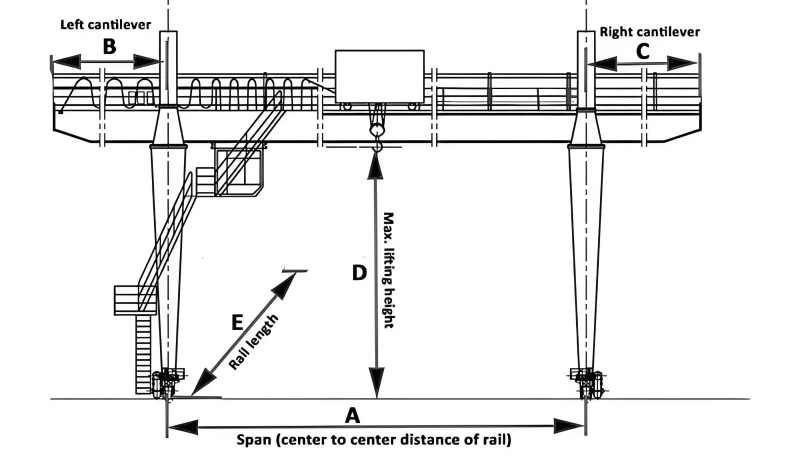
SKETCH
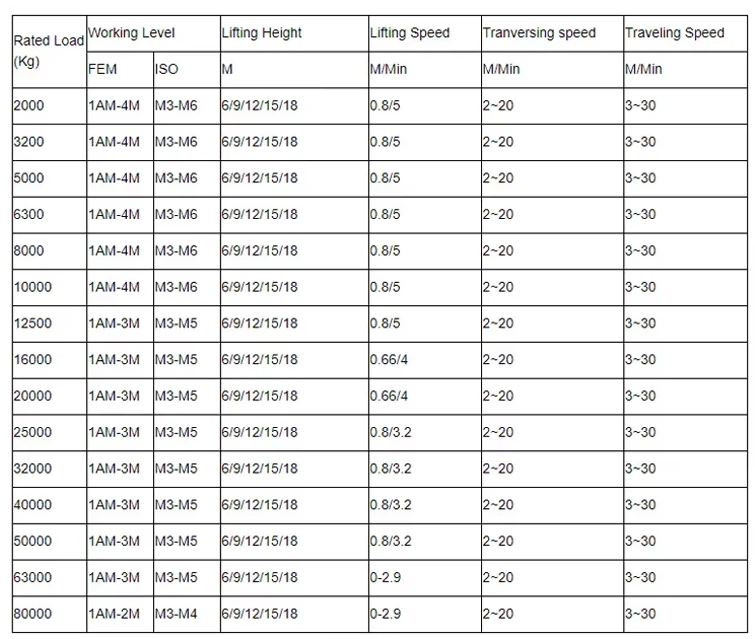
Main technical
Advantages
Advantages of MG Box Type Double Beam Gantry Crane
This crane is engineered for the most demanding industrial applications, offering a powerful set of benefits that justify its position as a premium lifting solution.
1. Unmatched Strength and Stability
Extreme Load Capacity: Designed to handle loads from 20 tons to over 500 tons with ease, making it suitable for the heaviest industrial applications.
Superior Rigidity: The box girder design provides exceptional resistance to bending, torsion, and dynamic loads. This minimizes deflection and ensures stable operation even under maximum load and long spans.
Exceptional Stability: Reinforced legs with A-frame or cross-bracing prevent leaning and racking, crucial for handling off-center loads.
2. Superior Durability and Uptime
Built for Severe Service: Rated for M6 (Severe Duty) or M7 (Very Severe Duty) cycles, meaning it is engineered for continuous, intensive use, often 24/7.
Long Operational Life: Constructed with premium, industrial-grade components that withstand shock loads, harsh environments, and constant use, resulting in decades of reliable service with minimal downtime.
3. Maximum Hook Height and Precision
Optimal Vertical Space Use: The top-running trolley design provides the maximum possible hook height, which is critical for stacking, handling tall loads, or operating in facilities with high ceilings.
Precision Control: Equipped with Variable Frequency Drives (VFDs) for smooth, jerk-free acceleration and deceleration, allowing for precise load positioning and spotting.
4. Operational Versatility
Wide Application Range: Suitable for both indoor and outdoor use in the most demanding industries.
Adaptable to Various Tasks: Can be fitted with a variety of heavy-duty attachments:
C-hooks for steel coils
Magnets for scrap and steel plate
Grabs for bulk materials
Spreader beams for long or delicate loads
5. Enhanced Safety and Control
Integrated Safety Systems: Features like Load Moment Indicators (LMI), redundant braking systems, and anti-collision systems prevent overloads and operational errors.
Fail-Safe Design: Components are over-engineered with safety factors that exceed standard requirements, ensuring integrity under extreme stress.
Advanced Control Options: Can be operated from a comfortable, climate-controlled cab or via radio remote control for optimal operator visibility and safety.
Application
Applications of MG Box Type Double Beam Gantry Crane
The MG Box Type Gantry Crane is the backbone of industries where lifting massive weights is a core part of the business.
1. Steel and Metal Industry
Steel Mills: Handling raw steel coils, slabs, and finished products in melting shops and rolling mills.
Metal Service Centers: Stacking and moving steel plates, coils, and structural beams.
Scrap Yards: Equipped with a magnet for moving and loading ferrous scrap.
2. Heavy Machinery and Equipment Manufacturing
Assembly Operations: Moving massive mining truck frames, agricultural equipment, and industrial presses.
Component Handling: Positioning large weldments, engines, and other heavy sub-assemblies.
3. Shipping Ports and Intermodal Yards
Container Handling: Moving shipping containers in port yards and terminals.
Heavy Lift Cargo: Handling project cargo and heavy machinery for loading onto ships.
4. Power Generation
Power Plants: For maintenance tasks like lifting turbines, generators, and transformers.
Dam Construction: Handling large components for hydroelectric power projects.
5. Other Critical Industries
Mining: Handling large crushers, mills, and other processing equipment.
Precast Concrete Yards: Handling massive concrete beams and panels for infrastructure projects.
Shipbuilding: Lifting and positioning large ship sections and components.
Crane production process
The production process for an MG Box Type Double Beam Gantry Crane is a complex, multi-stage procedure that involves advanced engineering, heavy fabrication, precision assembly, and rigorous testing. It is typically carried out by specialized heavy industry manufacturers.
Here is a detailed breakdown of the production process.
Stage 1: Design & Engineering
This is the foundational stage where the crane's performance and safety are defined.
Client & Site Specification Analysis: Reviewing capacity, span, lifting height, duty cycle (M6/M7), runway details, and operational needs (e.g., magnet, grab, special hooks).
Advanced Engineering:
Structural Analysis (FEA): Using Finite Element Analysis to model the entire structure-girders, legs, end trucks-under dynamic loads, including wind, seismic, and collision scenarios. This ensures no point is over-stressed.
Mechanical Design: Designing the severe-duty hoist units, trolley, travel drives, and wheel systems to meet the specified duty class.
Electrical & Control Design: Creating schematics for power supply, motor drives (VFDs), PLC networks, and the integration of all safety and automation systems.
Bill of Materials (BOM) Creation: A comprehensive list of all raw materials (high-tensile steel plates) and thousands of purchased components (Siemens/ABB drives, Demag hoists, etc.).
Stage 2: Material Procurement & Preparation
Procurement: Sourcing certified high-tensile steel plates and sections from reputable mills. Ordering specialized, name-brand components from global suppliers for reliability.
Material Preparation: Steel plates are shot-blasted to remove mill scale and primed for corrosion protection. They are then cut to size using massive CNC plasma or flame cutting machines for precision.
Stage 3. Structural Fabrication & Assembly
This is where the crane's massive skeleton is built.
Panel and Sub-Assembly Fabrication:
Girder & Leg Fabrication: The double girders and legs are fabricated as large box sections from steel plate. Internal stiffeners are welded in to prevent buckling.
Process: Components are fit in massive, custom jigs to ensure straightness and correct geometry. Critical welds are performed using Automated Submerged Arc Welding (SAW) for deep penetration and high quality. All critical welds are inspected via Ultrasound (UT) or X-ray (RT).
Stress Relieving: The completed major sections (girders, legs) are heated in a computer-controlled furnace to relieve internal stresses from welding, preventing future distortion and ensuring dimensional stability.
Machining: Connection points, rail mounting surfaces, and drive mounting pads are machined on large boring mills and planers to ensure perfect alignment and fit-up during final assembly.
Stage 4: Mechanical Assembly
The structural frame is integrated with the mechanical systems.
Mega-Blocks Assembly: Large sub-sections, like a full leg with its end truck and drive, are pre-assembled.
Bridge and Boom Assembly: The main girder sections are joined, and the entire bridge structure is aligned with the end trucks.
Drive Unit Installation: The long travel drive assemblies (motor, gearbox, wheel) are installed onto the end trucks. The trolley travel drives are installed on the trolley frame.
Hoist Assembly: The severe-duty main and auxiliary hoist units are mounted and aligned on the trolley frame.
Stage 5: Electrical & Control System Installation
The crane's "nervous system" is installed.
Cable Installation: Hundreds of meters of power and control cables are laid in protective cable trays and conduits throughout the structure.
Panel Installation: Main high-voltage switchboards, VFD drive cabinets, and PLC control panels are installed in dedicated, protected electrical rooms on the crane itself.
Sensor and Safety System Installation: Limit switches, anti-collision sensors, and the Load Moment Indicator (LMI) system are mounted and wired.
Operator Interface Installation: The operator's cab is installed and wired, or the radio remote control system is configured.
Stage 6: Pre-Delivery Testing & Inspection (FAT)
Before disassembly, the fully erected crane in the factory undergoes rigorous testing, often with the client present.
Visual & Dimensional Inspection: Verifying workmanship, paint quality, and all critical dimensions (span, wheelbase).
No-Load Test: Running all motions (hoist, trolley, gantry) without a load to check for smooth operation and abnormal noise.
Load Testing:
Static Load Test: Lifting a test load of 125% of the rated capacity and holding it to verify structural integrity and brake holding capacity.
Dynamic Load Test: Lifting 110% of the rated capacity and running it through all operational motions to ensure performance under real-world conditions.
Functionality & Safety Tests: Verifying all limit switches, E-stops, overload protection, and the LMI system.
Stage 7: Dismantling, Painting & Shipment
Systematic Dismantling: The crane is carefully disassembled into transportable modules (girder sections, legs, trolley), with all components meticulously tagged.
Final Painting: A high-performance, multi-coat paint system is applied for long-term corrosion protection in harsh industrial environments.
Packaging & Shipment: Components are securely packaged and shipped, often via heavy-lift vessels or specialized road transport.
Stage 8: Site Erection & Commissioning (SAT)
Site Preparation: The manufacturer verifies the customer's runway is complete, level, and correctly aligned.
Erection: Using large mobile cranes, the manufacturer's specialized crew reassembles the crane on its permanent rails.
Final Connections & Testing: All systems are re-connected and subjected to a final Site Acceptance Test (SAT) to ensure perfect performance in the actual operating environment.
Operator Training: Comprehensive training is provided for the customer's maintenance and operations personnel.

Workshop view:
The company has installed an intelligent equipment management platform, and has installed 310 sets (sets) of handling and welding robots. After the completion of the plan, there will be more than 500 sets (sets), and the equipment networking rate will reach 95%. 32 welding lines have been put into use, 50 are planned to be installed, and the automation rate of the entire product line has reached 85%.




Hot Tags: mg box type double beam gantry crane, China mg box type double beam gantry crane manufacturers, suppliers, factory
You Might Also Like



Send Inquiry