









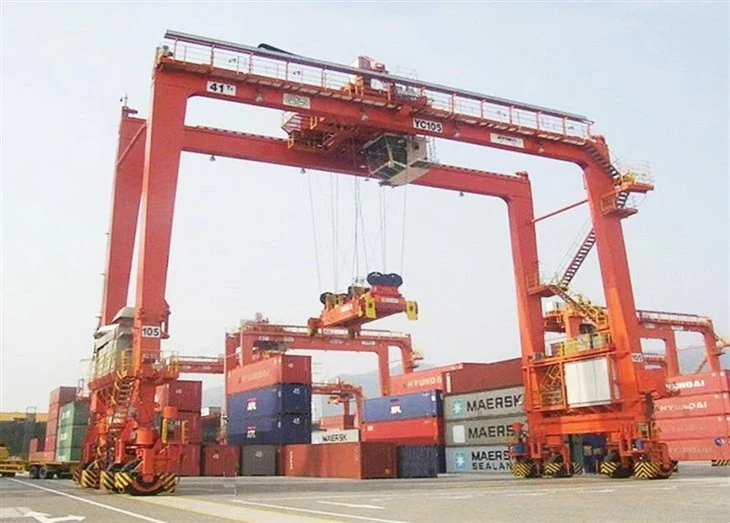
75t Rubber Tired Gantry Crane
Products Description
Advantages of RTG Cranes:
✔ Flexibility – Can be relocated as needed.
✔ No Rail Dependency – Unlike rail-mounted gantry cranes (RMG), RTGs can move freely.
✔ High Lifting Capacity – Suitable for heavy loads.
Disadvantages:
❌ Higher Maintenance – Tires and engines require regular upkeep.
❌ Limited to Hard Surfaces – Requires a smooth, paved surface for operation.
Key Features of a 75-Ton RTG Crane:
Lifting Capacity:
Designed to handle loads up to 75 metric tons (82.5 US tons), often with a spreader for shipping containers or specialized hooks/attachments for heavy cargo.
Mobility:
Runs on rubber tires, allowing easy movement around terminals or worksites without the need for fixed rails.
Typically equipped with 4-wheel or 8-wheel drive for stability and maneuverability.
Power Source:
Usually diesel-powered (some modern versions may use hybrid or electric systems).
Some models feature regenerative braking for energy efficiency.
Boom & Span:
Fixed or adjustable boom (some RTGs have telescopic booms).
Wide span (typically 20–30 meters) to cover multiple container rows or work areas.
Control & Automation:
Operator cabin with ergonomic controls.
Advanced models may include semi-automated or remote-control options.
Safety Systems:
Load moment indicators (LMI), anti-collision systems, and outriggers for stability.
Emergency stop functions and wind-resistant designs.
Comparison with Other Gantry Cranes
| Feature | RTG (Rubber-Tired) | RMG (Rail-Mounted) | STS (Ship-to-Shore) |
|---|---|---|---|
| Mobility | High (rubber tires) | Limited (fixed rails) | Very limited (fixed rails) |
| Lifting Capacity | Up to 75t+ | Up to 50t+ | Up to 100t+ |
| Installation Cost | Medium | High | Very High |
| Best For | Medium ports, intermodal yards | Large automated terminals | Deep-sea port operations |
Lifting Capacity: 30 metric tons (30,000 kg)
Span: 10m–35m (customizable)
Lifting Height: 6m–20m (adjustable)
Hoist Type: Double-girder with electric wire rope hoist (QD-type)
Travel System: Motorized (rail-guided or rubber-tired)
Wheel Type: Steel wheels (for rails) / Pneumatic tires (floor use)
Control System: Cabin-operated or remote control
Power Supply: 380V/50Hz (3-phase)
Structural Steel: Q345B (high-strength) with corrosion-resistant coating

Pictures & Components
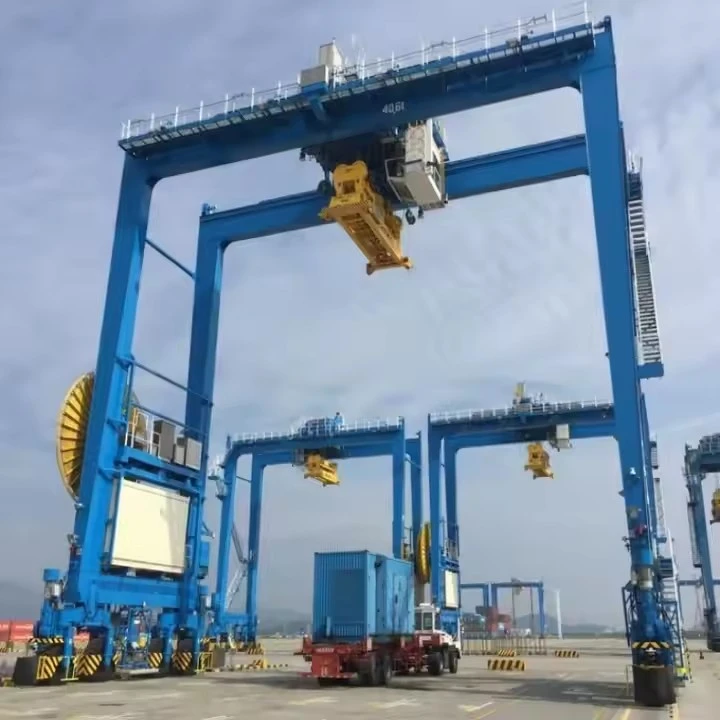
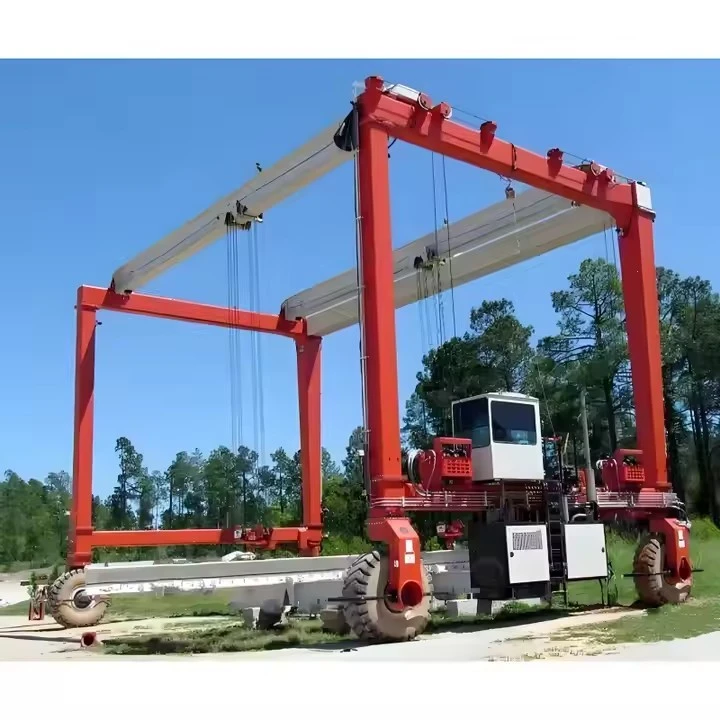
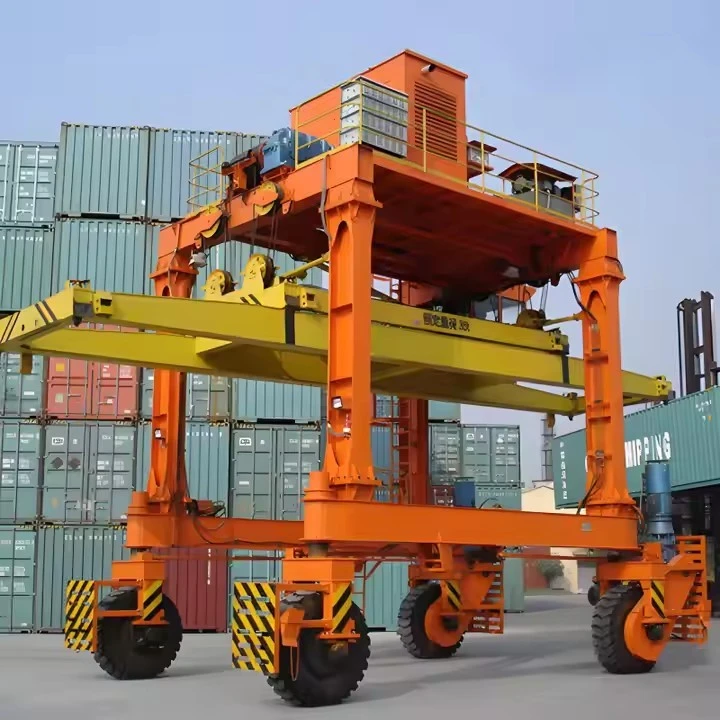
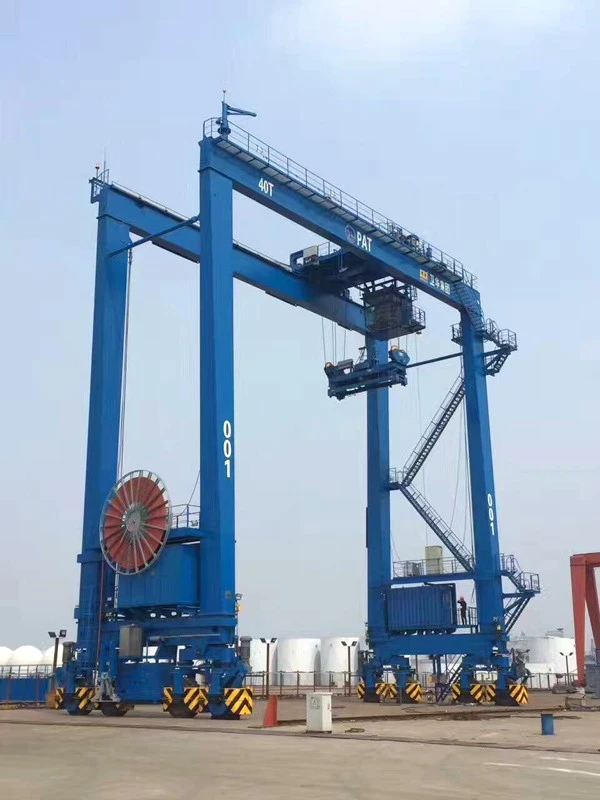
A 75-ton rubber-tired gantry crane (RTG) consists of several key structural, mechanical, and electrical components that work together to enable heavy lifting and mobility. Below is a breakdown of its major components:
1. Structural Components
A. Main Gantry Frame
The primary steel structure that spans the working area.
Includes legs, beams, and cross members for stability.
Designed to handle dynamic loads and wind forces.

B. Boom (Lifting Arm)
Fixed or telescopic boom for hoisting loads.
Some RTGs have a knuckle boom for adjustable reach.
C. Spreader (For Container Handling)
An attachment for lifting shipping containers (20ft, 40ft, 45ft).
Can be manual, semi-automatic, or fully automatic (with twistlock sensors).
 |
 |
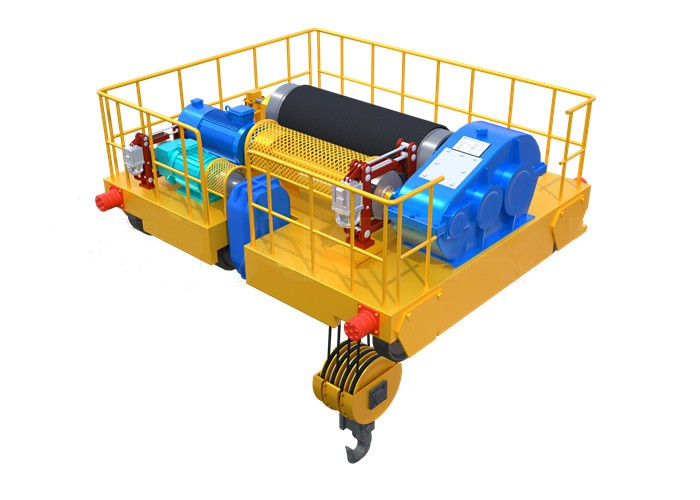
D. Trolley & Hoist Assembly
Moves horizontally along the gantry beam.
Includes wire ropes, sheaves, and a hoist motor for lifting/lowering.
 |
 |
2. Mobility & Drive Components
A. Rubber Tires
Heavy-duty, high-load tires (usually 8–16 tires, depending on design).
Some use solid rubber tires for durability in harsh environments.
B. Drive System
Diesel engine (or electric/hybrid in modern RTGs).
Hydraulic or electric wheel motors for propulsion.
Transmission & axles for power distribution.

C. Steering System
4-wheel, 8-wheel, or crab steering for maneuverability.
Some RTGs have all-wheel steering for tight spaces.
D. Braking System
Service brakes (hydraulic/disc brakes).
Parking brakes (mechanical or hydraulic).
Some have dynamic braking for energy recovery.

3. Electrical & Control Systems
A. Operator Cabin
Ergonomically designed with joysticks, control panels, and monitors.
Includes load moment indicator (LMI) for safety.
B. Power Distribution
Generator set (for diesel RTGs) or electric power supply (if grid-connected).
Circuit breakers, transformers, and cables.
C. Automation & Sensors
Anti-sway system (for load stability).
Collision avoidance sensors (laser/ultrasonic).
Remote control options (optional in some models).

4. Hydraulic Systems
Hydraulic pumps & cylinders (for boom movement, steering, and brakes).
Oil cooling system to prevent overheating.
Pressure relief valves for safety.
.
5. Safety & Auxiliary Components
A. Outriggers / Stabilizers
Extendable legs to prevent tipping during heavy lifts.
B. Lights & Alarms
Warning beacons, horns, and LED lights for visibility.
Emergency stop buttons.
C. Wind Resistance Features
Anemometer (wind speed sensor).
Rail clamps (for securing in high winds).

6. Optional Add-Ons
GPS tracking for fleet management.
Hybrid/Electric drive for reduced emissions.
Automated stacking systems (for container terminals).

SKETCH

Main technical

Advantages
A 75-ton RTG crane offers several benefits, making it a preferred choice in ports, logistics hubs, and heavy industries. Key advantages include:
1. High Mobility & Flexibility
No rail dependency – Unlike rail-mounted gantry cranes (RMGs), RTGs can move freely on rubber tires.
Easy relocation – Can be driven to different work areas without disassembly.
Adjustable span – Some models allow width adjustments to fit different container rows.
2. Strong Lifting Capacity
Handles up to 75 metric tons, suitable for heavy containers, machinery, and project cargo.
Can be fitted with different spreaders or hooks for various load types.
3. Cost-Effective for Medium-Sized Terminals
Lower infrastructure cost compared to rail-mounted cranes (no need for fixed tracks).
More affordable than large ship-to-shore cranes for smaller ports.
4. Versatile Applications
Works in ports, intermodal yards, construction sites, and factories.
Can stack containers up to 5–6 high (depending on model).
5. Improved Productivity
Faster container handling compared to traditional forklifts or reach stackers.
Some models feature semi-automation for precision and efficiency.
6. Adaptability to Different Environments
Works on paved surfaces (concrete or asphalt).
Some RTGs are hybrid or electric, reducing emissions in eco-sensitive areas.
Application:
1. Ports & Container Terminals
Stacking and transferring shipping containers between trucks, trains, and storage yards.
Loading/unloading from vessels (when used alongside quay cranes).
2. Intermodal Logistics Hubs
Transferring containers between trucks, railcars, and storage areas.
Used in inland container depots (ICDs) for cargo consolidation.
3. Heavy Industry & Manufacturing
Handling steel coils, heavy machinery, and large fabricated parts.
Used in shipyards, power plants, and construction material yards.
4. Project Cargo & Construction
Lifting precast concrete segments, wind turbine components, and industrial modules.
Suitable for large infrastructure projects (bridges, dams, etc.).
5. Military & Disaster Relief
Rapid deployment for moving heavy equipment and supplies in emergency situations.
Crane production procedure
1. Design and Planning
Demand Analysis: According to customer needs and usage scenarios, a detailed demand analysis is carried out to determine the specifications, load, span, lifting height, etc. of the crane.
Engineering Design: Engineers use CAD and other design software to carry out detailed design, including structural, mechanical, electrical and other aspects to ensure that the design meets relevant standards and specifications.
2. Material Procurement
Material Selection: Select appropriate steel, motors, control systems and other components according to design requirements.
Supplier Screening: Screen suppliers of materials and components to ensure the quality and reliability of materials.
3. Processing and Manufacturing
Cutting and Forming: Cut, weld, bend and other processes on steel to form main beams, end beams and other structural components.
Machining: Precision machining of key components, such as turning, milling, drilling, etc., to ensure that the size and accuracy meet the design requirements.
Surface Treatment: Spray, galvanize or rust-proof metal parts to enhance corrosion resistance and aesthetics.
4. Assembly
Component Assembly: Assemble the main beam, end beam, trolley, lifting mechanism and other components to form a complete crane structure.
Installation of electrical system: Install electrical equipment such as motors, control cabinets, sensors, limit switches, etc. to ensure the normal operation of the electrical system.
5. Debugging and testing
Preliminary debugging: Carry out preliminary debugging of the crane to check the coordination and operation of each component.
Load test: Carry out load test to ensure the safety and stability of the crane under rated load, and test the functions of safety devices such as overload protection and limit switches.
Performance test: Test the performance indicators of the crane such as lifting speed, running speed, braking effect, etc. to ensure that they meet the design requirements.
6. Quality inspection
Quality inspection: Carry out a comprehensive quality inspection of the crane, including appearance, size, performance, etc., to ensure compliance with relevant standards.
Safety assessment: Carry out safety assessment to ensure the normal operation of all safety devices and systems.
7. Delivery and installation
Packaging and transportation: Pack qualified cranes and prepare them for transportation to the customer site.
On-site installation: Carry out on-site installation according to customer requirements, including basic production and equipment debugging.
Training and handover: Train operators to ensure that they master the operation methods and safety precautions of the equipment and complete the handover work.


Workshop view
Material Inspection
Quality Inspection: Strict quality inspection is carried out on the purchased raw materials to ensure that they meet the design requirements and national standards.
Material Storage: Qualified materials are stored according to classification to prevent corrosion or damage.
Cutting and Forming
Steel Cutting: Use plasma cutting, laser cutting or flame cutting and other technologies to cut the steel according to the size of the design drawing.
Forming Processing: Form the steel plate through bending, rolling, welding and other processes to manufacture the main beam, end beam and other structural parts.
Welding
Component Welding: The cut and formed steel parts are welded into the main structures such as the main beam, end beam and trolley. The welding process needs to be strictly controlled to ensure the structural strength and welding quality.
Weld Inspection: Use non-destructive testing technology (such as ultrasonic testing, radiographic testing) to inspect the welds to ensure that there are no cracks or other defects.
Machining
Precision Machining: Precision machining is performed on the key components of the crane, such as wheel sets, bearing seats, pulleys, etc., to ensure their dimensional accuracy and surface quality.
Assembly of the whole machine
General assembly: On the basis of pre-assembly, the overall assembly of the crane is carried out, including the final installation of the main beam, end beam, lifting mechanism, walking mechanism, etc.
Commissioning and testing
Under dynamic conditions, the operating performance of the crane is tested, including the testing of lifting, walking, steering and other functions. The overall size of the assembled bridge crane is checked to ensure that all dimensions meet the design requirements.
Spraying and anti-corrosion treatment
Surface treatment Rust removal: Rust removal on the surface of the crane, common methods include sandblasting, pickling, etc. Primer spraying: Spray anti-corrosion primer on the treated surface to prevent metal oxidation and corrosion. Topcoat spraying Color spraying: Spray topcoat according to customer requirements or industry standards to give the crane a protective and decorative effect. Marking: After spraying, mark the crane's identification information in accordance with the specifications, such as model, rated load, etc.
Factory and installation
Packaging and transportation
Packaging protection: Protectively package the key components of the crane to prevent damage during transportation. Transportation arrangement: According to the equipment size and transportation conditions, select a suitable transportation method to transport the crane to the customer's site.
Acceptance and delivery
Customer acceptance
On-site acceptance: The customer conducts on-site acceptance of the crane according to the contract requirements and technical specifications to check the performance and quality of the equipment.
Problem rectification: If any problems are found, the manufacturer needs to rectify them in time to ensure that the equipment fully meets the customer's requirements. Delivery and use Operation training: The manufacturer usually trains the customer's operators to ensure that they can operate the crane correctly and safely.


Hot Tags: 75t rubber tired gantry crane, China 75t rubber tired gantry crane manufacturers, suppliers, factory
You Might Also Like


Send Inquiry