










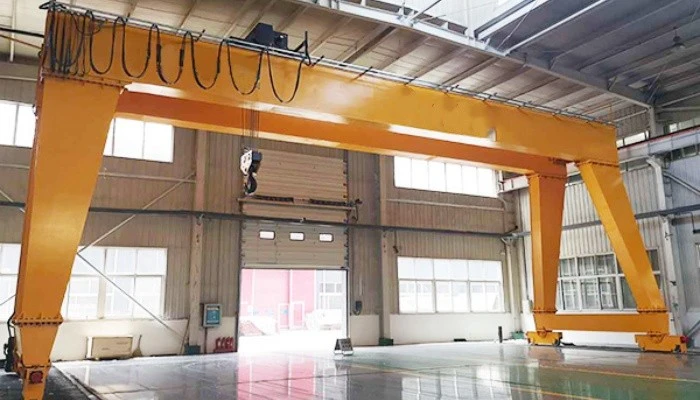

50T Double Beam Gantry Crane Widely Used
Products Description
A 50-ton double beam (double girder) gantry crane is a heavy-duty lifting system designed for outdoor or semi-outdoor applications where no overhead support structure exists. It's widely used across industries for moving large, heavy loads efficiently and safely.
Core Components:Engine, Bearing, Gearbox, Motor, Gear
Place of Origin:Henan, China
Warranty:2 years
Weight (KG):50000 kg
Video outgoing-inspection:Provided
Machinery Test Report:Provided
Application:Outdoor
Keywords:Gantry Crane
Rated Loading Capacity:50Ton
Cross travelling speed:44.6m/min
Long travelling speed:47.1m/min
Control way:cabin
Power supply:Cable reel
Steel track:QU80
Power:3-phase AC 50HZ 380V

Pictures & Components
1.Main beam
Structure & Design
Double Beam Configuration:
Two parallel main girders run across the span of the gantry crane, supporting the hoisting trolley.
Box Girder Type (Most Common):
Welded rectangular or box-type steel structure provides high strength and torsional rigidity - essential for 50-ton loads.
Material:
High-strength structural steel (e.g., Q345B or S355) for enhanced load capacity and fatigue resistance.
Design Standards:
Follows FEM, DIN, or ISO standards for load bearing, deflection limits, and welding quality.
2.Lifting System
1)Hoist Mechanism (Main Lifting Unit)
Type:
Usually uses a winch-type hoist (not wire rope electric hoist) due to the heavy capacity (50 tons).
Configuration:
Mounted on a trolley that runs along the top of the double girders.
Structure Includes:
Hoisting Motor
Drum
Wire Ropes
Pulley Block
Hook Assembly
Brake System
Gearbox/Reducer
2)Lifting Motor & Drive
Motor Type:
3-phase squirrel cage or slip ring motor, often combined with frequency converter (VFD) for speed control.
Features:
High starting torque
Smooth acceleration and deceleration
Overheat protection
Insulation class F or H
3)Wire Rope & Drum
Wire Rope:
High-strength, anti-twist steel rope with lubrication and anti-corrosion coating.
Drum:
Grooved steel drum ensures proper wire rope winding with minimal wear.
Safety Ratio:
Usually a >5:1 safety factor for wire rope vs. rated load.
4)Hook & Pulley Block
Hook Material:
Forged steel (grade 34CrNiMo6 or equivalent), equipped with a safety latch.
Swivel Hook:
Can rotate 360° to align with the load direction.
Pulley System:
Multi-sheave block to distribute the load and reduce lifting stress.
 |
 |
3.End carriage
Structural Design
Box-Type Welded Structure:
Fabricated from high-strength steel plates with full-penetration welds, ensuring durability under high loads.
Connection with Main Girders:
Bolted or rigidly welded to both ends of the double main girders, forming a rigid frame.
Supports Crane Legs:
For full gantry cranes, end carriages are mounted on supporting legs; for semi-gantries, only one side has a leg.
  |
4.Crane travelling mechanism
Crane Wheels:Forged steel wheels (driving & idle) mounted on end carriages
Drive Motor:Heavy-duty motors for longitudinal movement
Gear Reducer:Integrated with the motor for torque control and smooth motion
Drive Shaft:Connects motor to wheels (if non-independent drives are used)
Rail Clamp System:Ensures stability and prevents crane from being lifted by wind
Buffer System:Rubber or polyurethane bumpers at end of travel limits
Limit Switches:Prevent over-travel and potential collision
Track Rails:Laid on ground/foundation, typically 38–50 kg/m rail profiles
5.Trolley travelling mechanism
Trolley Frame:Welded steel structure supporting the hoisting mechanism
Traveling Wheels:Hardened steel wheels running on top-mounted rails on the main girders
Travel Drive Motor:Motor + gearbox to drive the trolley wheels
Gear Reducer:Transmits motor power to the wheels at controlled speed and torque
Guide Rollers:Prevent lateral sway and keep the trolley aligned on the rail
Rail System:Flat bar or square rail mounted on the top of each girder
Limit Switches:Prevent over-travel and potential collision at either end of the beam

7.Crane Hook
Hook Block Assembly
The hook is integrated into a hook block, which includes:
Pulley Sheaves: Multiple wheels to guide the wire rope
Bearings: For smooth rotation
Side Plates: Heavy-duty plates enclosing the pulley system
Hook Nut/Locking System: Prevents hook loosening under load
Equalizer Beam (if double hook): For balanced lifting of uneven loads

8.Motor
Key Features
Duty Class:
Motors are typically rated S3 (intermittent duty) or S4 (cyclic duty) for cranes.
Insulation Class:
Class F or H, suitable for high-temperature and heavy-duty operation.
Protection Grade:
At least IP54–IP65, protecting against dust and water ingress.
Brake Integration:
Lifting motors come with electromagnetic or hydraulic brakes, ensuring immediate holding on power-off.
Cooling Method:
Often self-cooled with fans, especially for continuous-duty applications.
Mounting Type:
Flange-mounted (for compact configurations)
Foot-mounted (for easy maintenance)

.
9.Sound and light alarm system & limit switch
1)Sound and Light Alarm System
This system provides audible and visual alerts to warn nearby workers and operators during crane operation, improving safety and helping prevent accidents.
2) Limit Switches
Limit switches are mechanical or proximity sensors that stop or reverse the motion of crane components to avoid over-travel or mechanical damage.

10.Safety Devices
1)Overload Protection Device
Function: Prevents lifting more than the rated capacity (50T).
Types: Load cell sensor, hydraulic pressure sensor, or electronic overload relay.
Action: Stops hoisting and triggers alarm if overloaded.
2)Lifting Limit Switch (Upper & Lower)
Function: Prevents the hook from being lifted too high or lowered too far.
Type: Rotary cam, lever arm, or proximity switch.
Safety Benefit: Protects the hoist and drum from damage due to rope over-wrap or slack.
3)Travel Limit Switches
Function: Stops trolley and crane motion at the end of their travel path.
Location: Mounted at ends of girder rail (trolley) and runway (crane).
Action: Cuts travel motor power to prevent collision with end stops.
4)Sound and Light Alarm System
Function: Provides audible and visual warnings during crane operation.
Components: Flashing LED beacon + siren (85–110 dB).
Triggered by: Lifting, traveling, emergency, or fault detection.
5)Wind Speed and Storm Lock System
For outdoor gantry cranes
Wind Speed Sensor: Warns if wind exceeds safe operating limit.
Storm Lock (Rail Clamp): Mechanically locks crane to rails to prevent movement during strong winds or shutdown.
11.Control Mode
1)Pendant Control
Description:
A handheld wired control panel connected by a cable to the crane.
Features:
Buttons or joysticks for all crane functions: hoisting, trolley travel, crane travel.
Emergency stop button.
Durable, waterproof, and ergonomically designed.
Advantages:
Operator close to load area for better visibility.
Simple and reliable with minimal interference.
2)Radio Remote Control (Wireless Control)
Description:
Wireless handheld transmitter allowing operator freedom to move around the crane.
Features:
Multi-function joystick or push buttons.
Emergency stop switch.
Range of 50–200 meters or more.
LED indicators for signal strength and battery status.
Advantages:
Improves operator visibility and safety.
Eliminates cable snag hazards.
Ideal for outdoor or large span operations.
3)Cabin Control (Operator Cabin)
Description:
Enclosed cabin mounted on the crane or gantry, where the operator sits to control the crane.
Features:
Full control console with levers, buttons, and displays.
Climate control (AC/Heating).
Good visibility with large windows and sometimes camera systems.
Communication systems.
Advantages:
Comfortable for long shifts.
Protection from weather and dust.
Suitable for precise control in complex operations.
4)Semi-Automatic / Automated Control (Optional)
Description:
Integration of PLC (Programmable Logic Controller) and automation systems to control repetitive tasks.
Features:
Pre-programmed hoisting and travel sequences.
Safety interlocks and alarms.
Remote monitoring and diagnostics.
Advantages:
Increases operational efficiency.
Reduces operator fatigue.
Ensures consistent lifting quality.

12.Sketch

Main technical

Advantages
1. High Load Capacity & Structural Strength
Designed to handle heavy loads up to 50 tons reliably.
Double girder structure offers greater stability, load distribution, and bending resistance compared to single girder models.
Ideal for frequent or continuous heavy lifting.
2. Wide Span & Large Coverage Area
Suitable for wide-span operations in outdoor yards or large workshops.
Can cover large working areas without the need for building-support structures.
3. Enhanced Operational Efficiency
High lifting height and wide working range.
Fast hoisting, trolley travel, and crane travel speeds.
Reduces material handling time significantly compared to forklifts or mobile cranes.
4. Full Safety System Integration
Equipped with overload limiters, travel limit switches, emergency stops, brake systems, and wind locks (for outdoor use).
Improves workplace safety and reduces risk of damage or injury.
5. Flexible Control Modes
Offers pendant control, radio remote control, or cabin operation, depending on working conditions.
Optional semi-automation or full automation for repetitive tasks.
6. Customizable for Applications
Adjustable in terms of span, lifting height, wheelbase, and speed.
Can be equipped with custom hooks, magnets, grabs, or lifting beams depending on the material type (e.g., steel, concrete, containers).
Application
1. Heavy Manufacturing
Applications: Handling large machine parts, steel structures, molds, dies, and assemblies.
Industries: Machinery fabrication, heavy equipment plants, metal structure workshops.
2. Steel Mills and Foundries
Applications: Moving steel plates, billets, coils, ingots, and finished steel products.
Why gantry crane: Handles hot, heavy, and irregular materials in tough environments.
3. Precast Concrete and Construction
Applications: Lifting and transporting precast beams, concrete blocks, bridge segments, and columns.
Industries: Bridge construction, precast factories, tunnel segment yards.
4. Shipyards and Marine Industry
Applications: Assembling ship parts, lifting hull sections, engines, or other large components.
Setup: Often used along slipways or docks with large span coverage.
5. Logistics Yards and Ports
Applications: Container handling, cargo loading/unloading in rail yards or port terminals.
Advantage: High capacity and mobility make it ideal for outdoor bulk cargo areas.
6. Power Plants and Energy Sector
Applications: Moving heavy turbines, generators, transformers, and maintenance components.
Use Case: Essential for handling oversized and sensitive electrical equipment.
7. Railway Yards
Applications: Lifting and placing rail tracks, wheels, bogies, and heavy components.
Why gantry: Works without fixed overhead structure, ideal for rail-side operations.
Crane production procedure
1. Raw Material Preparation
Select high-strength Q235B/Q345B steel for structural components.
Inspect and test all raw materials for quality compliance (chemical and mechanical testing).
Cut beams and plates to required sizes using CNC cutting machines.
2. Main Girder Fabrication
Form box-shaped or U-shaped girders from pre-cut steel plates.
Automatic submerged arc welding (SAW) for longitudinal seams.
Internal diaphragms and stiffeners are welded inside the box for reinforcement.
All welding seams are inspected with ultrasonic and radiographic testing.
3. End Carriage Manufacturing
Cut and machine the end truck beams.
Mount crane wheels, bearing housings, and gearboxes.
All connection surfaces are milled for accurate alignment with main girders.
Pre-assembly done to ensure parallelism and squareness.
4. Trolley/Hoist Assembly
Trolley frame is fabricated and equipped with:
50T lifting mechanism (hoist)
Wire rope drum, motor, gearbox, and hook assembly
Electrical cabling and control box mounted on trolley.
Hoist and trolley tested for functionality before installation on girders.
5. Machining & Drilling
Precision CNC machining for mounting holes, rail guides, and gear housing interfaces.
Drilling of limit switch points, cable brackets, and guardrails.
Machined parts inspected with calipers and gauges to verify tolerances.
6. Welding Inspection & Non-Destructive Testing (NDT)
All welded joints undergo:
Ultrasonic Testing (UT)
Magnetic Particle Inspection (MPI)
Visual weld inspection
Repair and rework carried out as needed before painting.
7. Surface Treatment & Painting
Full surface sandblasting to Sa2.5 standard.
Anti-rust primer coating, followed by two layers of industrial topcoat.
Final paint thickness: ≥100–120μm.
Custom color schemes available (e.g., yellow, red, blue).
8. Electrical System Installation
Install:
Control panels
Limit switches
Safety devices
Cables, festoon systems, or cable reels
Connect motors, sensors, alarms, and control interfaces.
Conduct electrical continuity and insulation testing.
9. Final Assembly
Mount main girders to end carriages using high-strength bolts or welding.
Install trolley onto the crane rails.
Ensure alignment of wheelbase, gear meshing, and rail clearance.
10. Factory Testing (FAT)
Conduct no-load and load testing (up to 125% of rated capacity).
Test includes:
Hoisting and lowering
Trolley travel
Crane travel
Safety device functionality
Dynamic load test checks mechanical integrity under motion.
11. Packing & Delivery
Disassemble into transportable modules.
Label parts and components.
Use steel racks, wooden crates, and anti-rust packaging.
Ship via truck, container, or flat rack depending on size.
12. On-Site Installation & Commissioning
Reassemble crane structure at customer site.
Perform full alignment check and tightening of all fasteners.
Conduct load testing, calibration, and operator training.
13. Quality Assurance & Documentation
Provide complete documentation:
Material certificates
Welding and inspection records
Test reports
Operation manual
Electrical drawings
CE/ISO certification if required

Workshop view:
The company has installed an intelligent equipment management platform, and has installed 310 sets (sets) of handling and welding robots. After the completion of the plan, there will be more than 500 sets (sets), and the equipment networking rate will reach 95%. 32 welding lines have been put into use, 50 are planned to be installed, and the automation rate of the entire product line has reached 85%.


Hot Tags: 50t double beam gantry crane widely used, China 50t double beam gantry crane widely used manufacturers, suppliers, factory
Previous
Mobile Gantry Wheel Hoist CraneYou Might Also Like


Send Inquiry