










Precast Yard Gantry Crane
Products Description
What is a Precast Yard Gantry Crane?
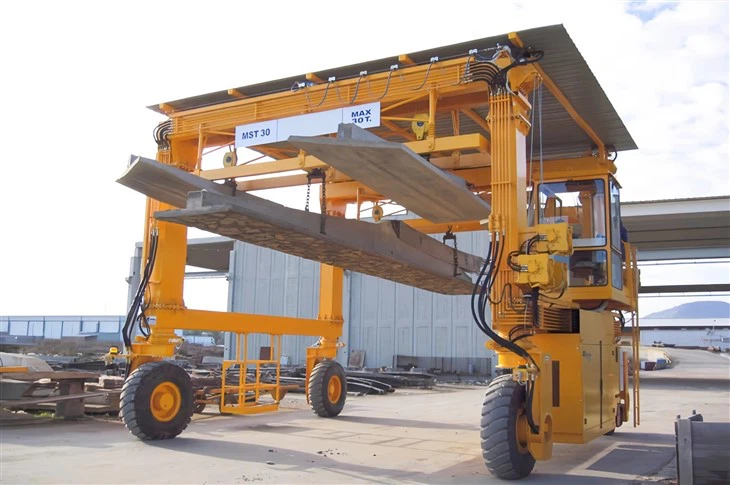
It is typically a large-capacity, double-girder, rail-mounted gantry crane that travels along tracks embedded in the production yard. It covers critical work areas such as the casting beds, curing stations, and storage areas, and is used for:
Stripping forms from concrete
Moving molds
Lifting and turning finished products
Loading products onto trucks for shipment
Advantages of a Precast Yard Gantry Crane
Handles Extreme Loads: The only practical way to move massive, heavy precast elements safely and efficiently.
Maximizes Yard Layout Efficiency: By operating on a fixed runway, it provides comprehensive coverage of the production line without obstructing ground-level activities.
Superior Product Handling: Precision controls and spreader beams prevent costly damage to the fragile concrete products, reducing waste and rework.
Improves Workflow: Enables a continuous production flow from casting beds to curing and storage, streamlining the entire manufacturing process.
Enhances Safety: Removes the need for mobile cranes to operate constantly within the tight confines of the yard, reducing collision risks and ground worker hazards.
Types of Gantry Cranes in Precast Yards
Single Girder Gantry Crane: Used for lighter loads (e.g., hollow-core slabs, small septic tanks) in smaller yards.
Double Girder Gantry Crane: The most common type for heavy precast production, offering higher capacity and better hook height.
Semi-Gantry Crane: Where one end of the bridge runs on a raised runway and the other end on a ground-level rail. Useful for covering a storage area along a building wall.
Lifting Capacity 320 tons
Span (Width) 3 - 12 meters (adjustable)
Lifting Height 3 - 10 meters
Working Class A3-A5 (light to medium duty)
Hoisting Speed 0.5 - 8 m/min (variable)
Main Beam Type Single/double girder (box-type)
Power Supply 220V/380V 3-phase or manual
Control Mode Pendant control/wireless remote
Hoist Type Electric chain hoist/wire rope hoist
Travel Drive Manual push or motorized
Corrosion Protection Hot-dip galvanized or marine-grade paint
Wind Resistance Up to Beaufort scale 6 (for outdoor use)
Operating Temp -20°C to +50°C

Pictures & Components
The components of a Precast Yard Gantry Crane are engineered for extreme strength, precision, and durability to handle massive, high-value concrete elements.
1. Primary Structural System (The Backbone)
Double Main Girders: These are the primary horizontal beams. The double-girder design is mandatory for high capacities and long spans. They are typically fabricated as box girders from thick steel plate for superior strength and resistance to twisting and sagging under extreme loads.
End Trucks (Legs): The massive vertical structures at each end of the girders. They house the long travel wheels, drives, and connections to the girders. Legs are often A-frame or braced to provide exceptional stability and prevent leaning when lifting loads off-center.
Runway & Rails: A critical, fixed infrastructure.
Running Rails: Heavy-duty steel rails (often crane rails) on which the crane travels.
Runway Beams & Foundation: Robust, reinforced concrete beams and foundations that support the rails and ensure they remain level and aligned under dynamic loads and over time.
2. Lifting & Handling System (The Workhorse)
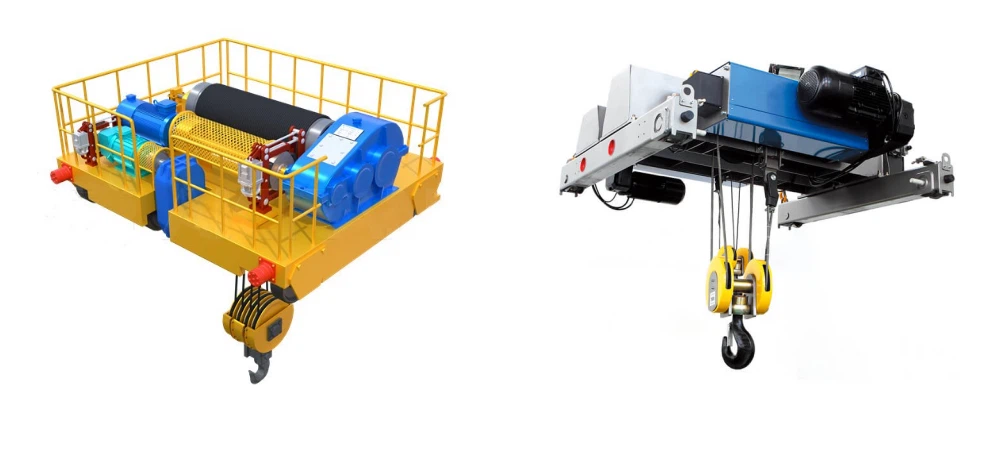
Main Hoist Unit (High-Capacity, Low-Speed):
Hoist Motor: High-torque, low-speed motor designed for precise control of heavy loads.
Wire Rope Drum: Machined drum with precise grooving to spool multiple layers of high-strength wire rope.
Gearboxes: Heavy-duty gears designed to handle the immense torque required.
Multiple Disc Brakes: Primary and secondary (emergency) braking systems.
Auxiliary Hoist: A second, smaller-capacity, faster hoist on the same trolley for handling lighter duties like empty molds, rebar cages, or tools.

Trolley Frame & Drive: The structure that carries the main and auxiliary hoists. It features powerful drives and flanged wheels to travel smoothly along rails on top of the main girders.
Specialized Lifting Attachments (Critical for Precast):
Spreader Beams: Essential for distributing the lifting force to multiple pick points on the concrete element. This prevents cracking and internal damage.
Lifting Frames: Customized frames designed to handle specific products like wall panels, allowing them to be lifted vertically without tilting.
Rotating Hooks: Allow for the controlled turning of elements (e.g., turning a beam on its side).
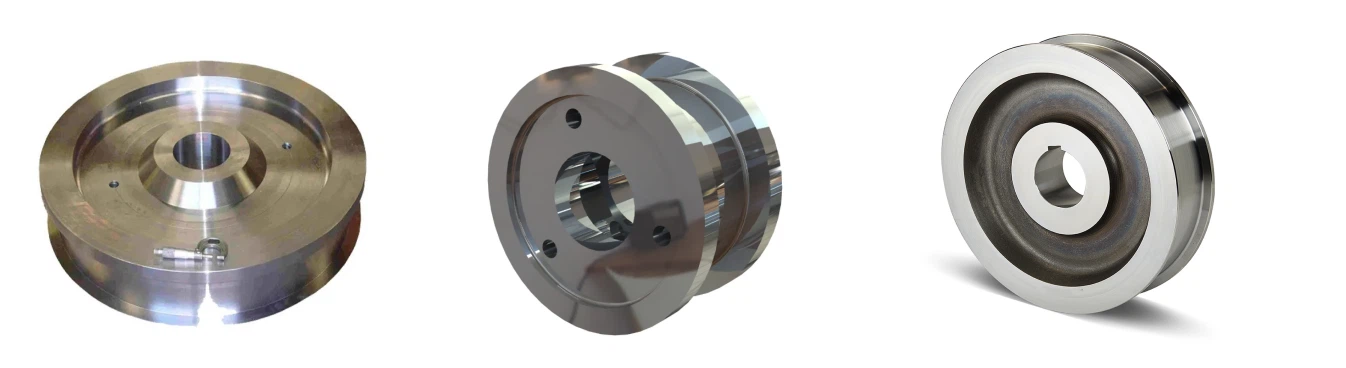
3. Power, Control & Motion Systems (The Nerves)
Long Travel Drive: The system that moves the entire crane along the runway. Includes multiple motors, gearboxes, and large-diameter flanged wheels on each end truck for synchronized movement.
Power Supply System:
Conductor Bar System (Enclosed Track): The most reliable method for long-travel, heavy-duty cranes. Provides continuous power without the maintenance issues of festoon systems.
Operator Control:
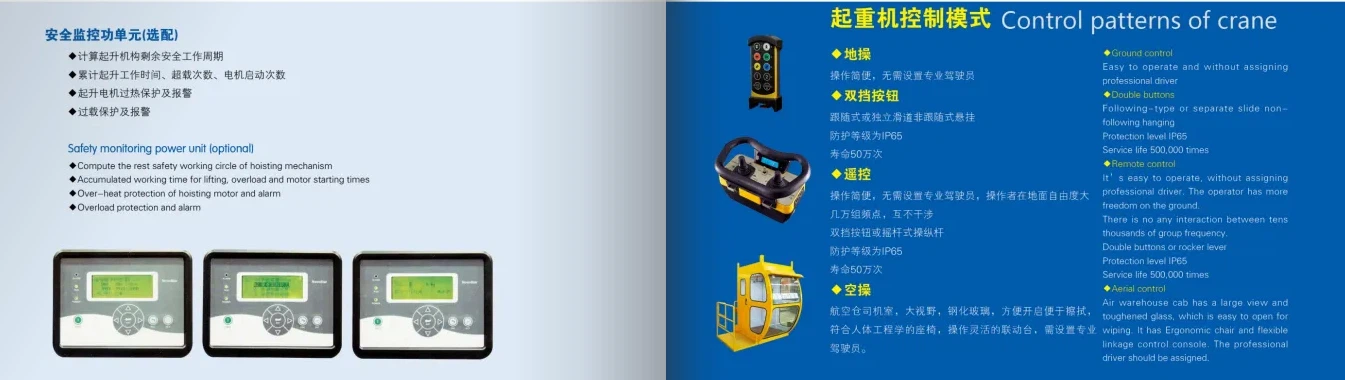
Radio Remote Control: This is the standard and preferred method. It allows the operator to move freely on the ground for optimal visibility of the load and hook, which is crucial for precise placement and safety.
Operator's Cab: Less common but used in some yards, typically suspended from the crane bridge.
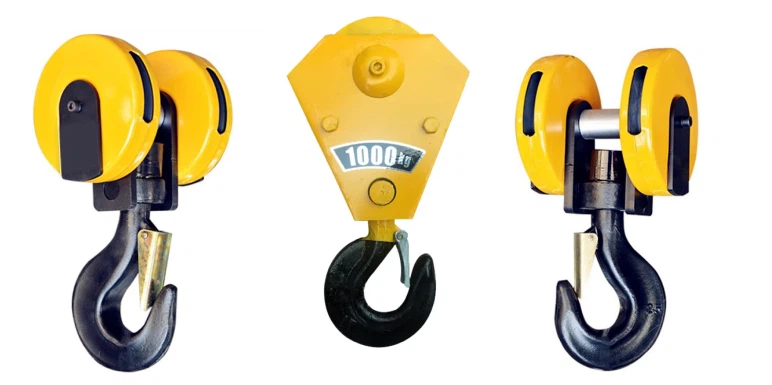
4. Critical Safety Systems (The Lifeline)
Load Moment Indicator (LMI): A non-negotiable safety device. It constantly monitors the load weight, calculates the crane's stability, and can automatically prevent dangerous operations if an overload is detected.
Redundant Braking Systems:
Primary Hoist Brake: A high-capacity disc or caliper brake.
Secondary (Emergency) Brake: A fully independent backup brake.
Motor Brakes on all motions: For trolley and gantry travel.


Limit Switches: Heavy-duty upper and lower limit switches for all hoisting and travel motions to prevent over-travel.
Anti-Collision Systems: Used when multiple cranes operate on the same runway to prevent accidents.
Anemometer: Wind speed indicator for outdoor yards, which can alarm or shut down operations in high winds, as precast elements act like large sails.
Rail Clamps / Anchors: Large mechanical clamps that lock the crane to the rails to prevent movement during storms or when parked.

Summary: Why Components are Heavy-Duty
| Standard Crane Component | Precast Yard Gantry Crane Component | Reason for Upgrade |
|---|---|---|
| Single Girder | Double Box Girder | Strength and rigidity for multi-ton loads and long spans. |
| Standard Duty Hoist | Low-Speed, High-Torque Hoist | Precise, controlled lifting of fragile concrete. |
| Basic Hook | Spreader Beams & Lifting Frames | To distribute load and prevent product damage. |
| Pendant Control | Radio Remote Control | Optimal visibility for the operator to ensure precise placement. |
| Standard Electricals | Industrial-Grade & Weatherproof | Reliability in an outdoor, industrial environment. |
Conclusion: Every component of a Precast Yard Gantry Crane is over-engineered for capacity, precision, and reliability. The integration of a robust double-girder structure, powerful and slow-speed hoists, specialized lifting attachments, and comprehensive safety systems makes it a custom-engineered solution for the unique demands of the precast concrete industry.
SKETCH
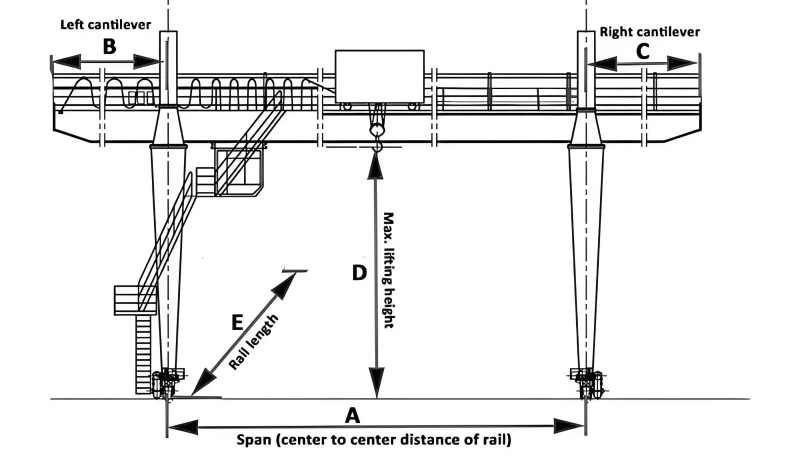
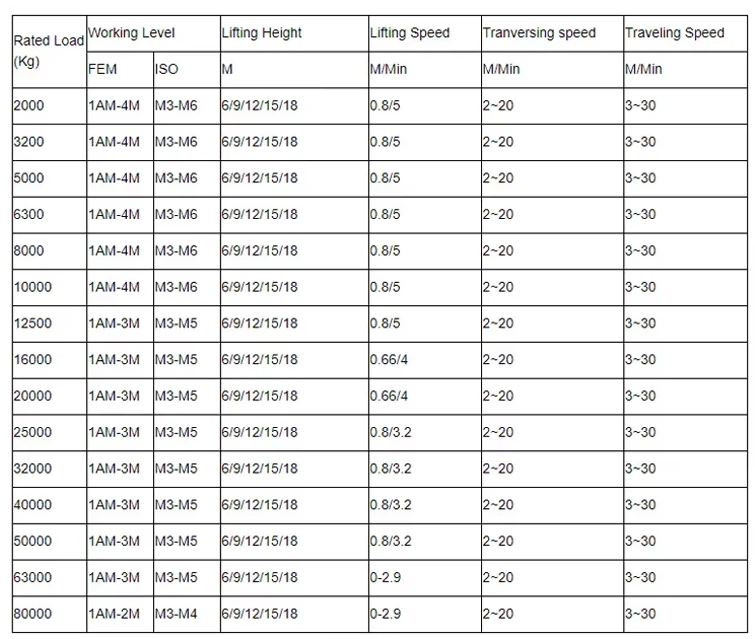
Main technical
Advantages
Advantages of a Precast Yard Gantry Crane
1. Unmatched Efficiency and Workflow Optimization
Continuous Production Flow: Enables a seamless, moving assembly line from casting beds to curing stations and finally to storage, drastically reducing waiting times.
High-Speed Handling: Designed for severe-duty cycles, allowing for the rapid movement of multiple heavy elements per hour.
Eliminates Bottlenecks: Replaces slower, less reliable methods like multiple mobile cranes, creating a predictable and efficient production rhythm.
2. Superior Product Handling and Quality Control
Precision Control: Equipped with Variable Frequency Drives (VFDs) and micro-speed controls for smooth, jerk-free movement. This is critical for preventing cracks and damage in brittle, green concrete.
Specialized Attachments: The use of spreader beams and custom lifting frames distributes lifting forces evenly, preventing internal stress and damage to the concrete, which directly translates to higher product quality and less waste.
3. Enhanced Safety
Radio Remote Control: Operators can control the crane from the ground, providing the best possible view of the load and its surroundings, away from pinch points and potential falling hazards.
Stable and Predictable Movement: The rail-mounted system is inherently more stable than rubber-tired mobile cranes, especially when handling loads that can act like sails in the wind.
Integrated Safety Systems: Features like Load Moment Indicators (LMI), redundant brakes, and limit switches prevent overloads and operational errors.
4. Optimized Space Utilization
Full Yard Coverage: The crane operates on a fixed runway, covering the entire width and length of the production yard-casting beds, curing areas, and storage-without obstructing ground-level activities.
Overhead Operation: By working overhead, it keeps the yard floor clear for trucks, workers, and other equipment, maximizing the use of available space.
5. Cost-Effectiveness and High Return on Investment (ROI)
Reduced Labor: One crane and one operator can do the work of several smaller machines and their crews.
Minimized Product Loss: The precision handling significantly reduces breakage and waste of high-value concrete products.
Lower Long-Term Costs: While the initial investment is high, its durability and reliability lead to lower lifetime operating costs compared to maintaining a fleet of mobile cranes.
Application
Applications in a Precast Yard
1. Mold Preparation and Casting
Placing Rebar Cages: Lowering heavy, pre-assembled steel reinforcement cages into the molds with precision.
Positioning Molds: Moving and aligning large, heavy steel molds on the casting beds.
2. De-Molding (Stripping)
This is one of the most critical tasks. The crane is used to lift the empty, heavy steel molds off the cured concrete elements. This requires a perfectly vertical, controlled lift to avoid damaging the product.
3. Product Handling
Transfer to Curing: Lifting the freshly stripped elements and moving them to controlled curing chambers or areas.
Moving to Storage: Transporting finished elements from the curing area to the storage yard.
Turning/Inverting: Using a rotating spreader beam to flip elements like double-tee slabs or beams for transportation or specific installation requirements.
4. Storage and Finishing
Stacking: Precisely stacking elements in the storage yard to maximize space. The high lifting height of a double-girder gantry is essential for this.
Transport to Finishing Stations: Moving elements to stations for processes like grinding, patching, or sandblasting.
5. Loading Out
Truck Loading: The final step, involving the precise loading of precast elements onto flatbed trailers for shipment to the construction site. The crane's precision is key to safe and efficient loading.
Crane production process
The production process for a Precast Yard Gantry Crane is a meticulous sequence of engineering, fabrication, and assembly. It transforms raw steel and purchased components into a robust, precision machine capable of handling massive concrete elements.
Here is a detailed breakdown of the production process.
Stage 1: Design & Engineering
This is the foundational stage where the crane is conceived and specified.
Customer Requirements Analysis: Reviewing capacity, span, lifting height, duty cycle (typically M5 or M6 for precast yards), and specific operational needs (e.g., need for a rotating hook, specific lifting beam designs).
Conceptual & Detailed Design:
Structural Analysis: Using Finite Element Analysis (FEA) to model the bridge girders and end trucks for stress, deflection, and fatigue under full load. This is critical for ensuring the crane can handle the dynamic loads of heavy, swinging concrete elements.
Mechanical Design: Selecting and designing the hoist units, trolley, travel drives, wheels, and shafts. The main hoist is often a low-speed, high-torque design for precise control.
Electrical Design: Creating schematics for power supply, motor controls (VFDs are standard), safety circuits, and radio remote control systems.
Bill of Materials (BOM) Creation: A complete list of all raw materials (steel plates, profiles) and purchased components (motors, brakes, wire rope, VFDs, radio controls).
Stage 2: Material Procurement & Preparation
Procurement: Sourcing raw materials from certified steel mills and purchased components from specialized manufacturers (e.g., reputable hoist and drive suppliers).
Material Preparation: Steel plates are shot-blasted to remove mill scale and primed for corrosion protection. They are then cut to size using CNC plasma or flame cutting machines for high precision.
Stage 3: Structural Fabrication & Assembly
This is the core of the manufacturing process.
Girder Fabrication:
CNC Cutting: Web and flange plates are cut to profile.
Sub-Assembly: Components are fit together in large jigs to ensure straightness and correct geometry.
Welding: Automated Submerged Arc Welding (SAW) is used for long, critical welds to ensure deep penetration and high strength. Manual welding is used for smaller, complex areas. All welds are performed by certified welders.
Stress Relieving: The completed girders are heated in a large furnace to relieve internal stresses from welding, preventing future distortion and ensuring dimensional stability.
Machining: The girder ends and the surfaces where the trolley rails will be mounted are machined to ensure a perfect fit with the end trucks and smooth trolley travel.
End Truck Fabrication: A similar process of cutting, welding, and machining is used to create the rigid leg structures that house the wheels and travel drives.
Stage 4: Mechanical Assembly
Bridge Assembly: The two main girders are bolted or welded to the end trucks to form the complete bridge structure. Alignment is critical at this stage.
Trolley Assembly: The trolley frame is built, and the main and auxiliary hoist units are mounted onto it. The hoist drums, gearboxes, and motors are aligned with precision to ensure smooth operation and long life.
Drive Unit Installation: The long travel drive assemblies (motor, gearbox, wheel) are installed onto the end trucks. The trolley travel drive is installed on the trolley frame.
Rail Installation: The crane rails for the trolley are installed and aligned on top of the main girders.
Stage 5: Electrical & Control System Installation
Panel Building: Main control panels, housing VFDs, programmable logic controllers (PLCs), and protective devices, are assembled and tested.
Crane Wiring: The panels, conductor bar system, and all motors and sensors are wired together on the crane structure. Wiring is done in protective conduits or cable trays.
Safety Devices: All limit switches, the Load Moment Indicator (LMI) system, and emergency stop buttons are installed and wired.
Radio Remote Control: The receiver is installed on the crane, and the handheld transmitter is configured and tested.
Stage 6: Works Testing & Inspection (FAT - Factory Acceptance Test)
Before disassembly for shipment, the fully assembled crane undergoes rigorous testing in the factory.
Visual & Dimensional Inspection: Checking for workmanship, paint quality, and verifying all critical dimensions.
No-Load Test: Running all motions (hoist, trolley, bridge) without a load to check for smooth operation, abnormal noise, and proper alignment.
Load Testing:
Static Load Test: Lifting a test load of 125% of the rated capacity and holding it to check for structural integrity and brake holding capacity.
Dynamic Load Test: Lifting a test load of 110% of the rated capacity and running it through all motions to verify performance under real-world conditions.
Safety Function Test: Verifying the operation of all limit switches, brakes, E-stops, and the LMI system. The radio remote control is also thoroughly tested.
Stage 7: Dismantling, Painting & Packaging
Dismantling: The crane is carefully disassembled into transportable pieces (girders, end trucks, trolley, etc.), with all components and connection points clearly marked.
Final Painting: A final coat of high-visibility, weather-resistant paint is applied, often in the customer's specified color.
Packaging: Components are packaged with protective covers on machined surfaces and electrical components to prevent damage during transit.
Stage 8: Site Installation & Commissioning (SAT - Site Acceptance Test)
Site Preparation: The manufacturer verifies the customer's runway is complete, level, and correctly aligned.
Erection: Using mobile cranes, the manufacturer's crew reassembles the crane on the customer's runway.
Final Connections: Connecting electrical power, finalizing wiring, and checking alignments.
Site Commissioning & SAT: Repeating key functional and safety tests with the customer present to ensure the crane performs perfectly in its final location. Operator and maintenance training is also provided.
This meticulous, staged procedure ensures that every Precast Yard Gantry Crane is safe, reliable, and built to maximize productivity for years to come.

Workshop view:
The company has installed an intelligent equipment management platform, and has installed 310 sets (sets) of handling and welding robots. After the completion of the plan, there will be more than 500 sets (sets), and the equipment networking rate will reach 95%. 32 welding lines have been put into use, 50 are planned to be installed, and the automation rate of the entire product line has reached 85%.




Hot Tags: precast yard gantry crane, China precast yard gantry crane manufacturers, suppliers, factory
You Might Also Like


Send Inquiry