


Water Plant Crane Design Principles That Reduce Cost and Operational Risk
Most Important Takeaway
A properly designed water plant overhead crane is not about lifting capacity alone-it is about reducing long-term costs, avoiding downtime, and ensuring reliable maintenance access across the entire plant.
Key Takeaways
This guide helps you:
Avoid overspending on unnecessary crane specifications
Prevent early failure caused by corrosion and harsh environments
Ensure full crane coverage for all maintenance areas
Select the right overhead crane capacity for water treatment plants
Reduce operational risk through better layout and redundancy planning
Why Crane Design Directly Impacts Cost and Operational Risk
In a water plant overhead crane system, the crane is not used frequently. Most of the time it stays idle, sometimes for weeks or even longer. But when maintenance work is required, it immediately becomes a critical piece of equipment. At that moment, there is no backup option in most cases. The crane either performs properly, or the maintenance process stops. This usually happens during real working situations such as: - Equipment replacement like pumps, motors, and valves - Emergency repairs when unexpected failures occur - Shutdown maintenance where heavy components must be lifted safely and quickly In practice, the crane is not about daily usage. It is about being fully reliable when it is finally needed. single girder overhead cranefor your reference 1- 20 ton
+Why Crane Design Directly Impacts Cost and Operational Risk
+Cost vs. Risk Connection
+What You Should Focus On
Principle 1: Match Crane Duty to Intermittent Maintenance Use
In a water plant overhead crane system, one of the most common mistakes is choosing the wrong duty classification. This directly affects both cost and long-term reliability. When the crane is over-specified, it is designed for heavy, continuous industrial use that the water plant does not actually need. In this case, you end up paying for higher-grade motors, structures, and components that will rarely be fully utilized. The result is simple: unnecessary capital cost without real operational benefit. On the other hand, if the crane is under-specified, the equipment may not be built with enough stability for real maintenance conditions. Even though usage is infrequent, the crane must still perform reliably every time it is activated. Inadequate duty design can lead to overheating, mechanical wear, or inconsistent performance when the crane is suddenly required for lifting work. So the risk is on both sides-overspending or reduced reliability.
+Cost Risk
+Design Focus
+Buyer Action
Principle 2: Prioritize Corrosion Protection to Avoid Early Failure
In a water plant overhead crane environment, corrosion is one of the most common and least visible problems. The crane is constantly exposed to humidity, condensation, and in many cases chemical vapors from treatment processes. Over time, these conditions slowly affect both electrical and mechanical parts. Moisture and chemicals usually do not cause sudden failure on day one. Instead, they gradually create hidden damage in key areas such as:
Electrical failures
Moisture entering control panels or junction boxes
Short circuits or unstable signal transmission
Motor insulation degradation over time
Structural corrosion
Rust forming on steel beams and exposed connections
Weakening of surface protection layers
Increased wear on bolts, joints, and supporting structures
These issues develop slowly, but once they reach a certain point, they start affecting reliability during actual maintenance work.
+Operational Risk
+Cost Impact
+Design Focus
+Buyer Action
Principle 3: Optimize Crane Coverage for Full Maintenance Access
In a water plant overhead crane system, one of the most overlooked design issues is incomplete coverage. On paper, the crane may look fully capable. The span seems correct, the runway is installed, and everything appears to match the layout. But in real operation, small gaps in coverage become real problems during maintenance.
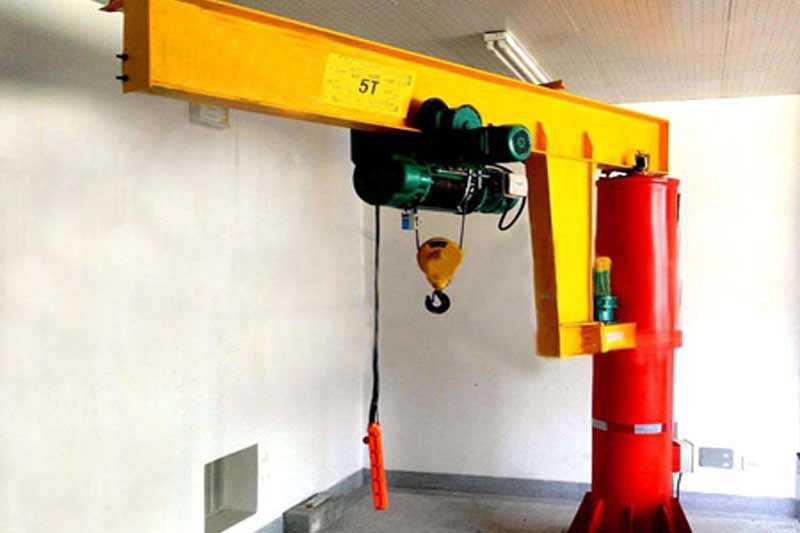
Floor mounted jib crane for limited space
When coverage is not properly planned, the most common issues are:
Inaccessible equipment
Certain pumps, valves, or motors cannot be reached directly by the hook
Equipment is located outside the effective lifting zone
Maintenance teams are forced to find alternative lifting methods
Unsafe lifting methods
Workers may use chain blocks or temporary gantries
Lifting is done at awkward angles or restricted positions
Increased risk during emergency maintenance work
These problems usually do not appear during installation. They only become clear when actual maintenance starts, especially in tight pump rooms or long treatment channels.
+Operational Risk
+Cost Impact
+Design Focus
+Buyer Action
Principle 4: Select the Right Capacity Based on Actual Loads
In a water plant overhead crane system, crane capacity is one of the most sensitive decisions because it directly affects both cost and safety. Many buyers tend to either overestimate or underestimate the real lifting requirement, and both situations create long-term problems. When the crane is oversized, the structure, hoisting system, and electrical components are all designed for higher loads than actually needed in a water treatment plant. In practice, this means you are paying for extra steel strength and higher-rated components that will rarely be used. The result is a higher investment without real operational benefit. On the other hand, if the crane is undersized, the risk is more serious. The crane may not be able to safely handle the actual maintenance loads, especially during emergency lifting of heavy pumps or motors. This creates operational limitations and can also introduce safety concerns during lifting work. So the balance here is not optional-it directly affects both cost efficiency and safe operation.
+Cost Risk
+Typical Range
+Design Focus
+Buyer Action
Principle 5: Ensure Redundancy to Protect Continuous Operation
In a water plant overhead crane system, redundancy is often ignored during early planning, but it becomes very important when something goes wrong. The main issue is simple: the crane is not just supporting maintenance-it is often the only lifting tool available in a critical area. If the crane fails during maintenance work, everything can stop immediately. Pumps may already be disassembled, parts may be mid-lift, or heavy equipment may be waiting to be installed. At that moment, even a small mechanical or electrical failure can interrupt the entire maintenance process. This is not a theoretical situation. It happens in real plants when:
The hoist cannot start after long idle periods
Electrical faults occur in control systems during lifting
Mechanical wear prevents safe lifting operation
A single crane is assigned to a key maintenance zone
When there is no backup system, the maintenance work has to pause until the crane is repaired.
+Operational Risk
+Cost Impact
+Design Focus
+Buyer Action
Integrating All Principles into a Cost-Effective Crane Solution
In many water plant overhead crane projects, the most common mistake is treating crane selection as a simple equipment purchase. Buyers often focus only on capacity, price, or delivery time, and the crane is selected as a standalone item without fully considering how it will work inside the plant. At first, this approach seems practical. You get a quotation, compare specifications, and make a decision. But the problem appears later, when the crane is installed and used in real maintenance work. Because the crane was not planned as part of the full system, small gaps start to show up. It may not fully match the plant layout, it may not align with actual maintenance routes, or it may not perform well under the real environmental conditions inside the water treatment area. These issues usually do not stop operation immediately, but they gradually increase maintenance difficulty and cost over time.
+Common Buyer Mistake
+Better Approach
+Result
Conclusion: Reducing Cost and Risk Starts with the Right Design Decisions
For crane buyers, the real value of a water plant crane system is not just in the technical specifications. It is in how well the crane actually supports daily maintenance work and long-term stable operation in real plant conditions.
A crane that looks good on paper but does not fit the plant will always create hidden cost later. The safer approach is to focus on how the crane will be used in real maintenance situations, not only how it is described in drawings or datasheets.
If you pay attention to a few key points during selection, you can avoid most common problems:
Proper duty selection that matches intermittent maintenance use
Corrosion resistance suitable for humid and chemical environments
Full coverage design that reaches all maintenance areas
Accurate capacity based on real equipment weights
Redundancy planning to avoid single-point failure
When these points are correctly planned, your overhead crane for water treatment plant will perform more reliably in daily operation and during emergency maintenance.
In practical terms, the result is simple:
Lower lifecycle cost
More reliable performance
Reduced downtime risk
In the end, the right crane design is not an extra cost. It is a practical decision that helps you avoid future problems and keep your plant running with fewer interruptions.


